



-Mobility hardware-software-cloud-based technology all developed in-house
– After dominating the automobile market, we expanded into the robot/drones/energy solutions/smart infrastructure sectors.
– Actively collaborating with major companies such as Continental Automotive Korea and Renault Korea
-IPO preparations accelerated…Sales growth through IP licensing model
The boundaries between various industries such as automobiles, robotics, drones, energy solutions, and smart infrastructure are gradually becoming blurred. Both startups and large companies are fiercely competing to enter and expand into these industries. Among them, a company with technology that encompasses all five industries is attracting attention. This is mobility solution company 'DRIMAES'.
DreamAce has all the technologies needed to innovate the user experience (UX) of three-dimensional space. Founded in 2015, it entered the market by developing automobile control software solutions, and has since expanded into various fields such as drones, robots, smart infrastructure, and energy solutions. It pitched as a promising Korean mobility startup at the 'Pitch Studio' session of 'VIVA Technology 2025', Europe's largest startup exhibition held in Paris, France from the 11th to the 14th, and will exhibit as a representative company in the future mobility field at 'Next Rise 2025', Asia's largest venture/startup festival held at COEX from the 26th to the 27th.
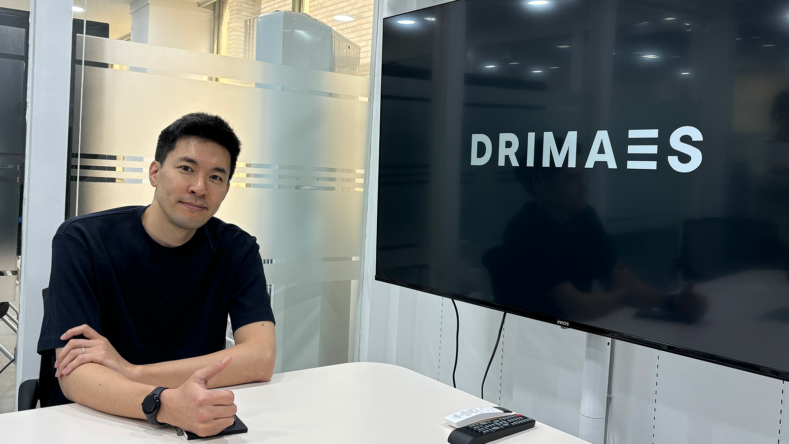
Possess core foundational technologies that can be expanded into five industries
Dream Ace is engaged in automobiles, drones, smart infrastructure, energy solutions, and robotics, which seem like completely different fields. These areas share similar technologies. CCO Lee Se-yeon explained, “Robotics, automobiles, drones, and smart signage (digital signage, etc.) all have similar basic technologies. The technologies are applied in three major structures: hardware, software, and cloud.”
Dream Ace's flagship solution, the 'In-Vehicle Infotainment Platform (IVI)', is a hardware installed inside a vehicle that provides vehicle information and entertainment (music, web browser, etc.) functions on the internal screen. Each function is an application software and runs on an operating system such as Linux or Android Automotive OS. Data collected from hardware and software is managed in the cloud.
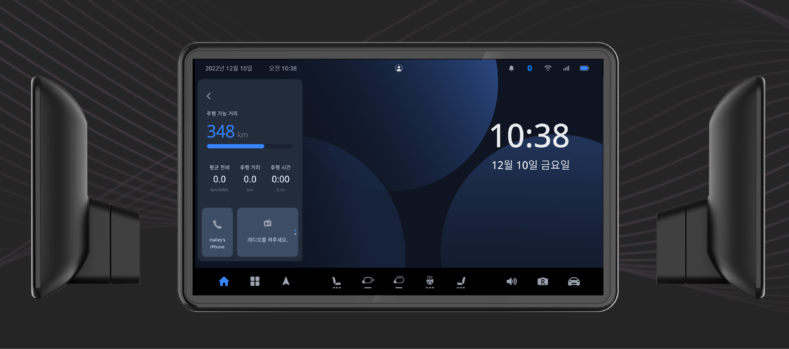
In order to innovate the user experience (UX) in a three-dimensional space, technology in all areas such as hardware, software, and cloud is required. Dream Ace has its own technology that encompasses all three. It is capable of everything from concept generation for UX improvement to development of basic technology to realize it. This is why the ambition to become the 'Apple of the mobility industry' is not at all unreasonable.
Sales growth with own technology IP.. Cooperation with Continental Automotive Korea/Renault Korea, etc.
Based on this proprietary technology, Dream Ace provides a B2B licensing model to its clients. CCO Lee Se-yeon explained, “Since customization is based on IP (intellectual property rights), the amount of work required for development is small, and unlike simple services, we can proactively consult on the client’s needs.”
Dream Ace is rapidly increasing its customer base and partnerships based on IP. Currently, it has secured a large number of customers and partners, including more than 3 domestic OEMs (automobile manufacturers), more than 5 domestic Tier 1s (first-tier suppliers of finished vehicle parts), and more than 20 other partners and solution providers. In particular, it has built trust through long-term collaboration with auto parts manufacturer Continental Automotive Korea since its establishment, and has achieved results that lead to product launches through open innovation with Renault Korea. The vehicle infotainment device installed in Renault Korea's new car 'Grand Koleos' is a representative example.
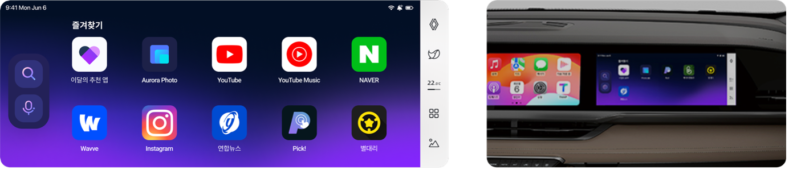
Dream Ace's vehicle software installed in Renault Korea's hybrid SUV 'Grand Koleos'. Through collaboration with Naver, the web browser 'Naver Whale' was included in the software. (Photo courtesy of Dream Ace)
In the mobility industry, 'endurance' is more important than technology
The mobility industry is not a sprint, but a marathon. It takes at least 2-3 years for a product to be mass-produced, and there are also high regulatory hurdles that must be verified. CCO Lee Se-yeon explained, “This industry is closer to the construction industry,” and “The common characteristic of all five business areas is that they do not adopt unverified ‘world’s first’ technologies. This is because safety has not been verified, and it is difficult to estimate which regulations they might violate.” That is why long-term survival strategies and business designs are more important than dominating the market with just one new technology.
In order to create a cash flow that can sustain the period required for mass production, Dream Ace carried out government R&D (research and development) projects in parallel during the early stages of its establishment, and also actively attracted investment. After about four years of trial and error since its establishment, it has increased its understanding of the industrial structure and succeeded in its first mass production delivery in 2023. Based on successful mass production cases, it has secured about 10 large corporate clients to date.
Since we have taken the lead in the automobile industry, which is the most difficult in terms of technology and regulation, it has been easier to expand into other areas. This is an expansion strategy that is possible because we have understood and studied all the basic technologies of spatial UX and turned them into our own IP. Compared to the recent trend of many automobile startups jumping into the robotics field, Dream Ace is ahead by entering the market 3-4 years earlier.
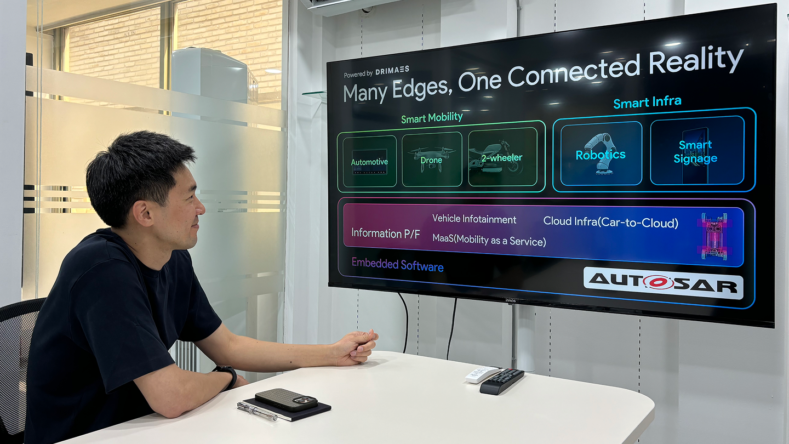
Strategic steps such as global expansion and regional resource linkage
Dream Ace’s products are expanding their presence in the global market beyond Korea. They have entered Europe, the US, and Japan, and there is high potential for growth in the global market going forward. “Mobility has the property of being a public good that can be used universally. In addition, unlike smartphones, cars can be owned and managed as assets, so designing experiences specialized for vehicles is becoming increasingly important in the global market,” explains the CCO.
Linking with the region is also one of Dream Ace’s key growth strategies. Starting their business in Daegu, they secured human resources and infrastructure by taking advantage of the regional characteristics of the automobile industry. They are continuing their collaboration with Kyungpook National University in the field of AUTOSAR (automobile control software). The CCO said, “There seems to be a lot of talent hidden in the region. We plan to continue to create models of collaboration with local IT/SW talent in the future.”
“ Dreaming of UX innovation that connects all spaces”.. IPO preparations in full swing
Dream Ace sees mobility as a concept that connects ‘spaces’ rather than a simple means of transportation. The CCO explained, “There is a great need for digital transformation in factories that are in partnership, and our technology can be applied here as well.” Furthermore, when the era of connecting various spaces such as factories, logistics centers, offices, and homes comes, Dream Ace’s technology can act as a connector that connects these spaces into a single flow.
The CCO emphasized, “For example, when an order comes in from an office, the product is manufactured at a factory, shipped to a logistics center, and finally delivered to each home, and the entire process can be connected. Existing large corporations and startups specialize in specific areas of technology, but it is also important to be the one connecting each area. The technology we have can act as that connector,” and said that Dream Ace’s role in the future mobility industry will become even more important.
Dream Ace, which is preparing for an IPO listing, is experiencing a new growth momentum. CCO Lee Se-yeon said, “Our top priority is to further solidify the foundation of B2B sales. We are also considering entering B2B2C in the future.” Based on the current main field of automobiles, the plan is to expand actual sales in other fields such as drones, energy, and robotics.
Dream Ace, which has grown by running for a long time in the mobility industry where it is difficult for startups to survive, is a case that shows the importance of a survival strategy with a long-term perspective rather than short-term performance. CCO Lee Se-yeon emphasized the importance of understanding the industrial structure to junior entrepreneurs, saying, “The mobility industry must be able to survive for a long time. You need to know the characteristics of this industry and enter it, and you can also see which parts of the industrial structure need to be improved.”
The technology that Dream Ace possesses plays a role in connecting various spaces in daily life, such as automobiles, residential spaces, and factories. Based on its solid foundation technology, Dream Ace is expanding into various fields beyond the mobility industry, and attention is focused on whether it can be reborn as a company that designs connections across lifestyles.
You must be logged in to post a comment.