



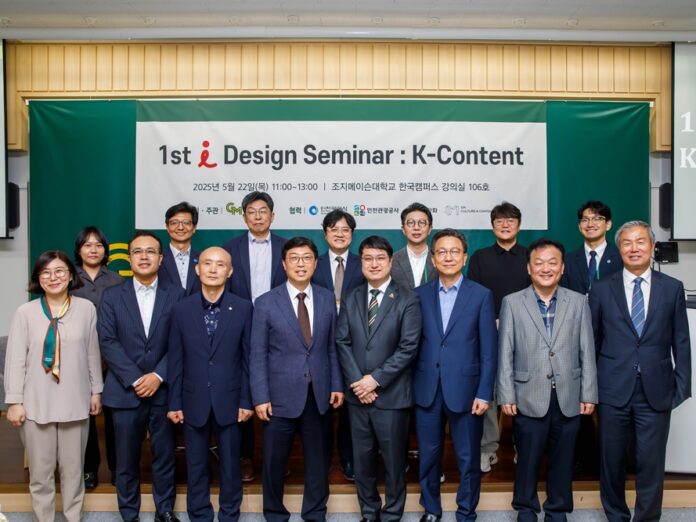
George Mason University Korea announced on the 22nd that it successfully held the '1st iDesign Seminar: K-Content' in cooperation with Incheon City. This seminar was hosted and organized by George Mason University Korea, and Incheon Metropolitan City, Incheon Tourism Organization, Hanwha Corporation, and SM C&C participated as cooperative organizations.
This seminar was organized to present a practical development strategy for Incheon City to leap forward as a central city of K-content based on the academic foundation of K-content and excellent private cases. George Mason Korea Campus officially announced the plan to establish the 'K-content Research Institute' and promised to provide an academic and policy foundation for the development of 'K-con-land', which is being promoted by the Incheon Free Economic Zone Authority (IFEZ).
The detailed schedule of the seminar began with the Incheon Metropolitan City Content Planning Office and opened with a congratulatory speech by Joshua Park, the representative of George Mason University Korea Campus. The first session was held under the keyword topic of Decode, and Professor Lee Gyu-tak of the Department of International Studies at George Mason University Korea Campus gave a presentation on “How did K-content grow?” from the perspective of content discourse interpretation.
The second session was held under the keyword topic of Deploy, and four practitioners gave case presentations on “How is K-content created?” Incheon Metropolitan City Content Promotion Coordinator Seo Bo-min gave a presentation on “Incheon’s i-policy” and SM C&C BX Group Manager Lee Song-jae gave a presentation on “K-Culture.” Incheon Tourism Organization Tourism Industry Manager Kim Tae-hyun gave a presentation on “Incheon’s Content” and lastly, Hanwha Infra Solution Division Content Business Team Manager Moon Beom-seok gave a presentation on “K-Fireworks.”
The third session was held under the keyword theme of Design, where presenters discussed how to create K-content starting in Incheon under the theme of ‘A Future We Run and Create Together.’
In particular, at the seminar, experts related to K-content presented more practical policy proposals and on-site strategies, including the current status of K-content and its potential for global expansion, cases related to K-content, Incheon City's role in the development of K-content, and tasks for Incheon City to grow into a global content hub.
Professor Lee Kyu-tak of the Department of International Studies at George Mason University Korea Campus said, “The ‘Hallyu,’ which refers to the globalization of K-Culture and K-Content, has a history of nearly 30 years already, and the Hallyu that started with the popularity of dramas in the Chinese-speaking world has led to the success of K-Pop, Korean media content in general, and even to overseas interest in Korean society and culture in general beyond popular culture. Therefore, now is the time to think about the future of the Hallyu, K-Culture, and K-Content, and this is increasing the need for active interest and investment from the central government as well as development of K-content at the regional level.”
Joshua Park, head of George Mason University Korea Campus, said, “Our school has been working hard on research and education for domestic and international students in the fields of Hallyu, K-pop music industry, K-games, and public diplomacy by experts in various fields related to K-content. In particular, the K-Culture Media Research Institute scheduled to open this year will work with Incheon City to develop Incheon-style content discourse, as well as academic research, program activation, and talent cultivation.”
Furthermore, he said, “This seminar will serve as a meaningful starting point for designing the future of K-content and the role of a K-content hub where academia, industry, and local governments work together to promote Korean culture as an exemplary case of industry-academia cooperation,” and emphasized, “George Mason Korea Campus will continue to expand research and educational cooperation with domestic professional organizations, various companies, and universities and faithfully fulfill its role as a trustworthy global bridgehead so that it can contribute to the development of the K-content industry in Korea.”
- See more related articles
You must be logged in to post a comment.