



The process of hundreds of union members gathering in a gymnasium to vote in the midsummer heat was reminiscent of an analog-era museum.
Signatures buried in a pile of paperwork, loudspeakers blaring to check attendance, and general meetings being canceled due to a lack of quorum. These were common sights at reconstruction and redevelopment sites until just a few years ago.
“At that time, a union chairman was on the phone, worried, ‘What if we don’t meet the quorum again today?’ I personally witnessed a situation where paper documents were piled up on the desk and a dispute arose over whether a single consent form was forged.”
This is the reality before Readypost CEO Kwak Se-byeong (39) launched the 'General Meeting One-Stop' service in September 2021. Three years later, the landscape of the same redevelopment site has changed. Members check the agenda after authenticating themselves with their smartphones and vote with a few clicks. Results are tallied in real time. One association, whose project was in danger of being canceled due to a lack of quorum, successfully carried out the project with an attendance rate of 37% through online participation.
Drawing a digital map in an analog maze
When CEO Kwak Se-byung, formerly of SK Planet, decided to start a business, his goal was to create a real estate big data platform. However, during the market research process, he discovered a more urgent problem than analyzing commercial real estate data.
“We reviewed 16 services in the first six months. We traveled around the country and looked at the market. Then, at a point called the ‘general meeting,’ we had an ‘aha moment.’ It was shocking to see that decisions were still made with paper and stamps in a business involving tens of thousands of people.”
'General Assembly One Stop' is an integrated online general assembly platform for reconstruction and redevelopment associations developed by Ready Post. It has achieved the feat of being the first in Korea to implement electronic voting, electronic consent forms, and online general assembly, and has won the triple crown of special cases. It is not a simple online voting system, but an integrated solution that includes everything from managing the member list to calculating voting rights, conducting real-time general assembly, and reporting results.
Digital innovation that breaks through legal barriers
“The general meeting is centered on legal voting rights. However, the existing laws only allowed mail or in-person attendance. Without a legal basis, there was a risk that online voting would be invalidated.”
CEO Kwak Se-byeong challenged the regulatory sandbox to solve this problem. As a result, he obtained special approval from the Ministry of Science and ICT and the Ministry of Land, Infrastructure and Transport. He was the first in Korea to be recognized for legal digital transformation in three areas: ‘electronic voting,’ ‘online general meeting,’ and ‘electronic consent form.’
“We didn’t just develop the technology. We had hundreds of discussions with government agencies, legal experts, and union officials to establish the legal basis. The Urban Planning Act didn’t have any clear provisions on electronic voting or online general meetings.”
Securing technical reliability was also key. The General Member Stop established a system for identity verification and forgery prevention in connection with an electronic document certification agency. There have been cases where the General Member Stop records were accepted as evidence in actual legal disputes.
“There was a time when a certain member of a union claimed that he did not vote. Our system records everything, including IP addresses, device information, and authentication records. This was accepted as evidence in court. It was a moment when technology created trust.”
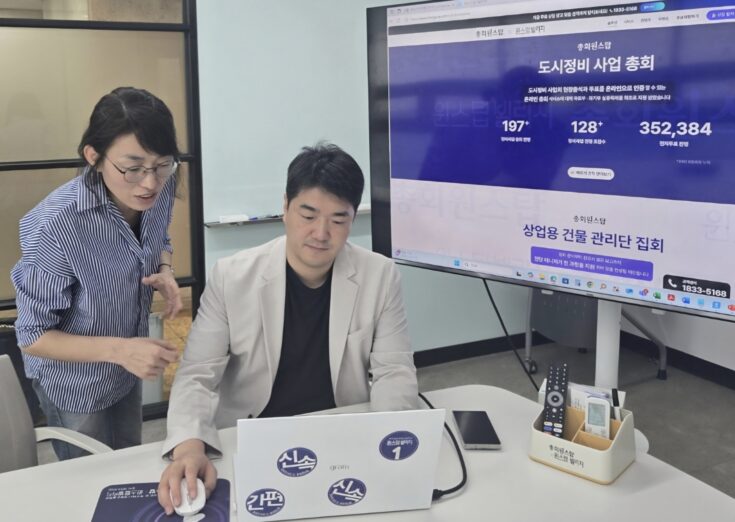
Do Eun-ju, Readypost Strategy Planning Director (left) and CEO Kwak Se-byeong (right)
Market innovation proven by numbers
The success of the General Membership Stop is proven in numbers. More than 200 general meetings have been held, and more than 350,000 members have participated. It is noteworthy that the participation rate in online general meetings is 2-3 times higher than offline ones.
“The lack of a quorum was the biggest obstacle to the reconstruction project. Especially in large cities like Seoul, the members are scattered across the country, making it difficult for them to physically attend. By increasing accessibility online, the participation rate has definitely increased.”
ReadyPost's competitiveness goes beyond simply being the first mover. Its differentiating points include the first domestic demonstration special case approval, certified electronic document system, intuitive UI/UX, operation of a professional consulting team, and customized solutions for combinations.
“Our UX designers sat down with people in their 70s to design the screens. We listened to their feedback, such as ‘This button is hard to see’ or ‘The font is too small,’ and improved upon it. The essence of technology is to make complex things simple.”
Dreaming of a digital infrastructure for urban development
On a whiteboard on one side of the office, the words “One-Stop Village” are written in large letters. This is the next step that CEO Kwak Se-byeong is envisioning.
“The general meeting is only one part of the urban development project. Now, we are expanding digitalization to the entire operation of the association. We are managing the entire process digitally, from budget management, document storage, land rights calculation, to application for sale.”
Readypost's future plans include expanding into 'One-Stop Village' to digitize the entire urban development administration and expanding its business into commercial real estate and multi-unit buildings. It is aiming for an IPO within 5 to 7 years.
“Urban development projects are long-term projects that take at least 10 years. During this time, the union executives change several times, and documents are often lost. We are creating an ‘OS for urban development’ that safely stores and transparently discloses records of all these processes.”
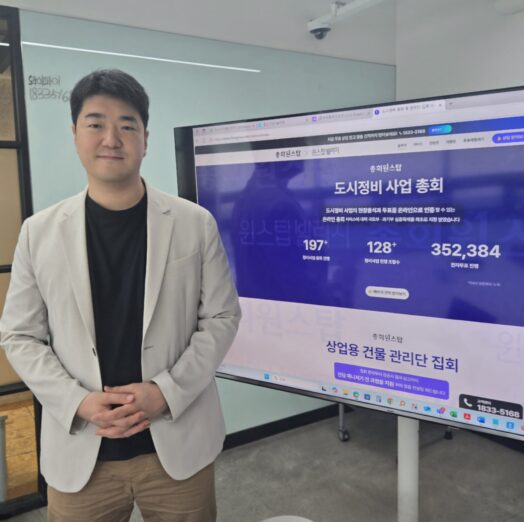
At the end of the interview, CEO Kwak Se-byeong talked about what he believes is the essence of technology.
“Technology should ultimately be a tool to reduce distrust and conflict among people. In redevelopment sites, questions like ‘who made that decision?’ and ‘when was that notice given?’ have always been the seeds of conflict. Our technology eliminates these questions themselves. All members of the union see the same information and make decisions on the same platform.”
The complex procedures of urban development projects that were buried in piles of documents have now been brought up on a transparent digital screen. The 'digital magic wand' presented by CEO Kwak Se-byeong is illuminating the dark maze of reconstruction. The remaining task is to make this light reach every corner of the urban development site.
You must be logged in to post a comment.