



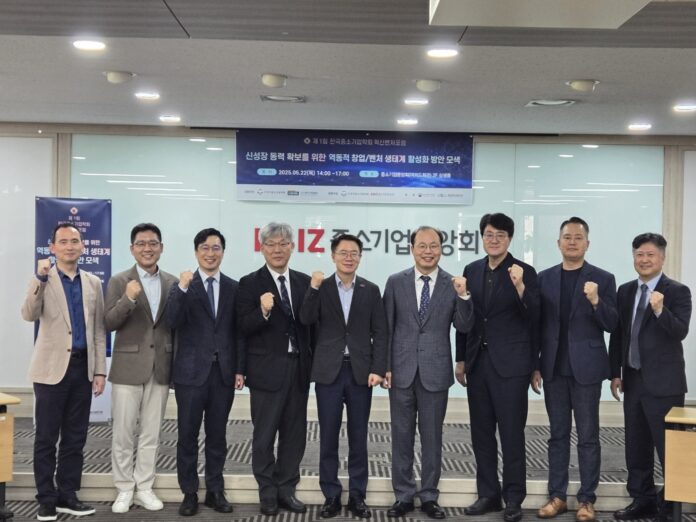
The Korea Small Business Association (Chairman Jin Byeong-chae, Professor at KAIST) held the first Korea Small Business Association Innovation Venture Forum in Yeouido, Seoul on the afternoon of the 22nd, in cooperation with the Korea Venture Business Association and the Korea Federation of SMEs. This forum sought to find ways to activate a dynamic startup and venture ecosystem to secure new growth engines, and discussed the direction of development for Korea’s venture ecosystem.
In his opening speech that day, Academic Society Chairman Jin Byeong-chae diagnosed, “Venture companies have achieved growth exceeding the national economic growth rate for the past 30 years, virtually driving economic growth during the low-growth era, and playing a pivotal role in transforming the Korean economic structure from traditional manufacturing to knowledge-intensive industries. In terms of job creation, they have already surpassed the combined number of employees of the four largest conglomerates.”
Chairman Jin continued, “In order for the Korean economy to leap forward again, we need to inject new vitality into the venture ecosystem and foster future industries. To this end, we must first ▲ reorganize the current stock option system to attract talented individuals into the ecosystem, ▲ induce private capital to flow into the venture ecosystem through groundbreaking tax reform, and ▲ reorganize the current venture company M&A system to activate the investment recovery market.”
In his congratulatory speech, Cho Moon-gap, head of the Economic Policy Division at the Korea Federation of SMEs, suggested, “In order to achieve sustainable growth in the Republic of Korea, where the engine of economic growth has stalled, we need to transform the industrial policy centered on a small number of large corporations into an ecosystem centered on SMEs and venture companies.”
To this end, Chief Choo explained that the top priority is to “utilize AI services in manufacturing, distribution, logistics, and service industries to increase the productivity of small and medium-sized and venture companies, and in particular, to expand the application of AI to the manufacturing industry to revitalize small and medium-sized manufacturing and maintain the legacy of a manufacturing powerhouse. To this end, it is urgent to enact the ‘Smart Manufacturing Industry Promotion Act’ and expand the budget to expand AI factories.
On this day, the forum featured presentations on topics such as: Working Differently for Startups (Professor Bae Jong-hoon of Seoul National University), Flipping the Plan for Korean Startups to Go Global (Professor Park Seong-hyeok of KAIST), and Venture Companies as New Growth Engines (Chairman of the Korean Society for Small Business, Professor Jin Byeong-chae of KAIST).
Professor Bae Jong-hoon diagnosed in his presentation, “Over the past 10 years, the risk borne by entrepreneurs at the entry point has been significantly reduced due to the advancement of the startup support system. This means that the startup ecosystem is in need of competition-based efficiency. Instead of support policies based on startup survival rates, alternatives include symmetrical regulations that support fair competition among ecosystem participants, idea discovery at the value chain level rather than the product level, and the establishment of shared data centers that include computer operation support services.”
In his keynote speech, Professor Park Sung-hyuk explained the concept and specific methodology of flip (relocation of headquarters overseas), one of the overseas expansion methods for startups, and introduced a method (deferred flip) for Korean startups to relocate their headquarters overseas without selling the company, through the latest case of Impact AI, an AI startup.
In his keynote speech, Professor Jin Byeong-chae introduced research results showing that “attracting large corporations to local areas helps increase local productivity and provide quality jobs, thereby increasing the income of local residents, but it has limitations in terms of regional economic growth, job creation, and expansion of startup ecosystems. Rather, fostering venture companies drives regional economic growth, job creation, and technological innovation.”
Professor Jin also emphasized that “in order for regional innovation special zones aimed at balanced growth to succeed, designating special zones alone is not effective; after designating a special zone, government-level financial investment, creation of a private investment ecosystem centered on the region, and talent cultivation centered on key local universities must be linked to achieve the unique purpose of the special zones as regional economic growth engines.”
After the presentation, a comprehensive discussion was held, moderated by Professor Park Kyung-min of Yonsei University, and attended by Professor Kim Sang-jun of Ewha Womans University, Professor Moon Jeong-bin of Korea University, Professor Yoon Hyeon-joong of Kangwon National University, and Secretary General Lee Jeong-min of the Korea Venture Business Association.
In particular, Secretary General Lee Jeong-min of the Korea Venture Business Association emphasized in the discussion, “For the youth and future of the Republic of Korea, venture policy must become the top agenda of national economic policy,” and proposed, “To this end, it is necessary to ▲make it mandatory for 68 statutory funds to invest in venture and startups, ▲reform the work hour system such as the 52-hour workweek, ▲establish a national target system for regulatory innovation standards, and ▲delegate industrial regulation authority to local governments.”
At the forum held that day, not only researchers and practitioners in the small and medium-sized venture sector but also those from the related venture business industry attended, and various policy suggestions were discussed amidst heated interest.
- See more related articles
You must be logged in to post a comment.