



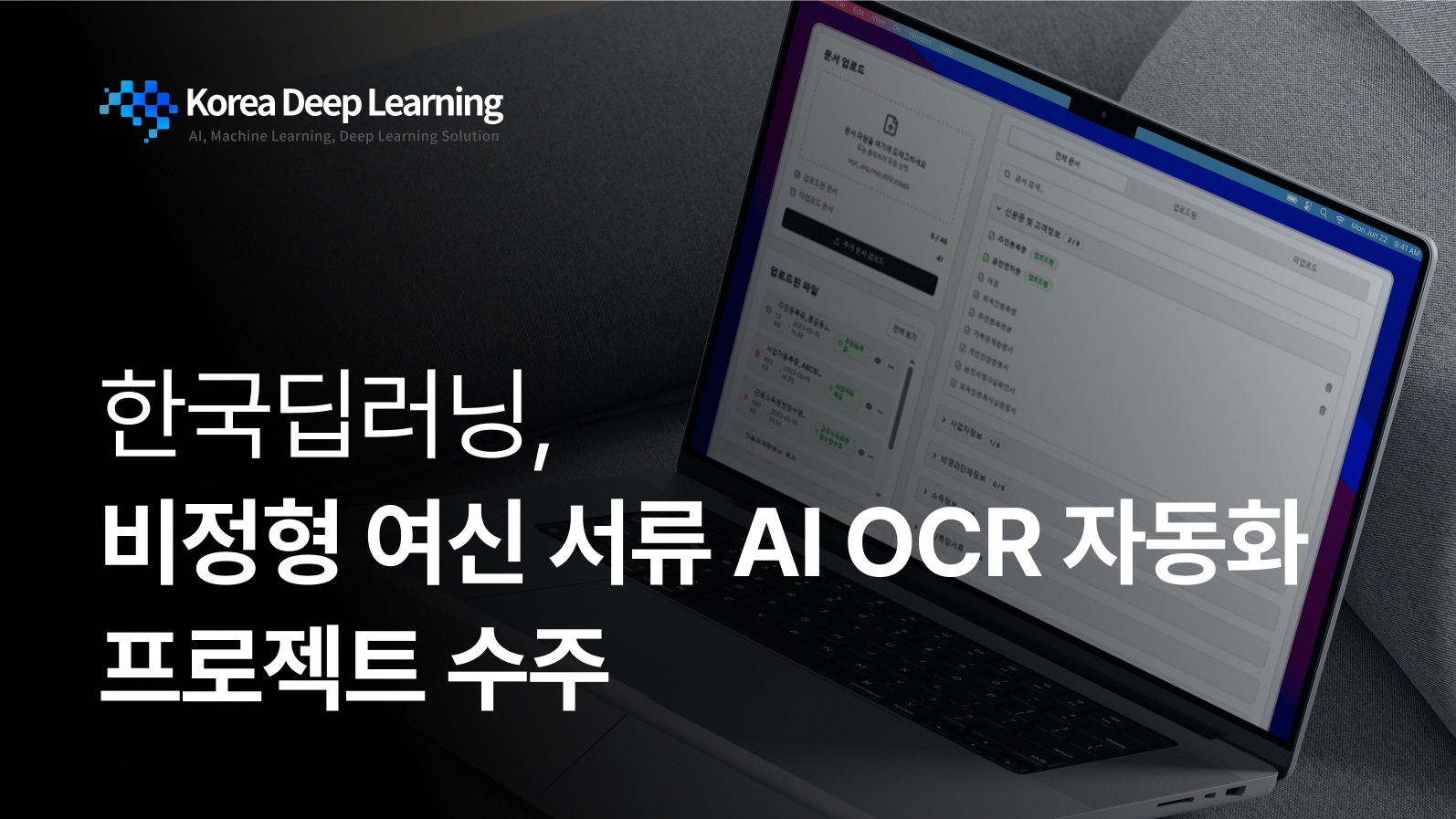
Korea Deep Learning , a visual intelligence-based AI solution company, announced on the 22nd that it had won a contract for the 'non-standard loan document AI OCR automation' project from a major domestic financial institution.
This project is an example of applying artificial intelligence technology that can analyze and judge the meaning of documents beyond simple optical character recognition (OCR) to financial work. 'DEEP OCR+' provided by Korea Deep Learning is a document understanding specialized model with self-training functions, designed to continuously improve processing accuracy and speed.
The financial institution received a total of 46 types of application and supporting documents as a single PDF during the credit review process and classified and entered them manually. As a result, problems such as document omissions, typos, and work bottlenecks repeatedly occurred, and Korea Deep Learning introduced DEEP OCR+ with the goal of automating this manual work process.
DEEP OCR+ is a visual intelligence model that can extract key information by analyzing the structure and context within a document based on the optical character recognition function. The Vision-Language Model (VLM) specialized in document understanding developed by Korea Deep Learning was built on the basis of learning over 400 million image and text data accumulated over 5 years, and can simultaneously process various document formats such as PDF, HWP, and Word.
In this project, the process of automatically splitting and classifying documents in merged PDFs, extracting key data, and then linking them to the company's computer system was automated. This is said to efficiently improve the document verification and input process that used to depend on manual work. The results can be checked through a real-time verification dashboard, and it is operated in a structure that improves work efficiency by linking with RPA (Robotic Process Automation).
Starting with this project, Korea Deep Learning is pushing to expand its technology to industries with a lot of document-based work, such as insurance, public institutions, and manufacturing, in addition to the financial sector.
Kim Ji-hyun, CEO of Korea Deep Learning, said, “In order for AI to be introduced to various industries, the ‘ability to see’ must come first,” and “Visual intelligence-based document understanding technology can be applied to various automation tasks and will become a key element in accelerating the digital transformation of companies.”
- See more related articles
You must be logged in to post a comment.