



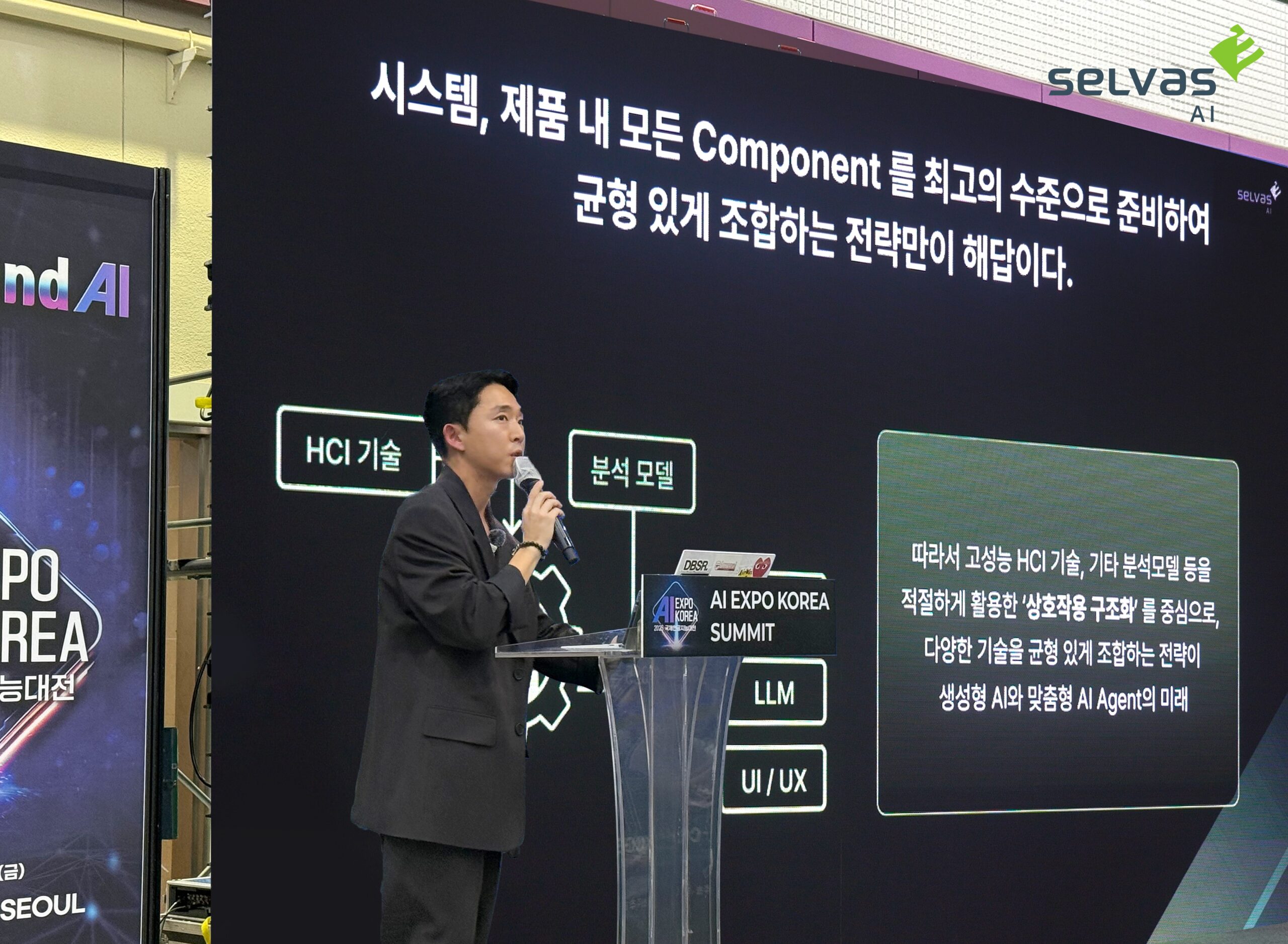
Selvas AI , an artificial intelligence company, announced on the 19th that it participated in 'AI SUMMIT KOREA', the official conference program of 'AI EXPO 2025' held at COEX in Samseong-dong, Seoul on the 16th, and announced a strategy for introducing industry-tailored AI agents.
On this day, Selvas AI gave a presentation on the topic of ‘The future of generative AI and customized AI agents opened by high-performance AI-based technology’ and shared the direction and key elements for building an AI system optimized for the corporate environment.
The presentation was given by Manager Kyungchae Kim of the Selvas AI Marketing Strategy Team, and explained the major technical challenges that companies face in the process of implementing AI agents and their solutions. In particular, as generative AI technology is being applied to various industries, he emphasized that a more sophisticated technical approach is needed to build an execution-oriented AI system that can be applied to actual industrial environments.
In his presentation, Manager Kim pointed out the following as common problems that occur when building AI systems: ▲excessive dependence on specific technology components such as Large Language Models (LLMs) and RAGs; ▲low connectivity between the system environment and models; ▲limitations on the application of open source-based projects. He went on to explain that if language processing performance is simply pursued, problems may arise in the system internalization and customization process due to a lack of integrated design and engineering capabilities.
He said, “The key to AI systems is not a single technology, but the organic connectivity and consistent design of the entire structure,” and “In order to solve the input-response mismatch problem that frequently occurs in general model-centered systems, a transition to domain-specific agentic AI is necessary.”
In addition, the high-performance human-computer interaction (HCI) technology that Selvas AI possesses was also introduced. Manager Kim explained that user experience (UX) design based on various HCI technologies such as STT (speech recognition), TTS (speech synthesis), handwriting recognition, and OCR (optical character recognition) plays an important role in the success of AI systems. He then introduced how these technologies are being applied in the field through actual industrial cases such as medical institutions, investigative agencies, audiobook platforms, and educational companies.
Finally, he said, “The success or failure of an AI project depends more on the integrated design of the entire system and the user’s experience in the real environment than on the accuracy of a single technology,” and “Selvas AI plans to continue R&D and technological advancement to internalize and commercialize AI agents optimized for industrial sites.”
- See more related articles
You must be logged in to post a comment.