



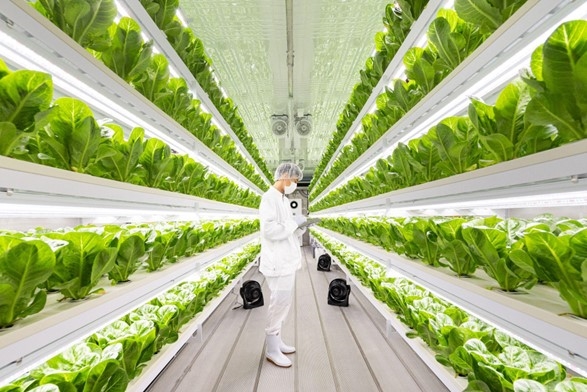
N.THING (CEO Kim Hye-yeon), a smart vertical farm specialist company, is pushing ahead with a 100 billion won logistics center-type vertical farm smart farm development project based on a project financing (PF) structure.
This project is a new agricultural and food infrastructure model that integrates production and distribution by building a smart vertical farm on a similar scale to the construction of existing cold chain logistics centers. It was planned based on the needs of large domestic and international distribution and food companies that want to solve the problem of unstable supply of fresh vegetables due to the climate crisis and aging agricultural population.
◆ Next-generation agricultural infrastructure, gradual expansion through PF method
Through this project, Ensing plans to create industrial agricultural assets that combine food production facilities with smart logistics bases and gradually expand them through a cooperative structure (PF method) with domestic and foreign logistics and infrastructure developers, financial institutions, and infrastructure funds. It plans to concretize investor attraction and development plans with the goal of closing the first PF within the second half of the year.
Founded in 2014, Ensing has attracted over KRW 32 billion in cumulative investment up to Series C and is aiming for an IPO (initial public offering) in 2027. It has developed the world's first organically connected modular smart farm, 'CUBE', and was the first to win the 'Best Innovation Award' in the agricultural field at CES 2020 and has been recognized for its technological prowess by obtaining a TI-2 rating from Technology Credit Bureau (TCB).
◆ Securing proven economic feasibility and stable supply chain
Ensing has already proven the economic feasibility and quality stability of vertical farms through collaborations with E-Mart, Baedal Minjok (Bmart), Samsung Welstory, Ottogi, KT&G, etc. In this project, the physical distance between the distribution center and the farm can be minimized to secure benefits such as reduced logistics costs, improved crop freshness, and improved supply speed. In addition, profit stability is expected to be strengthened through mid- to long-term supply contracts (including MOU/LOI).
◆ Outstanding production efficiency and implementation of ESG values
Enthing's vertical farm located in Icheon, Gyeonggi-do, records up to 94% reduction in water usage compared to existing systems, a crop waste rate of less than 5%, and an annual greenhouse gas reduction of approximately 34.7 tons. All facilities are operated on an electric basis, making it easy to transition to RE100 in the future.
Ensing's vertical farm, which can check and control the farm's cultivation environment such as temperature, humidity, light (LED), CO2, water, and nutrients in real time based on cultivation data and IoT-based environmental control technology, has a production volume per unit area that is more than 40 times higher than that of general fields or greenhouses. Currently, it is stably producing more than 1.12 million packs (approximately 120 tons) of various crops such as lettuce, herbs, baby leaf vegetables, and sprout vegetables annually, which are supplied to E-Mart and B-Mart.
In 2023, it will be the first to obtain pesticide-free/GAP eco-friendly certification and the 'Environmental Performance Label Certification' for vertical farms, and is recognized for its high value in terms of ESG management and sustainability. It provides differentiated freshness to consumers under the brand name of 'vegetables with living roots' and is attracting attention to the extent that related content has achieved 10 million views on SNS.
◆ Laying the foundation for industrialization through changes in government policy
The government is actively supporting the expansion of smart agriculture by recently reorganizing related systems, such as allowing vertical farms to enter agricultural and industrial complexes, exempting agricultural land conservation fees, and expanding the scope of value-added tax refunds, which is also an important policy foundation for promoting this project.
Meanwhile, according to global market research firm Statista, the global smart farm market size is expected to grow by more than 17.2% annually, from $15 billion in 2022 to $33 billion (approximately KRW 47 trillion) in 2027. As the importance of food security and climate change response is emphasized, the vertical farm market is growing by more than 25% annually, and demand for vertical farm solutions is rapidly increasing, especially in regions with low food self-sufficiency rates such as the Middle East and Southeast Asia.
Kim Hye-yeon, CEO of Anything, said, “Vertical farms are no longer simple agricultural products, but are evolving into industrial assets capable of producing food 24/7 within urban infrastructure.” She added, “Based on proven technological prowess and operational experience, Anything will lead large-scale projects with a PF structure and simultaneously lead the infrastructure and globalization of smart agriculture to realize the vision of being a ‘company that feeds the world’ on a global scale.”
- See more related articles
You must be logged in to post a comment.