



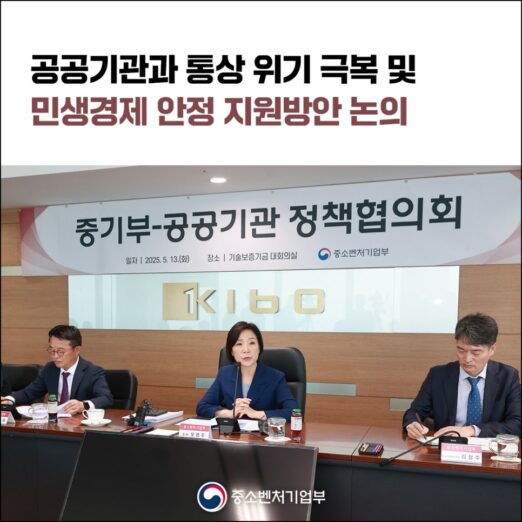
The Ministry of SMEs and Startups (Minister Oh Young-joo, hereinafter referred to as the Ministry of SMEs and Startups) announced on the 13th that it held a policy council meeting at the Seoul branch of the Korea Technology Finance Corporation with the participation of 11 public institution heads to overcome the trade crisis of SMEs and small business owners and to restore the people's economy.
This policy council, chaired directly by Minister Oh Young-joo, was prepared to review the status of policy implementation by each public institution for the management stability of small and medium-sized enterprises and small business owners who are experiencing difficulties due to rapid changes in the external environment, such as recent U.S. tariff measures, and the continued sluggish domestic demand, and to encourage the swift execution of the supplementary budget finalized on May 1.
At the meeting that day, the status of policy promotion and budget execution discussed between the Ministry of Strategy and Finance's departments and public institutions during the first half of the year, as well as efforts to improve the system by each institution, were first reviewed.
Next, they focused on discussing the status of each organization's export support projects and supplementary budget projects to respond to the trade crisis, such as the implementation of the 'SME and Venture Enterprise Export Support Plan' announced in February.
The Small and Medium Business Administration will expand emergency management stabilization funds and new market funds for companies affected by U.S. tariffs and wildfires, and establish an emergency fund to respond to trade risks to focus on supporting liquidity for export companies. In addition, it plans to support expert consulting for tariff response and resolution of difficulties through the export voucher program.
The Technology Guarantee Fund will provide preferential support, such as expanding the guarantee ratio (up to 95%) and reducing the guarantee rate (up to 0.4%P), to companies affected by tariff measures and advanced technology companies by supplying a total of KRW 1.2 trillion in special export guarantees, thereby improving the export responsiveness of small and medium-sized enterprises.
In order to overcome the crisis of small business owners, who account for a large portion of this supplementary budget, and to stimulate consumption, the Small Business Market Promotion Agency plans to expand the Small Business Burden Reduction Credit, which supports utility bills and insurance premiums for small business owners with annual sales of 300 million won or less up to a limit of 500,000 won; the Symbiotic Payback, which refunds 20% of the increased monthly card spending compared to the average monthly card spending last year in the form of digital Onnuri gift certificates; small business loans; Onnuri gift certificate refunds for vulnerable commercial areas; and the Hope Return Package project, which supports store demolition costs and revitalization.
In addition, we plan to support new or expanded technology development and overseas marketing projects for export companies in accordance with the business characteristics of each organization.
In the following session, where public institutions shared their current issues and concerns, each institution discussed current issues and sought ways to cooperate with the Ministry of SMEs and Startups to advance future tasks.
Minister Oh Young-joo emphasized, “I urge public institutions to make efforts to implement policies without a hitch to restore the people’s economy, and in particular, I urge them to swiftly push forward with the supplementary budget project so that small and medium-sized enterprises and small business owners in the field can feel the effects of the policies.”
He also added, “As the early presidential election is approaching, political neutrality in the public sector is more important than ever, so please be thorough in managing the service of public institution employees.”
The Ministry of SMEs and Startups plans to continue to communicate and cooperate with public institutions to quickly overcome the crisis and stabilize people's livelihoods, and to check and improve the status of policy implementation.
- See more related articles
You must be logged in to post a comment.