



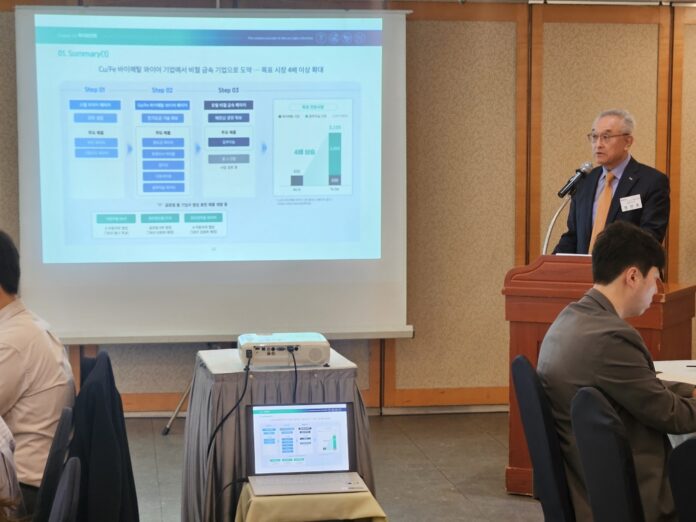
Keystron Co., Ltd. (CEO Min-ho Jeong), a Cu(copper)·Fe(iron) bimetal wire manufacturing company, held a press conference in Yeouido, Seoul on the 13th and announced its business strategy following its listing on the KOSDAQ market.
Established in 1992, Keystron, an affiliate of the Korea Iron and Steel Group, has been building a stable cash-cow business while gaining attention in the global market. Lead wires account for approximately 18% of the global market share, and cable wires are recognized for their quality in advanced countries such as the U.S. and Europe, accounting for 33.3% of sales in the region.
Cu·Fe bimetallic wire is a composite metal material that is made by joining metals with different properties and then stretching them into a wire shape. It is a core material that has both rigidity and conductivity. It is gaining attention as a substitute that simultaneously solves the durability problem and high cost problem that were limited by existing copper alone. It is being used as an irreplaceable solution in infrastructure, electronic devices, and industrial products where signal transmission is important.
Keystron CEO Min-ho Jeong said, “Keystron has grown into a Cu·Fe bimetal wire specialist based on differentiated quality competitiveness,” and expressed his ambition, saying, “Starting in 2027, we will utilize the idle land of our parent company’s Vietnam plant to enter the aluminum market and grow into a global non-ferrous metal manufacturer encompassing everything from bimetal to aluminum.”
Keystron's global export share is about 90%. It supplies products to 74 companies in 21 countries around the world. In particular, 90% of customers who have introduced Keystron products are repeat buyers, and 75% of them are continuing long-term transactions for more than three years.
Keystron achieved sales of KRW 69 billion last year, up 23% year-on-year, operating profit of KRW 5.9 billion, and net profit of KRW 8.8 billion, up 267% year-on-year.
Keystron is raising a total of 6.3 million shares through this IPO. The desired subscription price per share is 3,100 to 3,600 won, and it is expected to raise 19.53 billion won based on the lower limit. From the 12th to the 16th, it will conduct a demand forecast for institutional investors to determine the final subscription price, and from the 22nd to the 23rd, it will conduct subscription for general investors for two days. The subscription funds will be used for R&D investment and facility investment for new businesses, and the lead manager is Shinhan Investment Securities.
◆ Securing global customers for cables and lead wires based on production infrastructure
Keystron's Cu·Fe bimetal product line consists largely of lead wires and cable wires. Lead wires are mainly used for capacitors, which are core components of electronic devices, and are currently supplied mostly to three Japanese companies in the global market. Japanese companies account for approximately 30% of the global capacitor market, and Keystron is responsible for 60% of the lead wires supplied to them. Accordingly, Keystron maintains a solid market position, recording approximately 18% of the global market share. Based on this solid market position, Keystron has consistently achieved an average annual sales of approximately KRW 34 billion in the lead wire sector for the past three years.
Cable wires are widely used in infrastructure and industrial fields. In particular, Keystron is continuously expanding its influence in advanced markets such as North America based on its high-quality product competitiveness. The sales ratio in advanced countries increased from 26.6% in 2022 to 33% last year.
◆ Reorganizing the US Supply Chain, Securing Comparative Advantage
As of last year, the U.S. accounted for approximately 17% of Keystron’s cable wire exports. The countries that supply Cu·Fe bimetallic wires in the U.S. market are Korea, China, and Japan, and all three countries are subject to the same 25% tariff. Recently, local U.S. customers have been reducing their dependence on Chinese products and diversifying their supply lines in order to respond to global tariff risks. In this situation, Keystron’s products, which have superior price competitiveness compared to Japanese and U.S. products, are attracting attention in the U.S. Chinese alternative market.
Keystron's price competitiveness is expected to have a positive effect on strengthening its position in the U.S. market, and its export share to the U.S. is expected to increase in the future.
◆ Building a strong entry barrier and outstanding technical skills
The biggest barrier to entry in the Cu·Fe bimetal market is the difficult business license and strict environmental regulations. Currently, it is virtually impossible for new entrants to enter the bimetal market due to domestic environmental regulations. Even if the regulations are passed, the initial investment cost of at least 60 billion won is required to mass-produce bimetal and secure production yield, making entry itself a realistic barrier.
Keystron's Cu·Fe bimetal products boast excellent uniformity of coating thickness, excellent adhesion, and superior durability. These products are used as key materials in industries such as electronic devices and infrastructure that require strong external impact and constant conductivity. Keystron uses an electroplating process, which makes it very easy to control electrical conductivity, and the simplicity and efficiency of this process also allows it to secure an advantage in price competitiveness.
◆ Leaping forward as a non-ferrous metal manufacturer
Keystron's strategy is to enter the aluminum market by utilizing the idle site of the parent company's Vietnam plant starting in 2027. In 2027, it plans to secure yield and establish a mass production system in earnest, and through continuous expansion thereafter, secure a total annual production capacity of 51,000 tons by combining existing and new businesses by 2030. This corresponds to a 357% increase from the 2024 production capacity of 11,000 tons.
In addition, Keystron plans to focus on developing next-generation high value-added products such as MCF (metal-clad carbon fiber) for automotive seat heating wires, CCA (Copper Clad Aluminum) for motor windings, and welding wire for motor windings.
- See more related articles
You must be logged in to post a comment.