



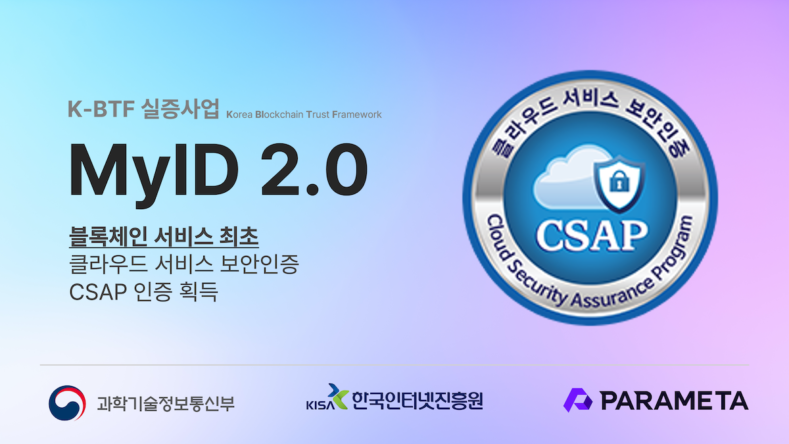
Web3 Enabler PARAMETA announced on the 12th that the Public Institution Blockchain Joint Infrastructure Demonstration Project (hereinafter referred to as K-BTF) 'MyID 2.0' has obtained the blockchain service CSAP (Cloud Security Assurance Program, cloud security certification).
CSAP certification is a mandatory security certification system for domestic public institutions to introduce cloud-based services. It is jointly operated by the Ministry of Science and ICT and KISA, and is issued only when strict information protection, physical security, and operational management standards are met.
'MyID2.0', which has obtained CSAP certification from Parameta, is a core DID service of K-BTF promoted by the Ministry of Science and ICT and the Korea Internet & Security Agency. MyID2.0 is a subscription-based (SaaS) platform that public institutions can introduce within a week by simply setting up the service without separately building a blockchain infrastructure.
Previously, it took several months of construction time and hundreds of millions of won for public institutions to introduce blockchain services such as DID, but through the joint infrastructure based on MyID 2.0, the introduction cost was reduced by more than 90%, and a foundation was established for immediate linkage to administrative services without development.
In addition, MyID 2.0 can be easily applied to various blockchain-based administrative services such as citizen cards, digital certificates, access authentication, and employee ID issuance, and is designed based on a simple administrator menu and API that allows administrators to set it up without separate specialized personnel.
Local governments and public institutions that have introduced this infrastructure can expect various digital transformation effects, such as improved services for residents, guaranteed data integrity, simplified administrative processing, and automated civil complaint authentication.
Kim Jong-hyeop, CEO of Parameter, said, “Through CSAP certification, we have secured a foundation for public institutions to provide safer and more reliable blockchain services,” and added, “We will continue to create best practices for domestic and international DID and Web3 data-based public platforms.”
- See more related articles
You must be logged in to post a comment.