



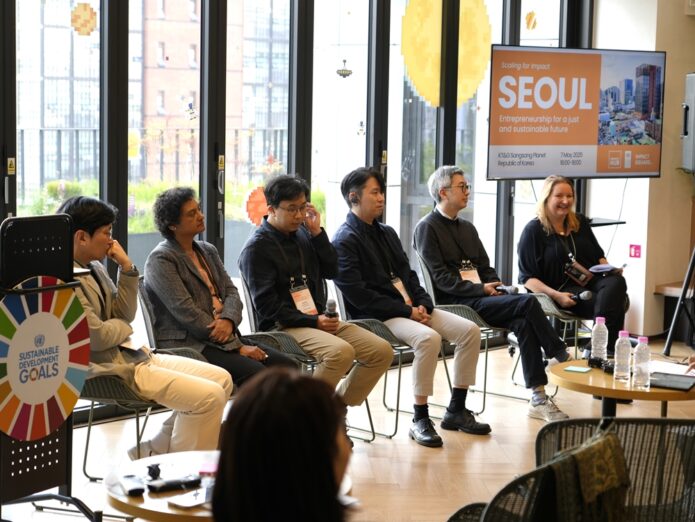
The global event 'Scaling for Impact', co-hosted by Impact Square, Impact Hub Network, and the United Nations Development Programme (UNDP) Seoul Policy Center, was held on the 7th at KT&G Sangsang Planet in Seongdong-gu, Seoul. Under the theme of 'Entrepreneurship for a Just and Sustainable Future', the event presented a report on the current status of the Korean youth social entrepreneur ecosystem, and domestic and international experts participated as panelists to explore innovation and global cooperation for impact creation.
This event was more meaningful as it brought together Impact Hub, the world’s largest network of social innovators, and key organizations that have been involved since the early days of the Seongsu Social Venture Cluster to discuss in-depth the current status and potential of the Korean impact ecosystem. In particular, panel discussions and participatory dialogue sessions with global speakers and participants included active discussions on the future direction of the Korean impact ecosystem and the potential for international cooperation from various regional perspectives.
In Part 1, we looked at the current status of Korea's impact ecosystem and drew consensus through the report, 'State of the Ecosystem for Youth Social Entrepreneurship in the Republic of Korea', which is scheduled to be published as part of UNDP's Asia-Pacific regional research series.
Lee Ju-ri, a UNDP Seoul Policy Center officer, introduced the report by saying, “UNDP is an international development organization that supports the eradication of poverty and reduction of inequality,” and said that UNDP is paying attention to the potential of the private sector, especially young entrepreneurs and impact startups, to contribute to the sustainable development goals. She explained the purpose of publishing this report to contribute to improving the structural impact ecosystem policies in developing countries, including Korea.
Research Fellow Kang Jae-won said, “Korea’s social venture policy started as an extension of the venture company policy, and initially focused on establishing the concept of social ventures and laying the foundation under the leadership of the government.” Citing the Ministry of SMEs and Startups’ 2023 survey on the status of social ventures in Korea, he evaluated, “Although the proportion of young entrepreneurs in their 20s is still low, the speed of conversion to operating profit is fast and the gap in entrepreneurship between men and women is small, which is very encouraging.”
He continued, “On the other hand, the high dependence on government policies is also a challenge that needs to be addressed,” and emphasized, “Young entrepreneurs are taking on the challenge with a lack of experience and weak capital, and customized support, social capital accumulation, and sustainable ecosystem design are essential for their growth.”
In the second panel discussion, moderated by Tatiana Glad (Chief Executive Officer of Impact Hub Network), panelists including Research Fellow Kang Jae-won (SME Venture Research Institute), CEO Kang Bong-soo (Deep Visions), Pamla Gopaul (African Union Development Agency NEPAD), CEO Heo Jae-hyung (Root Impact), and Director Kim Min-soo (Impact Square) had a heated discussion on the topic of ‘Entrepreneurship and Collaboration for a Fair and Sustainable Future.’ The discussion emphasized the importance of communities such as the Seongsu-dong Social Venture Cluster and the Impact Hub Network for the sustainability of the impact ecosystem, and opinions were exchanged on the direction of international collaboration based on trust.
During the discussion on the direction of Korea’s impact ecosystem and the growth of young entrepreneurs, Director Kim Min-soo (Impact Square) emphasized, “Korea has expanded the impact market under a government-led ecosystem, but now is the time to go beyond policy dependence and strengthen market-based survival capabilities.” He added, “We need more opportunities and great role models for young people to take on challenges.”
Research Fellow Kang Jae-won explained, “We need trust capital in our society, such as people who start businesses with good intentions and people who invest with good intentions.”
Regarding global collaboration, Pamla Gopaul (NEPAD, African Union Development Agency) shared African cases and advised, “A sustainable startup ecosystem requires a long-term perspective from governments, civil society, and international organizations, and international cooperation also requires customized strategies tailored to the realities of each region.”
CEO Kang Bong-soo (Deep Visions) explained that localization tailored to local needs and context is necessary as an approach for global collaboration, and CEO Heo Jae-hyung (Root Impact) suggested that global collaboration can begin by first finding a point where each person can practically connect.
In closing the discussion, Tatiana Glad (Impact Hub Network) reiterated the importance of collaboration based on networks and trust to build a sustainable ecosystem. In the group talk session that followed, participants divided into small groups and freely exchanged opinions on current issues in the impact ecosystem, possibilities for international cooperation, and ways to change the youth entrepreneurship ecosystem, continuing the excitement of the event.
“Today’s conversation was not just about youth entrepreneurship, but also a deep reflection on designing an ecosystem for future generations,” said Namhee Yoon, Director of Research at Impact Square, about the implications of this event. “Global collaboration should be a strategy for survival, not a utopia, and it should move beyond simple connections to real solidarity based on trust.”
- See more related articles
You must be logged in to post a comment.