



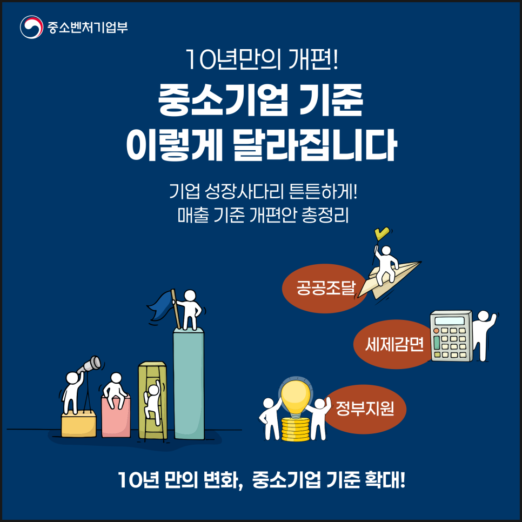
The Ministry of SMEs and Startups (Minister Oh Young-joo, hereinafter referred to as the Ministry of SMEs and Startups) announced that it has prepared a plan to revise the sales standards for SMEs to promote the corporate growth ladder and confirmed it through the economic ministers’ meeting held on the 1st.
The sales standards for small and medium-sized enterprises set in 2015 did not reflect the accumulated inflation over the past 10 years, resulting in cases where small and medium-sized enterprises graduated from the status of small and medium-sized enterprises simply due to a surge in production costs. If a company that has increased sales without regard to actual growth of the company falls outside the small and medium-sized enterprise standard, it will not be able to receive various benefits such as tax reductions, public procurement, and government support projects.
Accordingly, in order to support the stable growth of companies, the Ministry of SMEs and Startups formed a task force in April of last year with academia and experts from KDI, the Korea Institute for SMEs and Startups, and the Korean Economic Association to establish principles and standards for adjusting the scope of SMEs and to prepare a plan to revise the scope standards after gathering opinions from the SME sector.
The sales standard for small and medium-sized enterprises was raised from a maximum of 150 billion won to 180 billion won, and the sales sections were expanded from 5 to 7, while the upper limit of the sales standard by industry was expanded from the current 20 to 30 billion won. The sales standard for small businesses, which serves as the standard for small business owners, was adjusted upward from a maximum of 12 billion won to 14 billion won, and the sales sections were expanded from 5 to 9, while the upper limit of the sales standard by industry was raised by 5 to 2 billion won.
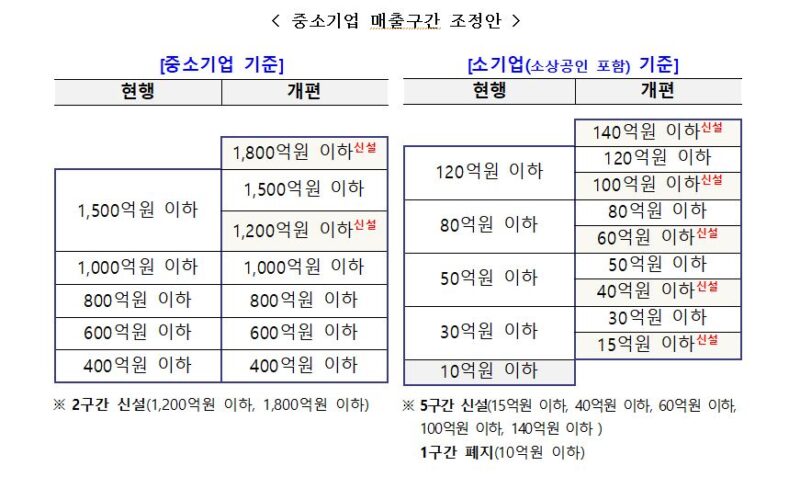
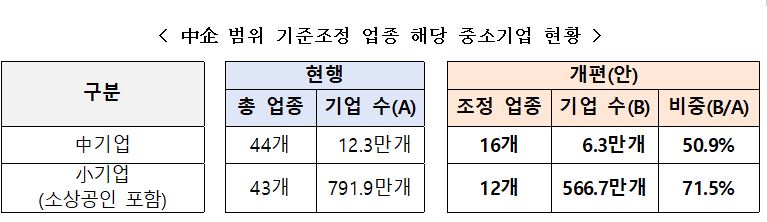
According to the reorganization plan, the sales ranges of 16 out of 44 SME industries and 12 out of 43 small business industries will be raised. Accordingly, about 5.73 million companies (63,000 medium-sized companies and 5.667 million small companies) belonging to the upwardly raised industries out of the total 8.04 million SMEs will receive stable benefits such as tax reductions, public procurement, and government support projects.
The restructuring plan comprehensively analyzed the distribution of companies within the industry, the appropriateness of the current sales standards, the inflation rate by industry, changes in the graduation rate of small and medium-sized enterprises, and the nominal growth rate, and sufficiently collected opinions from the industry to take into account special features that differentiate it from other industries.
For example, in the case of the primary metal manufacturing industry, the international price (LME) for imported non-ferrous metals such as aluminum, copper, and nickel has increased by more than 60% since 2015, and the demand for AI data center construction has led to further increases in metal prices, which has increased the cost burden. In the case of the automobile manufacturing industry, difficulties are expected due to the impact of the 25% tariff on individual US items, and the supply structure has changed from the single-product manufacturing method to the module product assembly method, which has led to an increase in sales without a change in profitability.
Minister Oh Young-joo gave two meanings to the reorganization of the scope after 10 years.
Minister Oh said, “First of all, this reorganization will solve the problem of small and medium-sized enterprises losing their status due to simple price increases, which will allow small and medium-sized enterprises to grow steadily, making the corporate growth ladder more solid. It will also help small and medium-sized enterprises that are having difficulties due to the strengthening of tariffs in the U.S., securing export price competitiveness, and the deterioration of the global raw materials supply chain.”
He continued, “In addition, since the principles and criteria for revising the scope criteria have been established through agreements with experts, academia, and small and medium-sized businesses, we expect that this will increase predictability and on-site acceptance when the scope criteria are reviewed every five years in the future.”
The Ministry of SMEs and Startups plans to announce the revision of the 'Enforcement Decree of the Framework Act on Small and Medium Enterprises' containing this revision plan in May and implement it in September after reorganizing the 'Online Small and Medium Enterprise Verification System.'
- See more related articles
You must be logged in to post a comment.