



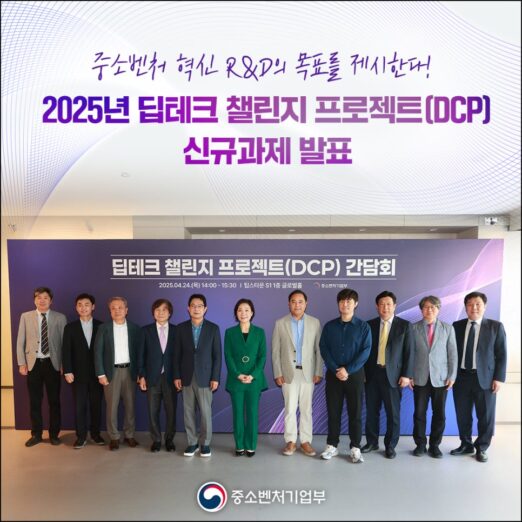
The Ministry of SMEs and Startups (Minister Oh Young-joo, hereinafter referred to as the MSS) held the '2025 DCP Strategy Meeting (hereinafter referred to as the Meeting)' at Tipstown in Seoul on the 24th and announced new tasks for the 2025 Deep Tech Challenge Project (hereinafter referred to as the DCP).
DCP is a large-scale R&D project that provides up to KRW 10 billion* in funding through public-private partnerships to enable small and medium-sized venture companies to boldly take on high-risk, high-performance R&D. Unlike existing R&D support projects that support tasks that companies want to do, this is a method in which companies, investment companies, and research institutes form a “project team” to take on a technology task that is absolutely necessary for national strategy when the government issues it.
Based on 140 technology demands from companies participating in this Deep Tech Challenge project, 19 tasks in future strategic fields such as bio, AI, and semiconductors were finally confirmed through verification by over 200 experts in each field.
The major exam topics by field are as follows.
◆ Advanced Bio: 4 items including development of cancer diagnosis device through liquid biopsy
Currently, a tissue biopsy method is used to collect suspected tissue to diagnose cancer, but it has limitations in that it is difficult to monitor changing patterns due to severe pain and physical burden. To overcome this, the task is to develop a high-difficulty technology that selectively captures a very small amount of tumor cells that fall from cancer cells into the blood and uses them for diagnosis. The goal is to predict early diagnosis of cancer and metastasis, recurrence, and prognosis based on precise data analysis using AI.
◆ Artificial Intelligence: Development of AI-based multi-functional robot solution to support nursing work, etc.
As the aging population accelerates, the demand for care is skyrocketing, but there is a limit to the increase in medical personnel. This project is to develop a robot that can comprehensively assist the work of professional medical staff in the medical field, and the key is the function of autonomously supporting nursing work. This project is to develop an optimized inference technology based on AI so that medical personnel, patients' needs, and the surrounding environment can be considered to perform autonomous work, and to develop a nursing work support solution that can be verified in the medical field.
◆ Semiconductor/Display: Development of mass production equipment for plating for manufacturing interposers based on multi-size wafers, etc.
The advanced semiconductor package market, such as HBM, AI, and high-performance computing, is highly dependent on overseas plating equipment with high uniformity and reliability, making it difficult to secure a stable production base domestically. This project is a technology to localize mass-production plating equipment that can respond to wafers of various sizes in order to implement advanced semiconductor packages. The goal is to develop an algorithm that controls uniformity and develop an optimized system that enables a high-speed plating process based on a uniform plating environment, thereby achieving high uniformity, productivity, and quality.
◆ Others: 10 projects in the fields of secondary batteries, mobility, aerospace, and carbon neutrality
The detailed RFP (Request for Proposal) for the above-mentioned tasks is listed in the Strategic Technology Bank, and the Ministry of SMEs and Startups plans to plan new tasks and list them additionally throughout the year.
The projects listed in the Strategic Technology Bank will be evaluated and accepted on a regular basis so that the project team can challenge throughout the year. The status of projects for which applications have been received will be disclosed to the bank immediately and a certain grace period will be provided. This is to promote competition by preventing preemption of projects and encouraging various companies to compete. The Ministry of SMEs and Startups plans to select and support 20 companies that will carry out DCP projects listed in the Strategic Technology Bank in 2025.
In addition, the Ministry of SMEs and Startups announced a plan to reorganize the DCP business through this meeting.
The main contents are as follows.
◆ Strengthening R&D strategy of small and medium-sized enterprises through integration and systematization of strategic functions
In order to discover challenging tasks in accordance with national strategic needs such as global competitiveness, market outlook, and socio-economic effects, the DCP planning basis will be shifted from the existing company-centered demand survey to one centered on strategic technology roadmaps.
In addition, in order to strengthen the R&D strategic planning function of the Small and Medium Business Technology Information Promotion Agency, we plan to integrate and operate the dispersed strategic functions such as the DCP Committee, Strategic Technology Roadmap Expert Committee, and PM Group into a single system.
◆ Activating competition through expanding openness
We are moving away from the recommendation system where investment firms discover and recommend promising companies, and are switching to a 'project team (consortium of companies, investment firms, and research institutes)' selection method where investment firms and research institutes can also be evaluated, and are accepting and evaluating applications year-round.
In addition, the 'Strategic Technology Bank' was introduced and projects were fully disclosed. Through this, companies and others will be able to sufficiently prepare project implementation plans and investment attraction strategies in advance, and competition among various entities is expected to be promoted.
◆ Systematization and efficiency of support
In response to the increasing demand for funds as the R&D phase progresses to the commercialization phase, we have changed to a step-by-step support structure that links equity investment after the R&D phase. Accordingly, equity investment is supported within 2 times the amount of follow-up investment attracted by the project team.
◆ Autonomous R&D performance and full-cycle support for PM
In order to respond to changes in the market environment, etc., and to ensure that R&D results lead to commercialization performance, we plan to match PMs 1:1 for each project and strengthen the autonomy and responsibility of detailed execution.
A moving target method is applied that allows development goals to be modified in response to market changes, and PMs in each field participate not only in project planning but also in the actual execution of the project to monitor changes in technology and the market, and, if necessary, provide support by matching experts in each field such as technology, commercialization, law, and IPO.
Minister Oh Young-joo said, “In this era of upheaval where survival cannot be guaranteed without boldly challenging innovative goals, the key to getting through it all lies with small and medium-sized venture companies and startups that possess technological prowess, creativity, and innovation.” He added, “We will actively support the innovation and challenges of small and medium-sized venture companies so that they can secure technological sovereignty and competitiveness in this era of global infinite technological competition.”
- See more related articles
You must be logged in to post a comment.