



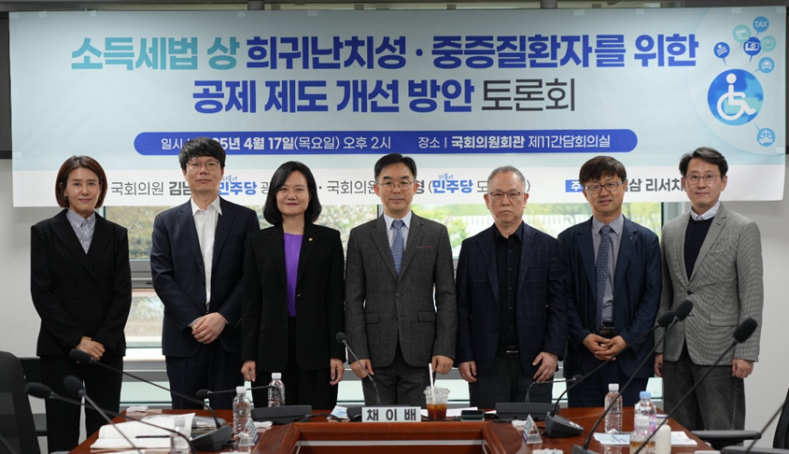
The policy discussion forum titled 'Improvement of the deduction system for patients with rare and intractable diseases under the Income Tax Act', hosted by Democratic Party of Korea lawmakers Kim Nam-hee (Gwangmyeong-eul, Gyeonggi Province) and Oh Ki-hyung (Dobong-gu, Seoul) and organized by Samjyeonsam Research Lab for the first time since its launch, was held on the 17th in the 11th conference room of the National Assembly Members' Hall.
This discussion was organized to examine the meaning and limitations of Article 107 of the Enforcement Decree of the Income Tax Act revised in February and discuss ways to improve it, in time for the 'Day of Persons with Disabilities' on the 20th. The income deduction for persons with disabilities provides a deduction benefit of 2 million won per year to reduce the financial burden of persons with disabilities, but there has been controversy over its effectiveness due to unclear criteria.
Director of Samjwisam Research Lab, Chae I-bae, who gave the opening speech, emphasized the significance of the deletion of Article 107, Paragraph 1, Item 4, “Clause 4, ‘Severely ill patients requiring constant treatment,’ which had been controversial due to its ambiguous criteria, and the establishment of Item 3, which is based on a special calculation disease group, made the criteria and subjects of judgment clearer.”
He continued, “Even severely ill patients who are eligible for the special calculation exception have to go through a separate decision by a medical institution to receive a disability certificate and submit it directly,” and emphasized, “We should automatically issue disability certificates based on the registration information for the special calculation exception and link them with the simplified Hometax data to improve accessibility to deductions.”
The special calculation system is a health insurance system that reduces the out-of-pocket expenses of patients with severe or rare diseases to 0-10%.
An Ki-jong, representative of the Korean Patient Organizations Association who participated in the discussion, suggested, “One of the disease requirements specified in Article 3, ‘a person who requires periodic treatment without interruption due to a similar disease or injury,’ is subject to concerns about arbitrary interpretation, so the disease targets can be clearly identified through statistical analysis of the types of diseases for which disability certificates are issued.”
Kim Seon-taek, Chairman of the Korean Taxpayers' Federation, said, "The disability certificate, which carries a social stigma, should be changed to a special calculation certificate, and in order to receive the disability deduction benefits, it should be sent in bulk through the Hometax year-end settlement simplification system from the National Health Insurance Corporation, just like registered disabled persons under the Disabled Welfare Act."
Han Min-hee, team leader of the Withholding Tax Division of the National Tax Service’s Corporate Tax Bureau, said, “In order for the National Tax Service to collect disability certificates issued by heads of medical institutions and provide them as simplified data, it is necessary to revise the Enforcement Decree of the Income Tax Act.”
The discussion also pointed out that the laws that determine who is eligible for the disability income deduction and medical expense tax deduction are complex and inconsistent, and that the provisions should be reorganized to improve taxpayer understanding.
Rep. Oh Ki-hyung, who hosted the discussion, said, “There is a claim that whether or not a patient is eligible for the additional deduction for the disabled under the Income Tax Act depends on which hospital they go to to request a disability certificate,” and added, “There is a need to overcome the limitations of the current tax system and seek ways to improve the system.”
Representative Kim Nam-hee, who co-hosted the event, also emphasized repeatedly that “as of 2021, less than half of the approximately 2.44 million people registered for special calculation benefits have received disability deductions,” and that “substantial improvement measures must be prepared to increase the effectiveness of the system’s operation and accessibility for taxpayers.”
- See more related articles
You must be logged in to post a comment.