



– Senior Housing Policy Discussion Held by Rep. Eom Tae-young… Around 100 National Assembly Members, Government Officials, and Agency Officials Attend
– Discussion of policy directions and innovation plans for public-private cooperation related to senior housing models such as the Korean Community Care Retirement Community (K-CCRC)
– Caredoc CEO Park Jae-byeong: “Development of Korean-style senior housing through public-private cooperation is important… Sustainable market must be formed”
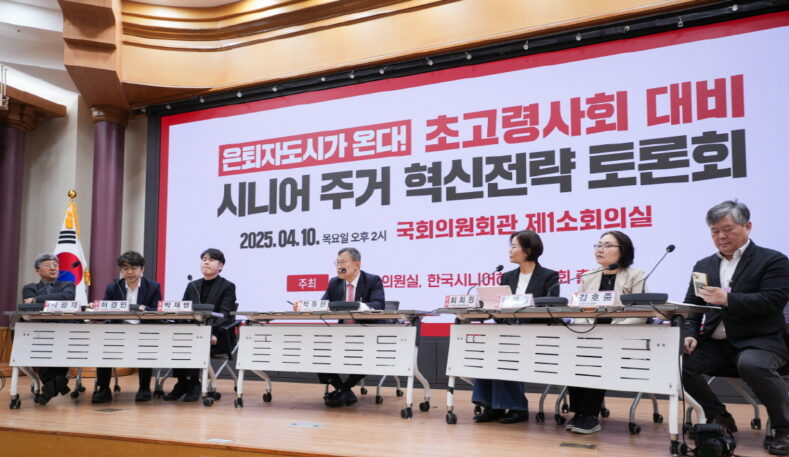
Senior total care company Caredoc (CEO Park Jae-byeong) announced on the 10th that the 'Retirement City is Coming! Senior Housing Innovation Strategy Discussion in Preparation for a Super-Aging Society' hosted by the office of Rep. Eom Tae-young of the People Power Party (Land, Infrastructure and Transport Committee) successfully concluded.
This event, held in the first small conference room of the National Assembly Members’ Hall, was designed to examine and discuss the concept of a ‘Korean-style retirement village’ and the current status of senior housing facilities in the era of 10 million elderly people. To this end, public and private senior housing experts gathered to focus on finding innovative ways to improve policies and cooperate with the public and private sectors.
Our country has already entered a super-aged society, with the proportion of the population aged 65 or older exceeding 20%, and it is expected that by the 2070s, about half of the population will be elderly. The demand for senior housing is also increasing, but the supply of welfare housing for the elderly is only 0.1% of the total elderly population, indicating that facility expansion is insufficient.
In relation to this, the importance of public-private cooperation is also increasing, as the 'Senior Residence Activation Plan' policy was discussed last year. In particular, this event was attended by over 100 senior housing experts, government officials, and key figures from organizations, demonstrating high interest in senior housing.
Rep. Eom Tae-young said in his welcoming speech, “We have organized this event to establish the concept of a ‘Korean-style retirement village’ and to seek practical measures for it,” and explained, “Our goal is to find an efficient and realistic solution by synthesizing government policies, private sector cooperation, and opinions from industry, the medical community, and consumers.”
The event was attended by many lawmakers from both the ruling and opposition parties, including People Power Party floor leader Kwon Sung-dong, People Power Party emergency response committee chairman Kwon Young-se, and Democratic Party of Korea lawmaker Maeng Sung-gyu, and Minister of Land, Infrastructure and Transport Park Sang-woo sent a written congratulatory address, drawing special attention from the political world and the government.
In his congratulatory remarks, floor leader Kwon Sung-dong said, “Japan, Germany, etc. are already actively implementing senior housing policies, and Korea should also seek fundamental solutions through cooperation between the National Assembly, government, and the private sector.” In addition, emergency response committee chairman Kwon Young-se said, “A ‘Korean-style retirement village’ that forms a community of life could be a solution that allows seniors to enjoy a happy remaining life.”
Rep. Maeng Sung-kyu, chairman of the National Assembly Land, Infrastructure and Transport Committee and co-chair of the “National Assembly Retirement City Research Forum,” emphasized, “A large-scale retirement city with more than 10,000 households equipped with housing, medical care, entertainment, sports, and communities will not only provide a comfortable retirement life, but will also be an important measure to solve the problems of local extinction and aging population.” Minister of Land, Infrastructure and Transport Park Sang-woo also expressed his opinion in a written congratulatory address, “In addition to existing efforts to stabilize housing for the elderly, such as promoting the enactment of the Retirement Village Act and revising the Private Rental Housing Act, more innovative strategies are needed, such as establishing an organic linkage model for medical care and welfare.”
The presentations were divided into two topics: policy tasks and environmental design. First, Park Dong-hyun, former chairman of the National Association of Senior Housing Welfare Facilities, emphasized the institutional problems and market polarization of senior housing through “Problems and Improvement Measures in Senior Housing Facility Policy,” and emphasized the need for expanded policy support and regulatory improvement. Jeon Hyeon-woo, a researcher at the Natural Science Research Institute of Seoul City University who co-authored “Why Do We Head to Megacities Every Day” with Professor Jeong Hee-won of the Department of Geriatrics at Asan Medical Center, explained the relationship between the environment and aging under the theme of “Prerequisites for Sustainable Aging: Cities and Communities,” and proposed urban community design centered on mobility and networks.
The general discussion was attended by leading senior housing experts, including Caredoc CEO Park Jae-byeong, who attended as a representative senior care company, former National Senior Housing Welfare Facility Association Chairman Park Dong-hyeon, Korean Housing Association President Park Kwang-jae, Ministry of Land, Infrastructure and Transport Housing Welfare Policy Division Director Heo Gyeong-min, LH Land and Housing Research Institute Director Lee Mi-hong, Well-Aging Research Institute Director Choi Hee-jung, and Monthly Long-Term Care Publisher Kim Ho-jung.
Caredoc CEO Park Jae-byung emphasized the importance of developing a Korean-style senior housing model that goes beyond copying foreign models and of public-private cooperation for this purpose. In particular, CEO Park Jae-byung emphasized, “We need to create a model that includes not only care but also jobs and leisure to fit the various life cycles of seniors, and furthermore, we need to be able to showcase this overseas.” In addition, the discussion covered a wide range of topics, including specific plans for establishing a Korean-style retirement village, the need to ease policy regulations on senior housing, and a certification system for senior housing establishment and operation expertise.
Rep. Eom Tae-young said, “In South Korea, a super-aging society, the issue of senior housing is an important issue that can no longer be delayed,” adding, “I hope that today’s discussion, where we heard various opinions and voices from the field, will become a stepping stone to forming a public consensus on senior housing and reaching a social consensus.”
Caredoc CEO Jae-Byung Park said, “In order to establish a Korean-style senior housing model specialized for Korea, we need to form a sustainable market by adding private-sector-led industries in addition to public welfare,” adding, “I hope that today’s discussion can become the cornerstone of K-CCRC, which the public and private sectors will create together.”
Meanwhile, Caredoc, as a leading company in senior housing, has been continuously making policy suggestions and public-private cooperation for market development and system improvement. To this end, it participated in the National Assembly Policy Debate on Senior Facilities hosted by Representative Jeon Yong-gi of the Democratic Party of Korea at the end of last year and emphasized the need for regulatory innovation. In addition, it is standing out in the market through the high-end residential nursing facility brand 'Caredoc Care Home', which has an average occupancy rate of 90%. Based on this market position and performance, it attracted investment from global asset management company Invesco last year and jointly launched 'Care Operation', the first senior housing operator in Korea, leading the advancement of the senior housing industry.
You must be logged in to post a comment.