



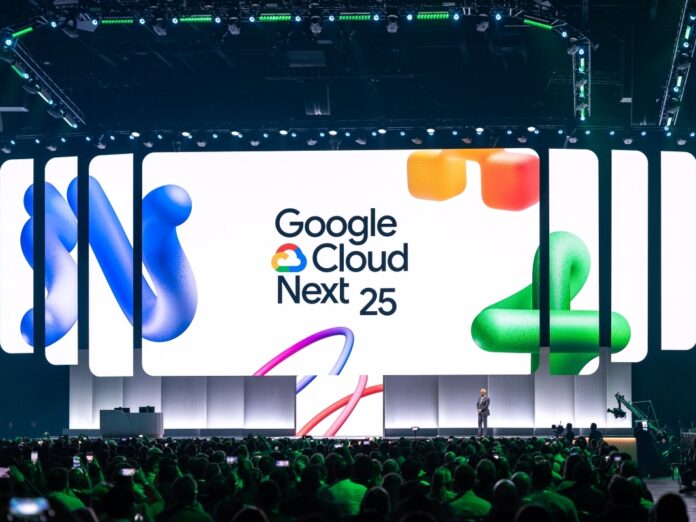
Google Cloud held its annual technology conference 'Google Cloud Next 25' at the Mandalay Bay Convention Center in Las Vegas, USA on the 9th (local time) and unveiled a number of technological innovations across the AI stack, from AI infrastructure to models, platforms, and agents.
The Next 25 event announced new products and technology innovations across all layers of Google Cloud’s integrated AI technology stack, including ▲AI infrastructure ▲Gemini models ▲Vertex AI ▲AI agents, under three key themes: AI-optimized platform, open multi-cloud, and interoperability.
Representative examples include the next-generation global network that will provide the infrastructure foundation for the era of generative AI, the AI Hypercomputer that opens a new era of computing with Cloud TPU and Google's distributed cloud, updates to Google's latest AI models including Gemini, new features of Vertex AI that implement a multi-agent ecosystem, Google Agentspace and Google Workspace that transform the productivity of companies and employees, and Google Unified Security and Security Agent, which are enhanced by AI.
Starting with a keynote speech revealing Google Cloud’s innovative technologies and latest vision, Next 25 will feature approximately 920 demo sessions and breakout sessions over three days. Among them, presentation sessions by Google Cloud customers who are using AI to solve problems in all industries around the world attracted attention. This year in particular, many Korean companies that are rapidly adopting generative AI technology based on execution power and innovative ideas will participate and share various innovative cases with Google Cloud’s global customers and partners.
▲Samsung Electronics announced an expansion of its partnership with Google Cloud at Next 25, saying that it will apply Google Cloud’s generative AI technology to Samsung’s new ‘home AI companion’ robot, ‘Ballie.’ Ballie combines Gemini’s powerful reasoning capabilities and multimodal capabilities with Samsung’s proprietary language model to coordinate actions and responses in real time, supporting natural and personalized conversational interactions. Furthermore, by using Google Search-based grounding technology, it can provide customized advice based on trusted sources.
▲LG AI Research Institute will introduce its own LLM model 'ExaOne' that has secured global competitiveness by utilizing Google Cloud's AI hypercomputer and infrastructure under the theme of 'Construction of LG AI Research Institute EXAONE Generative AI Model and Experience Based on AI Hypercomputing', and its successful case of developing an innovative enterprise agent AI.
▲Weverse Company efficiently carries out the task of completely migrating a large-scale data analysis platform to BigQuery by utilizing Gemini’s functions, and shares with the public a case study of creating a different dimension of analysis with BigQuery Machine Learning (BQML) and Gemini’s AI functions.
▲Kakao will introduce a case study on optimizing machine learning research performance on Google Cloud TPU and GPU and building and deploying a large-scale next-generation base model under the theme of ‘Building and servicing generative AI models using JAX.’
▲Kakao Healthcare will talk about the importance of collaboration between technology innovators and medical service providers in advancing healthcare technology and implementing AI agents under the theme of ‘Faster, Smarter Healthcare: Embracing Agent Workflows and the Latest Data Platforms.’
▲Studio Realive, a subsidiary of SM Entertainment, is actively utilizing AI to build various concept visualization works and video prototypes to provide immersive experiences to K-pop fandom around the world. Recently, Studio Realive introduced the beta version of Veo 2, Google’s latest image-based video generation model, through collaboration with Google DeepMind and Google Cloud. Veo 2 has noticeably improved errors that appeared in existing AI video generation, and its excellent understanding of the physical world and expressiveness of details have dramatically shortened the work time of creators.
“AI presents opportunities we’ve never experienced before. It has the power to improve our lives, increase productivity, and reimagine existing processes in ways we couldn’t have imagined before,” said Thomas Kurian, CEO of Google Cloud. “Google has been building machine learning into our products for more than 20 years, and we’ve invested in AI as part of our core mission to organize the world’s information and make it universally accessible and useful. With Google Cloud, we’re expanding that mission and actively supporting customers, developers, and partners to accelerate their goals with AI.”
Ji-Seong Jik, President of Google Cloud Korea, said, “Now is a critical time to leverage innovative technologies like AI to create fundamental change. Google is committed to supporting customer innovation by providing world-class infrastructure, models, platforms, and agents. Google Cloud will continue to build an open multi-cloud platform and interoperability to enhance customer flexibility and choice, and to shorten customers’ time to value.”
◆ Google Wide Area Network (WAN): The Next-Generation AI-Based Global Network for the Gemini Era
Google’s network is powered by more than 2 million miles of fiber-optic cable and spans more than 200 countries and territories. It provides services like Gmail, Google Photos, and Google Search to billions of users around the world with near-zero latency and trains Google’s most capable model, Gemini.
Google announced at Next 25 that it is making its global private network, Cloud WAN, available to enterprises around the world. Cloud WAN is optimized for application performance, and enterprises can achieve performance that is 40% faster than before while reducing total cost of ownership (TCO) by up to 40%.
◆ AI Hypercomputer: Computational performance that surpasses limits
Google Cloud’s AI Hypercomputer is a revolutionary supercomputing system comprised of hardware, software, and consumption models, meticulously designed to simplify AI deployments, dramatically improve performance, and optimize costs. Here are some of the key announcements about the AI Hypercomputer made at Next 25:
Introducing the Ironwood TPU: Google’s seventh-generation TPU, the largest and highest-performing TPU ever, delivering a 10x performance increase over Google’s previous-generation high-performance TPU (v5p). With over 9,000 chips per pod and 42.5 exaflops of compute performance, Ironwood is perfectly suited to meet the exponential growth demands of sophisticated AI models like Gemini 2.5.
- Expanded GPU Choices: Google Cloud supports A4 and A4X virtual machines (VMs) based on NVIDIA B200 and GB200 GPUs, giving customers a wider range of AI hardware options. Google is also the first cloud provider to support both models of NVIDIA’s next-generation GPU, Vera Rubin.
- Gemini Models Come to Google Distributed Cloud (GDC): Google Distributed Cloud now supports Google models in on-premise environments. Google has worked with NVIDIA to integrate Gemini into NVIDIA Blackwell systems, and with key partner Dell to enable Gemini to be used in both air-gapped and connected environments. Google Distributed Cloud enhances the existing air-gapped GDC product to enable Gemini to be used in the most secure and regulated environments, and has received approval for U.S. government Secret and Top Secret missions.
◆ Providing Google DeepMind’s leading models to cloud customers
Google Cloud supports rapid innovation by offering a broad set of Google models designed to meet the unique needs of diverse customers, based on groundbreaking research from Google DeepMind.
- Gemini 2.5 Family: The Gemini 2.5 model is a thinking model that has the ability to reason on its own before responding, delivering improved performance and accuracy. Following the public preview of the Gemini 2.5 Pro model on Vertex AI a few weeks ago, the Gemini 2.5 Flash model is now also available on Vertex AI. Gemini 2.5 Flash is ideal for everyday use cases where organizations need to provide real-time summaries or quickly find the documents they need when engaging with a large number of customers. Gemini 2.5 Flash also allows organizations to adjust the level of inference based on the complexity of the prompt, allowing organizations to optimize model performance to fit their budget.
- Google AI model enhancements: Google’s image generation model, Imagen 3, now supports high-quality image generation and inpainting. Google’s high-resolution voice model, Chirp, can generate personalized voices from 10-second audio files and isolate speakers from multi-speaker recordings. Veo 2, its video generation AI model, adds new advanced video creation and editing platform capabilities, including inpainting/outpainting, cinematic controls, and interpolation operations. In addition, Lyria, the industry’s first enterprise-ready text-to-music conversion model, was announced.
- Accelerate scientific research: AlphaFold 3 and WeatherNext models are supported in Vertex AI’s Model Garden, allowing companies to customize and deploy them for research and industrial environments.
◆ Vertex AI: A Unified Platform for AI Innovation
Vertex AI, Google Cloud’s unified platform for building and managing AI applications and agents, and training and deploying models, enables customers to better manage their AI initiatives. At Next 25, Google Cloud announced the following updates to Vertex AI:
200+ Models Available in the Vertex AI Model Garden: Customers can leverage Vertex AI’s full portfolio of open source models from the Allen Institute, including Google models, as well as third-party models from Anthropic, AI21, Mistral, CAMB.AI, and Qodo. They can also securely and custom train and tune models on their own data across the entire model family, including third-party models.
Grounded on more trusted sources: Vertex AI now provides location information grounded on third-party sources including Cotality, Dun & Bradstreet, HG Insights, S&P Global, and ZoomInfo, in addition to Google Maps, to ensure your agents have accurate and up-to-date information.
- Introducing Vertex AI Dashboard and Model Optimizer: The Vertex AI Dashboard provides organizations with better visibility and control with the ability to monitor usage, throughput, latency, and troubleshooting. The Vertex AI Model Optimizer leverages Google’s unique technical understanding of Gemini to automatically route queries to the best-performing models and tools based on an organization’s quality, speed, and cost preferences.
- Live API : Supporting real-time conversational interactions, the Live API enables streaming audio and video directly to Gemini, further expanding the possibilities for immersive multimodal applications.
◆ Vertex AI: Implementing a Multi-Agent Ecosystem
Vertex AI is the most open developer AI platform in the cloud and the only platform that offers a multi-AI agent solution that allows multiple agents to work together. Google Cloud announced the following new capabilities to help customers advance to the multi-agent ecosystem, regardless of where they are in their AI journey or what technology stack they choose:
- Agent Development Kit (ADK): This open-source framework simplifies the process of building sophisticated multi-agent systems while providing fine-grained control over agent behavior. The ADK allows you to build AI agents in less than 100 lines of intuitive code, and the Model Control Protocol (MCP) allows developers to easily add tools they can use.
- Agent2Agent (A2A) Protocol: Google Cloud was the first hyperscaler to create an open A2A protocol to enable enterprises to support a multi-agent ecosystem, enabling agents to communicate with each other regardless of the underlying technology. More than 50 partners, including Accenture, Box, Deloitte, Salesforce, SAP, ServiceNow, and TCS, are actively involved in defining the A2A protocol, sharing a common vision for multi-agent systems.
- Agent Garden: Agent Garden is a collection of ready-to-use samples and tools accessible from the Agent Development Kit that lets you connect agents to over 100 pre-built connectors, custom APIs, integrated workflows, or data stored in cloud systems like BigQuery and AlloyDB.
- Interoperability: Vertex AI enables customers to seamlessly manage agents built on multiple agent frameworks, including LangGraph and Crew AI. Google Cloud also announced that customers can build AI agents directly from their existing NetApp data without data duplication. Regardless of how customers choose to build their agents, Google Cloud helps them connect agents to key applications and enterprise data companies.
◆ Google AgentSpace: Empowering AI Capabilities for All Employees
First announced in December, Google Agentspace brings together the same high-quality enterprise search capabilities as Google Search, conversational AI, and Gemini and third-party agents to empower employees to find and synthesize information across their organizations, talk to AI agents, and take action with enterprise apps. Updates to Google Agentspace announced at Next 25 include:
- Chrome Enterprise integration : Employees can search and access all of their enterprise resources right from the Chrome search bar, streamlining workflows and improving productivity.
- Agent Gallery: View agents available across your company, including Google, internal teams, and partners, at a glance, making it easier for employees to search for and use agents.
- Agent Designer: A no-code interface for creating custom agents that automate routine tasks or augment knowledge, allowing employees of all skill levels to tailor agents to their workflows and needs.
- Idea Generation Agent: Uses a tournament-style framework to efficiently rank ideas based on criteria defined by employees, and supports brainstorming and problem solving by helping employees formulate or generate new ideas.
- Deep Research agent: Explores complex topics on behalf of users and delivers comprehensive, easy-to-read reports.
- Google Agentspace search on GDC: Scheduled to be released in preview in Q3 2025, Google Agentspace Search will help enterprise knowledge management teams unify access to all their data in a secure and permissioned manner.
◆ Google Workspace: AI-based productivity enhancement
Gemini not only delivers the best capabilities as an AI model, but also provides powerful features in Google Workspace, including popular apps such as Gmail, Google Docs, Google Drive, and Google Meet. Google Workspace offers innovative technologies that further enhance user capabilities through AI.
- Help me Analyze: Uncover insights from your data without separate prompts, support easier data-driven decision making, and turn Google Sheets into your own business analyst.
- Docs Audio Overview: Audio Overview in Google Docs lets you create high-quality, human-readable audio summaries, or podcast-style summaries, of your documents.
- Google Workspace Flows: Workspace Flows lets you automate routine tasks and repetitive tasks like managing approvals, researching customers, organizing emails, and summarizing your daily schedule.
◆ Google Security: Security Innovation Driven by AI
In today’s threat environment, enterprises are looking for the easiest and fastest way to leverage Google as part of their security team. Here are some of Google’s new innovations that help enterprises strengthen their cyber defense capabilities:
- Google Unified Security: Google Unified Security Platform leverages Geminai to improve every aspect of the practitioner experience. It creates a single security data fabric that is scalable and searchable across the entire attack surface, providing visibility, detection, and response across the network, endpoint, cloud, and apps. It also automatically enriches security data with the latest Google threat intelligence to detect and prioritize threats more effectively.
- Alert triage agent : The alert triage agent performs dynamic investigations on behalf of the user. It analyzes the circumstances in which each alert is triggered, collects relevant information, and then makes a judgment on the alert based on the agent's evidence and decision history.
- Malware analysis agent: The malware analysis agent examines the stability and maliciousness of code. It can generate and execute deobfuscation scripts based on Code Insight and analyze potential malware.
More information about the various technology innovations announced at Google Cloud Next 25 can be found on the Google Cloud Press Center and the Google Cloud Blog .
- See more related articles
You must be logged in to post a comment.