




The Ministry of SMEs and Startups (Minister Oh Young-joo, hereinafter referred to as the Ministry of SMEs and Startups) announced on the 7th that it has additionally selected 41 'specialized capacity BIs' that will solve problems of companies located in startup incubation centers (BI) based on institutional capabilities such as industry-academia cooperation functions, technology, professional manpower, and equipment.
The 'Specialized Capability BI' program is a new program established last year that helps incubation centers provide differentiated early-stage incubation programs tailored to the rapidly changing startup environment, rather than simply providing startups with a place to live.
Last year, the 52 'Specialized Capability BI' selected supported 916 startups, and the average sales of the supported companies increased by 22% (430 million won → 530 million won) and the number of employees increased by 28% (4.1 people → 5.2 people) compared to 2023.
This is higher than the average sales (KRW 450 million) or average employment (3.6 people) of all startup incubation center companies as of 2024, showing that the support effect of the 'Specialized Capability BI' program is excellent.
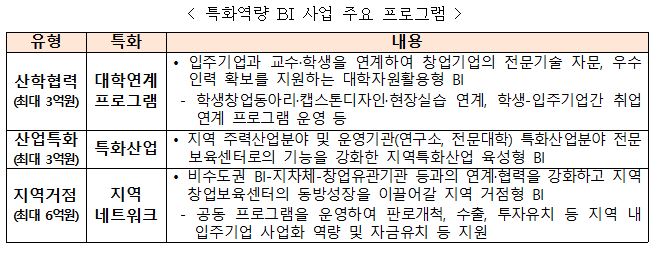
The 'Specialized Capability BI' selected this time is divided into three types: industry-academia cooperation, industry specialization, and regional base, and will receive up to 600 million won in support over two years. Through this, the Startup Incubation Center (BI) will step forward as a problem solver for problems faced by startups, such as technology development, market development, fund procurement, and human resource supply.
First, the industry-academia cooperation type mainly promotes problem-solving programs that help with difficulties faced by start-up companies in the early stages, such as technology guidance, mentoring, industry-academia joint technology development, and project planning, by utilizing experts such as university professors, existing technologies, and equipment.
The industry-specialized type is expected to expand the number of startups and venture companies in regional specialized industries by linking research institutes with startup companies to utilize their specialized technologies, equipment, and intellectual property rights.
The regional hub type will allow startup incubation centers in non-metropolitan areas with relatively poor startup infrastructure to form a consortium and jointly pursue investment attraction, market development, and networking, which are difficult for individual BIs to operate, thereby increasing accessibility to startup programs for regional companies.
Kyung-won Cho, the Director of Startup Policy, said, “The Startup Incubation Center must be reborn as an institution that provides customized support in the fields of technology and management to early-stage startups to promote business success,” and “Through this project, we hope that the Startup Incubation Center will establish itself as an incubation institution that will help early-stage startups in the region take a leap forward.”
- See more related articles
You must be logged in to post a comment.