



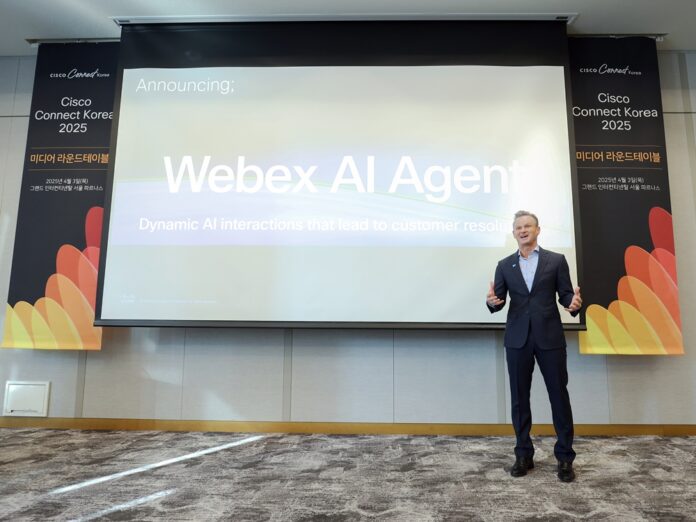
On the 3rd, Cisco held Cisco Korea's largest event of the year, 'Cisco Connect Korea 2025', at the Grand InterContinental Seoul Parnas in Samseong-dong, Gangnam-gu, Seoul.
The media roundtable event held that morning featured speakers including Cisco Korea CEO Jihee Choi, Cisco AI Product General Manager Anand Raghavan, and Cisco APJC (Asia Pacific, Japan, China) Collaboration Division Managing Director David Coventry. They introduced Cisco’s innovative security technologies and future business strategies, including AI Defense, which has been strengthened to fit the AI era.
In her welcoming speech, Cisco Korea CEO Jihee Choi said, “Cisco, which has led the networking industry for the past 40 years, is now transforming into a company that drives security, AI, and data innovation,” and “Cisco will support corporate customers’ AI transformation and digital resilience with networking, security, collaboration, and visibility solutions that have significantly enhanced AI capabilities.” CEO Choi said that this event is especially meaningful as it is the first official event since the acquisition of Splunk last year.
As artificial intelligence (AI) technology rapidly develops, cyber threats that are difficult to respond to with existing security solutions alone are increasing at an unprecedented rate. In response, Cisco recently launched a new security solution called 'AI Defense' to help companies develop, deploy, and protect AI applications with confidence even in a rapidly changing security threat environment.
'AI Defense' is fully integrated into 'Cisco Security Cloud', a total security platform based on Cisco's advanced AI technology, and realizes AI-based security enhancement at the network level. It is a differentiated end-to-end solution that only Cisco can provide, and is designed to quickly and effectively block new types of cyber threats. It utilizes AI's analysis and learning capabilities to detect and respond to threats in real time, while strengthening the security posture throughout the development and operation of corporate AI applications. Through this, Cisco is helping corporate customers continuously pursue innovation and safely grow their businesses even in a complex cyber threat environment.
“As AI becomes more and more central to every organization’s mission, three things have become critical: visibility into model usage, validation of models before they are deployed in production environments, and guardrails to protect models in production environments,” said Anand Raghavan, vice president and general manager of AI products at Cisco. “Cisco AI Defense provides a comprehensive platform that provides safe and secure access to third-party AI applications.”
He continued, “This platform protects AI-based applications based on safety, security, and privacy guardrails,” adding, “These guardrails comply with international standards such as the Large Language Model 10 Vulnerabilities (LLM10) selected by the Open Web Application Security Project (OWASP), the AI Risk Management Framework of the National Institute of Standards and Technology (NIST) in the United States, and MITRE ATLAS.”
Today’s business environment is undergoing a major transformation. The new era of productivity ushered in by AI is accompanied by a massive influx of information, which in turn has dramatically increased the amount of data that businesses and individuals must process. Employees are faced with an environment where physical work locations and ways of performing work are increasingly distributed, which poses new challenges for effective collaboration and maintaining security.
In response to these environmental changes, Cisco provides a portfolio of collaboration devices focused on improving employee experience (EX) and customer experience (CX) through its collaboration tool, Webex. Webex effectively supports employee interactions even in AI-centric environments, contributing to improving work efficiency. This is an approach based on Cisco’s customer experience philosophy that technology should support humans behind humans.
According to The Futurum Group’s Customer Experience Report: 2024, consumer satisfaction with current self-service voice and chat bots is relatively low. Fifty-nine percent of consumers surveyed said these bots were of little help. However, consumers still showed a willingness to actively use the technology. In particular, 94% of respondents said they would use self-service if the bot connected them to the right expert (64%), recommended proven solutions that have worked for other customers (50%), interacted with them through conversation (41%), or provided personalized answers based on their history with the brand (38%). This suggests that more intelligent AI-based self-service solutions have the potential to dramatically improve customer experiences.
Cisco has announced new features of the 'WebEx AI Agent' to actively respond to these customer demands. The recently updated WebEx AI Agent combines AI and human agents to shorten customer response times and automate problem resolution. The WebEx AI Agent analyzes customer needs through real-time conversations, suggests appropriate solutions, and can also act as a virtual agent that provides preset responses based on scripts.
David Coventry, Managing Director of Collaboration for Cisco APJC (Asia Pacific, Japan and China), said, “Webex AI Agent enables natural, human-like interactions across both voice and digital channels. Customers can build autonomous AI agents where AI drives the entire conversation, or they can guide the conversation with scripted agents where AI provides the underlying intelligence. These agents not only precisely understand the customer’s intent, but can also connect with existing systems, so we expect they will meet the needs of our customers.” The Webex AI Agent, which will be available soon, is expected to support nine languages.
- See more related articles
You must be logged in to post a comment.