

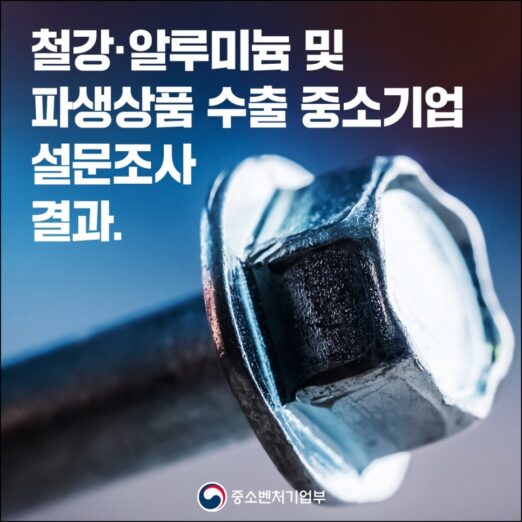
The Ministry of SMEs and Startups (Minister Oh Young-joo, hereinafter referred to as the Ministry of SMEs and Startups) announced the results of the 'Survey of SMEs Exporting Steel, Aluminum, and Derivatives' conducted jointly with the Korea Federation of SMEs (Chairman Kim Ki-moon, hereinafter referred to as the Korea Federation of SMEs) and steel and aluminum-related cooperatives on March 31.
As the US tariffs on steel, aluminum, and derivatives were fully implemented on the 12th, this emergency survey was conducted to preemptively uncover corporate difficulties and policy demands due to the tariffs.
The survey was conducted for 10 days from March 17 to March 26, and was conducted on 600 companies that export steel, aluminum, and derivatives.
The main findings of this survey are as follows.
◆ Difficulties faced by small and medium-sized enterprises due to tariffs on steel, aluminum and derivatives
First, the difficulties currently being faced or expected to face due to US tariffs were, in this order: ▲'Difficulty in accurately understanding US tariff policies' (41.8%), ▲'Rise in logistics costs due to tariff risks' (38.2%), ▲'Incurrence of costs for diversifying export countries' (36.5%), ▲'Difficulty in confirming whether or not a company is subject to US tariffs (28.2%)', ▲'Management difficulties due to delays or cancellations of export contracts with US business partners' (25.7%), ▲'Reduction in orders for domestic business partners exporting to the US' (23.3%), and ▲'Deterioration of export competitiveness in third countries other than the US' (22.7%).
◆ Self-efforts of exporting small and medium-sized enterprises to respond to tariffs
In addition, 32.5% of the responding companies were found to be preparing for tariff responses, and the items being prepared were, in order, ▲'efforts to reduce own costs such as production costs (52.8%)', ▲'discussing tariff burdens with U.S. business partners (51.8%)', ▲'participating in information sessions held by related organizations (30.8%)', ▲'concluding long-term contracts with business partners (14.4%)', and ▲'direct entry into the U.S. market (12.3%)'.
◆ Government support required due to tariff imposition
The government support needs due to tariff imposition were as follows: ▲'provision of tariff-related information (51.3%)', ▲'strengthening of logistics cost support (46.7%)', ▲'support for policy funds (loans, guarantees) (40.5%)', ▲'customs consulting by law firms, accounting firms, etc. (24.8%)', ▲'support for diversification of third-country exporters (19.2%)', and ▲'support for U.S. marketing (exhibitions, etc.)' (12.5%).
◆ Government support required for derivative product export companies
Among the companies that responded that they are exporting derivatives, 43.4% answered that they are experiencing difficulties in exporting derivatives, and the government support needed to resolve this was shown in the following order: ▲'professional consulting for checking US HS codes' (42.4%), ▲'consulting for calculating steel and aluminum content' (41.4%), ▲'document agency for customs clearance procedures, etc.' (33.5%), ▲'education for strengthening regulations of origin' (25.6%), and ▲'education on using HS code lookup systems such as the Korea Customs Service and the United States International Trade Commission (ITC)' (23.6%).
This survey revealed that SMEs prefer support methods that can solve their current export difficulties, such as tariff-related information, consulting, and policy funding support. In particular, information provision ranked first in both difficulties due to tariff imposition and policy demand, and derivative product export companies preferred consulting over education.
Accordingly, the Ministry of SMEs and Startups plans to provide prompt support for difficulties faced by exporting SMEs through the Difficulty Reporting Center. Export specialists will provide initial consultation and guidance through 15 regional Difficulty Reporting Centers, and for companies in need of funds, they will quickly provide funding through the recommendation process of the regional SME office, exemption from policy priority assessment, and fast-track procedures. In cases where in-depth consultation is required, customs-related in-depth consultation and on-site clinics will be linked and supported through customs specialists from the Business Support Group.
In particular, small and medium-sized enterprises are most eager to receive information on tariffs, so in cooperation with the Ministry of SMEs and Startups, the Korea Federation of SMEs, the Korea Customs Service, etc., we will introduce the latest trends and support policies related to US tariffs, and hold a 'US Tariff Imposition Response SME Support Explanation and On-site Consultation Session' in parallel with on-site consultation sessions. Starting with the Seoul area briefing session held on March 28, additional sessions will be held in the Gwangju-Jeonnam (4.7), Gyeonggi (4.9), Chungcheong (4.11), and Gyeongsang (4.15) regions. In addition, we plan to post related information and policy trends such as card news, leaflets, and support policy announcements on the Export Support Center website so that tariff-related information can be checked online.
Noh Yong-seok, the director of the Small and Medium Business Policy Office, said, “Starting with tariffs on steel and aluminum, tariffs on automobiles, and reciprocal tariffs, tariffs are expected to be imposed in various fields in the future,” and added, “In order to respond quickly to these tariffs by the U.S., we are operating an emergency response team within the Ministry of SMEs and Startups. We will continue to monitor the damage and difficulties SMEs are experiencing due to tariffs and provide customized support tailored to the situations of SMEs exporting, while resolving the difficulties and uncertainty SMEs are experiencing due to tariffs.”
- See more related articles
You must be logged in to post a comment.