



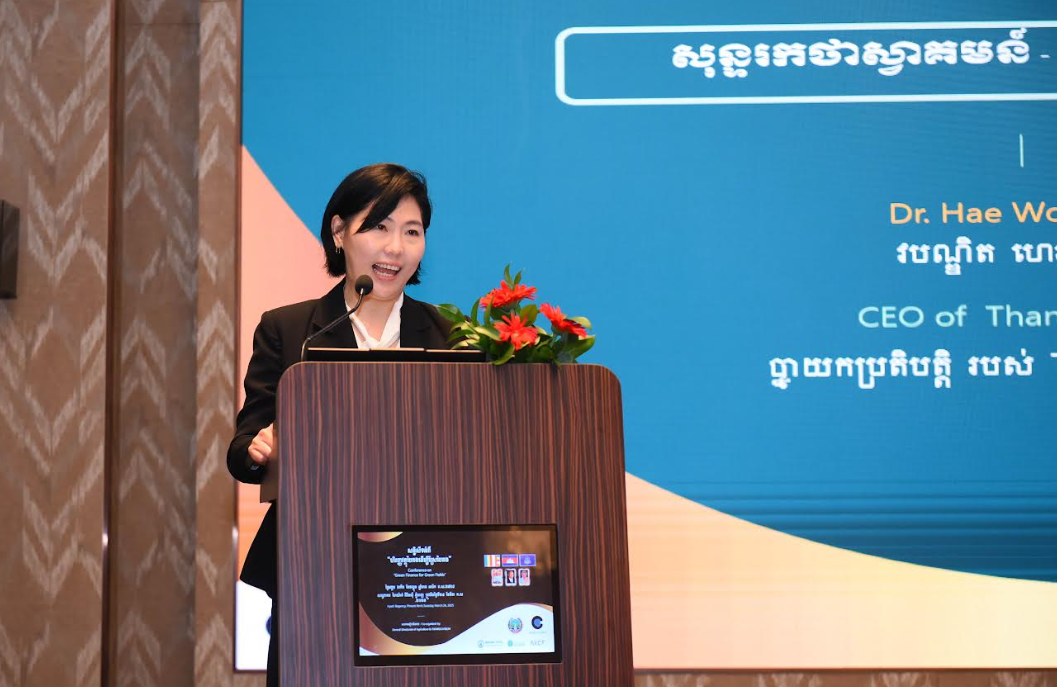
Climate tech startup ThanksCarbon announced on the 31st that it held a conference on the topic of 'Sustainable Agricultural Transition through Carbon Credits (Green Finance for Green Field)' with the Cambodian Ministry of Agriculture, Forestry and Fisheries' General Directorate (GDA) and the Global Green Growth Institute (GGGI) Cambodia on the 24th at the Hyatt Regency Phnom Penh, Cambodia.
This conference was organized to discuss ways to overcome the problems of decreased production and greenhouse gas emissions due to climate change in the agricultural sector through carbon emissions rights and technological innovation. It was attended by Kim Hae-won, CEO of ThanksCarbon, Kikozal, Deputy Minister of Agriculture, Forestry and Fisheries of Cambodia, Dr. Yontri, Deputy Director of the General Directorate of Agriculture of the Ministry of Agriculture, Forestry and Fisheries, and Kim So-mi, Director of the Global Green Growth Institute (GGGI) Cambodia.
Khy Kosal, Deputy Minister of Agriculture, Forestry and Fisheries, said the Cambodian government will introduce carbon credits as a new financing solution to support farmers and strengthen climate resilience. Anantaa Pande, Senior Program Officer at GGGI, explained the Korea-ASEAN Cooperation Fund’s methane reduction project, emphasizing the severity and importance of methane emissions from rice farming.
The full-scale case presentation session focused on the results of the Alternate Wetting & Drying (AWD) pilot project of Thankskabon in Battambang, Cambodia. According to the research results of Dr. Yontri, Deputy Director General of the General Department of Agriculture of Cambodia, and Researcher Sopic of the Royal University of Agriculture (RUA), rice farming areas that applied the AWD method showed not only reduced methane emissions, but also increased yields, reduced pests and diseases, and reduced fertilizer use.
Director Seungho Lee, who is in charge of the technology of ThanksCarbon, introduced MRV technology (Measurement, Reporting, Verification) that accurately measures and manages farmers’ implementation of rice paddy management through AI-based satellite analysis technology. It was emphasized that this innovative technology can produce high-quality carbon credits, which can greatly contribute to increasing farmers’ income and achieving the national greenhouse gas reduction targets (NDC) of Cambodia and Korea.
ThanksKabone co-founder and director Park Du-byung has outlined a concrete expansion plan to transform more than 500,000 hectares of rice-growing areas in Cambodia into sustainable agriculture by 2030.
The panel discussion that followed brought together experts from GGGI, ThanksCarbon, the Cambodia Bank for Agriculture and Rural Development, and the Cambodia Rice Association to discuss how carbon credits and green finance can build agricultural resilience.
ThanksCarbon CEO Kim Hae-won said, “It was a meaningful opportunity to exchange diverse opinions with experts centered on the successful case of the rice farming methane reduction project to secure the sustainability of agriculture in a rapidly changing climate environment.” He continued, “In order to respond to climate change and achieve sustainable growth, active cooperation from all stakeholders including the government, financial institutions, companies, and farmers is necessary, and ThanksCarbon will play the role of a key operator that activates the carbon emissions market through innovative technologies.”
- See more related articles
You must be logged in to post a comment.