



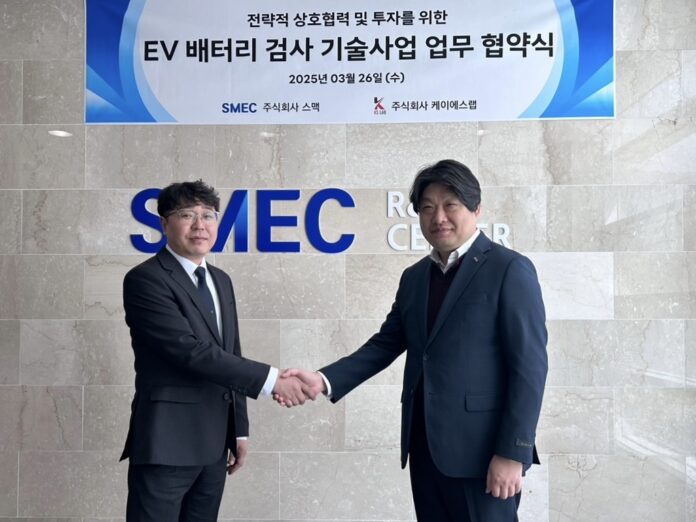
SMEC announced on the 27th that it signed a memorandum of understanding (MOU) for strategic technology cooperation and investment with KS Lab (CEO Seonghyuk Oh), a company specializing in electric vehicle battery testing solutions.
Through this collaboration, Smac plans to secure new electric vehicle battery diagnostic technology. It also plans to launch competitive inspection equipment that can meet the demands of the global market for inspection of multi-type and multi-variety electric vehicle battery packs.
KS Lab is an electric vehicle battery diagnosis company that collects and analyzes BMS (Battery Management System) data of electric vehicles and batteries in real time. It uses its own AI-based software technology to enable fast and accurate diagnosis without disassembling the battery. This has shortened the battery diagnosis time from 20 hours to less than 10 minutes. In particular, by applying the OBD (On-Board Diagnostics) terminal, it can analyze the status of not only the battery in the vehicle but also the removed battery pack. Through this technology, it possesses rapid inspection technology that can inspect up to 12 battery packs per day with one inspection device.
Since 2023, Smac has been selected as the supplier of waste battery dismantling equipment for the Korea Automobile Testing & Research Institute, and has steadily accumulated technology such as implementing a safe dismantling process in cooperation with battery discharge specialists. In addition, it has entered the electric vehicle battery inspection equipment market and is developing technology to precisely diagnose the condition of batteries.
As the electric vehicle market grows rapidly, the field of reuse and recycling of used batteries is also rapidly expanding. Accordingly, technology that accurately and efficiently diagnoses the condition and performance of batteries is essential. However, existing inspection methods (full charge/discharge method, DC-TRA, EIS, etc.) can only determine the degree of battery aging, and there were limitations in that it was difficult to conduct mass inspections due to the long inspection time and complex preprocessing process required.
To address these issues, the global electric vehicle battery testing market is increasingly in need of fast and economical rapid testing and diagnostic technology. Competition among companies to secure this position is becoming fiercer.
In particular, as a sharp increase is expected due to the spread of electric vehicles, the government announced that it plans to “strengthen the introduction of inspection equipment and management system to promote recycling of waste batteries.” In order to increase the recycling rate of 10 strategic key minerals to 20% by 2030, a full-cycle history management system for used batteries will be established, a certification system for battery recycling raw materials will be introduced, and waste battery component analysis and certification procedures will be strengthened. In addition, the plan is to support the introduction of waste battery inspection equipment and promote related technology development to enhance the competitiveness of the recycling industry.
A SMACK official said, “We believe that this can be an alternative to solving problems such as battery fires, as it allows for advance prevention and measures while driving or parking through real-time analysis of electric vehicle batteries,” adding, “Through this collaboration, we will present inspection equipment that is competitive in the global market based on innovative battery diagnostic technology.”
- See more related articles
You must be logged in to post a comment.