


KAIST Youth Startup Investment Holdings is a 100% subsidiary of KAIST, Korea's top technology university. It was established in November 2014 to support innovative technology-based startups born at KAIST. Initially, it invested directly using capital, but as the market recognized its performance, it established a fund in 2020 and has continued its full-scale investment activities. It has invested in 85 companies so far, contributing to the creation of a technology startup ecosystem and solving social problems.
We interviewed CEO Jeong Hoe-hoon to learn about KAIST Youth Startup Investment Holdings' investment philosophy and strategy, and how its portfolio companies are growing.

Impact investment in social enterprises such as ‘Sensi’
KAIST Youth Startup Investment Holdings aims for impact investment. It has set out to promote impact investment by forming an 'Impact Tech' fund worth 19.3 billion won in 2024 with MYSC, a representative domestic impact investment company.
KAIST Youth Startup Investment Holdings focuses on the commercialization and startup of innovative technologies based on research and development at KAIST, and actively supports startups with innovative technologies in the relevant fields. CEO Jeong Hoe-hoon said, “If social impact is possible along with investment returns, it would be the icing on the cake,” and introduced ‘ SENSEE’ as a representative impact investment case.
Founded in 2015, Sensi provides Braille publishing solutions for the visually impaired. It developed software that automatically converts digital documents into Braille and a special printer that can print them. Through this, the Braille book publishing period, which previously took 6 months to 1 year to do manually, was shortened to just one day, and the price of Braille books was lowered from $100-$150 to $10-$30. In this way, Sensi has contributed to the UN-SDGs’ goals of education and inequality resolution, while successfully entering the North American market and recording annual sales of 40 billion won. KAIST Youth Startup Investment Holdings prefers companies that can simultaneously create social and economic value.  Source: SENSEE CEO Seo In-sik's YouTube channel
Investment criteria are founding team, market, and competitiveness.
Regarding the criteria for evaluating startups, CEO Jeong Hoe-hoon said, “The most important are the founding team, market, and competitiveness in that order.” He emphasized, “The founder cannot succeed alone,” and “Just as a company sells products to customers, the founder must also be able to persuasively convey his vision and mission to his team members and build up a solid initial founding team.” His philosophy is that a business can only grow sustainably if the team members unite around the founder’s vision.
Regarding the market, he emphasized that “it is meaningless to occupy 100% of a small market” and that “companies should target markets with high growth potential.” This means that even if you monopolize the market with excellent products and services, if the market itself is small, economic performance will be limited, and for this reason, it cannot be an attractive investment opportunity for investors.
Finally, CEO Jeong said, “In order to get ahead of competitors, you need to have a differentiating strength,” and “various factors such as brands, supply chains, distribution channels, and technological prowess can be competitive.” KAIST Youth Startup Investment Holdings has focused on investing in companies with technological competitiveness, especially based on high technological understanding. Based on these evaluation criteria, KAIST Youth Startup Investment Holdings recently invested in ‘ Samsin .’
Samshin is an infertility medical technology startup established in 2023 that develops early infertility diagnosis kits and customized support services to increase the success rate of childbirth for infertile couples. CEO Shin Jae-cheong, who graduated from Yonsei University College of Life Sciences and Hanyang University School of Medicine, founded the company with his medical school classmates and friends he met at academic conferences. Their vision is to solve infertility problems based on their medical expertise and technological prowess.
The infertility treatment market has high growth potential. As the age of first birth in advanced countries increases, the number of patients undergoing infertility treatment is increasing, and as of 2024, the proportion of babies born through infertility treatment in Seoul will reach 14.6%. Accordingly, the demand for Samshin's early diagnosis kit and concierge service, which increase accessibility to infertility treatment, is also expected to grow.
In addition, Samshin provides innovative experiences to customers through its technology. When customers order a test kit and have their blood drawn, Samshin collects it, conducts a hormone test, and provides the results through an app. This increases the success rate of childbirth by predicting the possibility of infertility in advance without visiting a hospital. Since it has all three elements of a startup team, market, and competitiveness, KAIST Youth Startup Investment Holdings decided to invest in Samshin.
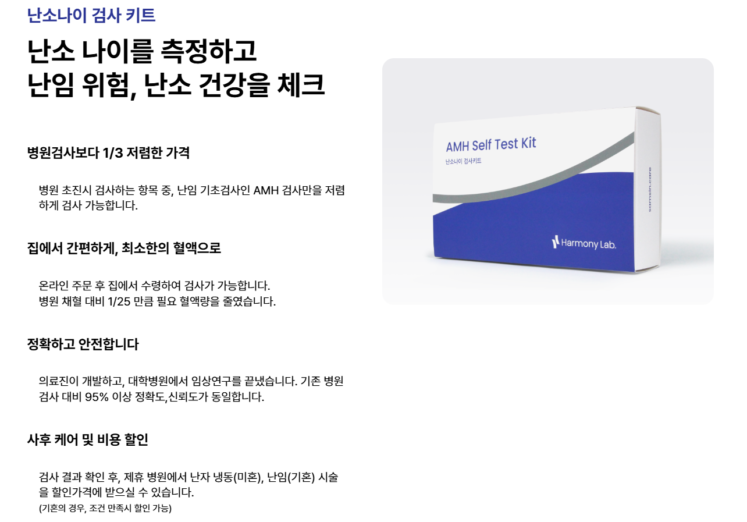 Source: Samshin website
Effectively providing startups with the resources they need
As an investment company, KAIST Youth Startup Investment Holdings’ greatest strength is definitely the KAIST ecosystem. CEO Jeong Hoe-hoon said, “The role of venture capital is generally thought to be investment, but the proportion from discovery/evaluation/investment decision is 20%, and the role of supporting the company until it builds up/scales up/exits after investment is 80%,” and explained, “Korean venture capitals are also expanding their roles and contributions to support the growth of startup teams.” In addition, he emphasized that KAIST Youth Startup Investment Holdings can effectively provide startups with the resources they need by utilizing KAIST’s research infrastructure and network.
In fact, various supports are being provided to enable portfolio companies to grow after investment. For example, a battery cathode material company hired a professor from KAIST’s Department of New Materials Engineering as a technical advisor, and a semiconductor design company built a test case in cooperation with Nanofab at KAIST. In addition, a company that needs bio data analysis was able to connect with and collaborate with biotech companies within the KAIST ecosystem.
The KAIST ecosystem is not just for companies from KAIST. Currently, only about half of the companies in the portfolio of KAIST Youth Startup Investment Holdings are founded by CEOs from KAIST, and there is no bonus point given to companies from KAIST during the investment review process. The two CEOs of 'Sensi' and 'Samsin' are not from KAIST. Anyone who is a portfolio company of KAIST Youth Startup Investment Holdings can receive support for growth through this ecosystem.
Focused investment in deep tech fields such as AI, data, semiconductors, eco-friendly energy, and robots
KAIST Youth Startup Investment Holdings, a subsidiary of the national university KAIST, plans to discover and closely support startups that will lead the development of industry and technology in Korea. CEO Jeong Hoe-hoon emphasized, “Nine out of the top 10 global market capitalization companies were founded in just 30 to 40 years,” and “The speed of technology and industry development is rapidly accelerating.” He continued, “The goal of KAIST Youth Startup Investment Holdings is to discover promising startups in a rapidly changing environment and closely support them so that they can contribute to the industry and economy as a whole.”
To achieve these goals, KAIST Youth Startup Investment Holdings plans to focus on investing in national strategic technology fields, focusing on startups in deep tech fields such as AI, data, semiconductors, eco-friendly energy, and robots. In particular, KAIST has been actively conducting research and technology development in these fields, and startup teams based on this are naturally emerging. KAIST Youth Startup Investment Holdings plans to discover these startups early, preemptively invest in them, and provide real growth opportunities by utilizing KAIST’s research capabilities and network.
You must be logged in to post a comment.