



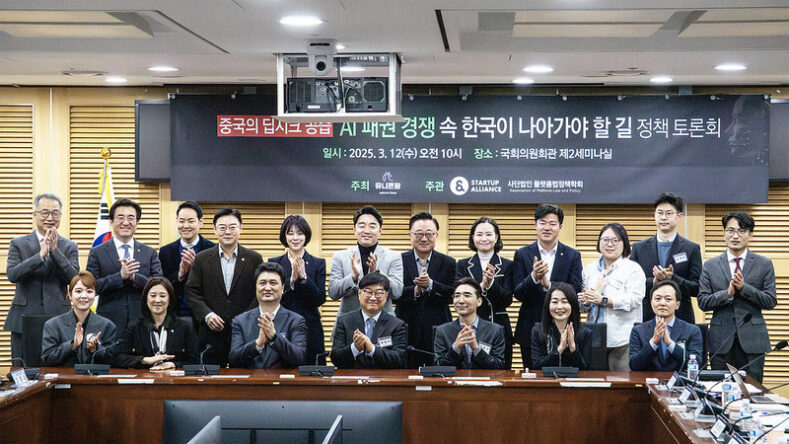
Startup Alliance (Director Lee Ki-dae), together with the National Assembly startup research group Unicorn Farm (Co-chairs: Democratic Party of Korea Assemblyman Kang Hoon-sik, People Power Party Assemblyman Bae Hyun-jin), and the Platform Law and Policy Society, held a policy debate titled “China’s DeepSec raid and the path Korea should take amidst the competition for AI hegemony” at the 2nd seminar room of the National Assembly Members’ Hall on the 12th. This debate was organized to seek the direction Korea should take amid the intensifying global AI hegemony due to the recent emergence of China’s DeepSec and to collect opinions from academia and industry.
Kang Hoon-sik, a Democratic Party lawmaker and co-chairman of Unicorn Farm, said, “There is a lot of talk that Korea is falling behind in the AI competition, but there is hope. Korea is a country that can utilize AI in various fields. It can develop in the direction of advancing platform, manufacturing, and energy policies by utilizing AI. The Democratic Party also needs a space that accepts change.”
Next, People Power Party lawmaker Bae Hyun-jin, co-CEO of Unicorn Farm, emphasized in her welcoming speech, “AI is already having a close impact on our lives, as evidenced by the stock market fluctuations whenever new AI technologies emerge,” and “It is time for our country, which ranks 6th in the world in AI competitiveness, to consider a strategic survival strategy in the AI hegemony competition led by the US and China.”
Lee Ki-dae, director of the Startup Alliance Center, which hosted the discussion, said, “When LLM first appeared in 2022, there was a perception that it was only a story of big tech companies, but after DeepSec, there were many questions about how such startups could be created,” and emphasized, “There is a need for discussion on what kind of selection and focus is needed to use limited resources as efficiently as possible compared to the U.S. and China.”
First, Professor Kim Sang-bae of the Department of Political Science and Diplomacy at Seoul National University opened the discussion with the topic, “US-China AI Hegemony Competition and Korea: Direction of National Strategy from the Perspective of International Politics.” Professor Kim said, “AI hegemony competition is an international political issue that goes beyond simple technological development and involves a complex mix of platforms, regulations, diplomacy, and arms races.” He added, “While the US is pursuing a civilian-centered open strategy and China is pursuing a government-led AI strategy, Korea, as a middle power, must establish a balanced AI policy.” He continued, “As the emergence of DeepSec has made AI technology a key element of the global hegemony competition, Korea also urgently needs to build AI data and cloud infrastructure at the national level.” He emphasized, “In order to survive in the AI competition, we need to come up with a national response plan that organically combines AI and platform strategies, not just individual technological innovations,” and said, “It’s like not being able to enter university by giving up Korean, English, and math and just memorizing subjects.”
Next, Professor Kang Hyung-goo of Hanyang University’s Department of Finance Management presented on the topic of “Analysis of the Current State of the Hyper-Large-Scale Artificial Intelligence Ecosystem and Response Measures,” and analyzed that “strengthening domestic AI data and cloud infrastructure is essential for Korean AI startups to maintain competitiveness in the global market.” He emphasized that “the government should approach the AI industry from the perspective of a platform strategy, not simply individual technology support,” and emphasized that “since the development of AI technology is directly related to the competitiveness of the platform industry, AI strategy and platform strategy should not be viewed separately, but a linked policy response is needed so that AI technology can be optimized within the platform ecosystem.”
In the comprehensive discussion that followed, Professor Hwang Tae-hee of the Law School at Sungshin Women's University served as the moderator and had an in-depth discussion on specific AI policy directions with experts from academia and industry.
Choi Nan-seol, a professor at Yonsei University Law School, said, “When technology first appears, our society has a brief period of favorable views, but then concerns and worries arise, leading to regulations.” He also emphasized, “The same situation seems to be happening with AI, so we need to think about whether we should be concerned first, as we are in a situation where we need to step up amid the current competition for AI hegemony.”
Kim Jae-won, CEO of Ellis Group, explained, “Data centers and cloud infrastructure are essential for the growth of the AI industry, but building large-scale data centers costs a lot of money,” and “To solve this, we are developing modular data centers to provide flexible and cost-effective AI infrastructure.” He continued, “In order to develop the domestic AI ecosystem, support is needed for rising electricity and network costs, and institutional improvements should be made to expand the use of AI in various fields such as defense, healthcare, and education.” He also emphasized, “There is high interest in modular data centers and AI digital textbooks in overseas markets such as Singapore, Japan, and Indonesia,” and “Korea should strategically move between the US and China and foster the AI industry.”
Kim Ji-ye, COO of Jobplanet, said, “There are many players in the current AI market, but the ecosystem has not been created yet,” and argued, “In a situation like the present, rather than focusing on a certain part of the AI market, we need an approach to properly create our own AI ecosystem, even if it is small.” COO Kim added, “Some may question the importance of creating a domestic ecosystem when the global ecosystem is already growing, but the existence of a domestic ecosystem, even a small one, will serve as a minimum safety net for entrepreneurs in the field.”
Jeong Ju-yeon, a specialist at the Startup Alliance, said, “The core of the AI ecosystem lies not only in the development of foundation models, but also in the development of application models,” and “It is inevitable to utilize the massive data and user base possessed by platform companies.” However, she pointed out that “while national support is currently focused on foundation models and semiconductor development, regulations on platform companies that can actually develop AI application models are being strengthened, creating policy contradictions.” She continued, “In order for the AI industry to grow sustainably, it is necessary to go beyond short-term government support and create an environment in which the private sector can build profit models and reinvest them to expand an independent ecosystem.”
Cho Young-ki, director of the Korea Internet & Security Agency, also pointed out the negative impact of excessive platform regulations on the development of the AI industry, saying, “AI technology innovation requires the use of large-scale data, but excessive personal information protection regulations can limit this and become a stumbling block to the development of the industry.” He also warned, “The prior regulation method can delay the technological development and market entry of AI companies, and put domestic companies at a disadvantage in global competition,” and “Excessive regulations can actually weaken the competitiveness of domestic platforms and work to the advantage of foreign companies.”
Gong Jin-ho, director of the Artificial Intelligence-based Policy Division at the Ministry of Science and ICT, emphasized the growth potential of the Korean AI industry and announced plans for active support at the government level. Director Gong said, “Some say that it is difficult for Korea to compete with the US and China, but we have sufficient capabilities, maintaining a global ranking of 3rd in AI patents and independent model development.” He then presented the following as key government support measures: ▲securing 18,000 GPUs by the first half of next year ▲promoting the world’s best LLM project ▲nurturing AI talent in cooperation with overseas universities. Regarding the basic AI law, he said, “We will focus on promotion rather than regulation, minimize unnecessary regulations, and sufficiently reflect opinions from the industry to reorganize the law.”
Finally, Professor Hwang Tae-hee of the Law School at Sungshin Women’s University, who moderated today’s discussion, concluded the discussion by saying, “AI is not limited to specific industrial issues, but has expanded to our daily lives, national interests, and the economy,” and “discussions should continue on what direction and strategy we should establish.”
Meanwhile, the content of this discussion can be viewed again on the Startup Alliance's official YouTube channel, and the discussion materials can be downloaded from the website.
- See more related articles
You must be logged in to post a comment.