



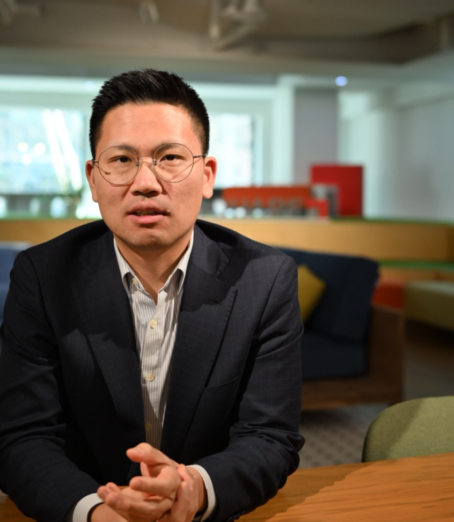
The commercial real estate market is in a correction phase amidst continued high interest rates and political uncertainty. On the 6th, we met with Jin Won-chang, head of big data at Alsquare, to hear about the market outlook and investment opportunities for the second half of 2025.
Still 'high interest rates', market recovery will be 'gradual'
The interest rate cut trend began in 2025. However, high interest rates are still having a significant impact on the commercial real estate investment market.
Director Jin Won-chang said, “The market is in the process of finding a balance between ‘expectations’ and ‘reality,’” and “Investment sentiment is gradually improving as the interest rate cut trend begins.” He explained, “In the office market, the total transaction amount recovered to 10 trillion won last year, but the reason for this was a significant increase in cases where strategic investors representing corporations purchased small and medium-sized quality assets, centered around GBD,” and “This proves that it is still difficult to attract large funds from the market due to the high interest rates.”
However, the high interest rate level is still a restraining factor in the market. Director Jin Won-chang predicted, “It will take time for the actual transaction market to recover because project financing (PF) and loan conditions have not improved significantly,” and “The interest rate gap between high-quality and low-quality assets will continue for the time being.”
In particular, it was pointed out that market uncertainty is increasing due to the inauguration of the second term of the Trump administration in the United States and domestic political instability.
“The Trump administration’s foreign policy changes and domestic political turmoil could weaken the confidence of economic entities and dampen investment sentiment. In particular, the slowdown in Korea’s economic growth rate and financial market volatility could have a negative impact on commercial real estate investment.”
Logistics Center Market: Supply and Demand Balance to Recover Around 2027
According to a recent Alsquare report, the new supply of logistics centers in the second half of 2024 has decreased by 6%. Regarding the structural cause of this decrease in supply, Director Jin Won-chang pointed out that “the decrease in the new supply of logistics centers is the result of several structural factors,” and “the core cause is the difficulty in securing project financing (PF).”
He explained, “The current domestic real estate PF structure is characterized by low equity capital investment and high dependence on guarantees by the developer,” and “As this structural vulnerability meets the interest rate hike period, financial institutions are showing a conservative attitude toward lending.” He added, “The overall recession in the construction industry is also a major cause,” and “As the burden of financing increases, the overall speed of logistics center development is slowing down.”
The vacancy rate of the room temperature logistics center has improved to 16% compared to the previous quarter, but rents have been stagnant for the second year. When asked when he expects this supply-demand imbalance to be resolved, he said, “In the case of room temperature logistics centers, a stable supply-demand balance is expected to be found around 2027,” explaining, “This is a natural adjustment period necessary for the market to digest the oversupply that has occurred so far.”
Director Jin Won-chang emphasized, “What is noteworthy is the polarization phenomenon by location,” and “Demand for logistics centers in excellent locations with excellent accessibility to Seoul and convenient transportation will remain steady, and rent increases will also be possible after 2025.”
Office market, regional differentiation and polarization deepening
The office market in each area of Seoul is showing distinct differentiation according to each characteristic. According to 'Alsquare Analytics (RA),' the vacancy rate in the CBD has increased slightly to 3.1%. He explained, "Due to the regional characteristics of government agencies and large corporations, the renewal rate of existing tenants is high, so the overall market is stable." However, he added, "Recently, some large corporations' relocation to the outskirts to reduce costs is acting as a cause of the increase in the vacancy rate."
Gangnam District (GBD) is the strongest district. Director Jin Won-chang said, “The vacancy rate is the lowest in Seoul at 2%, and rents are continuously rising,” and analyzed, “This is because new supply is limited while steady demand from IT companies and global companies continues.” He also said, “Prime-level offices centered around Teheran-ro are still showing high rental competitiveness.”
The Yeouido District (YBD) has been showing a clear trend recently. Director Jin Won-chang said, “The vacancy rate is at 1.3%, the lowest in Seoul. It is maintaining a relatively stable market.” He explained, “Financial companies are forming the main tenant base, and in the case of recently built prime offices, high occupancy rates were achieved due to the demand from financial companies.”
The polarization between prime offices and small and medium-sized buildings is also deepening. He said, “Prime offices are showing remarkable stability, with vacancy rates below 1%,” and “Even in a situation where uncertainty in the global economy is increasing, prime offices that have secured quality tenants are actually attracting attention.”
On the other hand, the small and medium-sized building market is experiencing considerable difficulties. The vacancy rate has risen to 5.4%, and rent increases have also stagnated. In particular, he pointed out that “the major problem is that IT companies and startups, which were major tenants, are moving to non-core business districts, accelerating the deterioration of profitability.”
Second Half of 2025: Focus on Data Centers and Life Science Facilities
The second half of 2025 is expected to be a market turning point, with interest rate cuts in full swing and global economic restructuring. Director Jin Won-chang said, “Investor sentiment will gradually improve as interest rate cuts become full swing,” and “Investors who have been waiting and watching will re-enter the market as capital procurement costs decrease.” He added, “Transactions are likely to be active, especially in quality assets such as prime offices.”
Regarding the expected return and risk factors for the next six months by asset type, he analyzed, “For offices, a stable return of 3-5% is expected for the next six months,” and “In particular, prime-grade offices in key locations have low vacancy rates and continuous demand, making them highly attractive for investment.” However, he pointed out, “The possibility of a decrease in rental demand due to an economic slowdown is a risk factor that needs to be carefully examined.”
Logistics centers are expected to show a flat or slight increase of 2-3%. The current vacancy rate is high at 23%, but the market is adjusting due to a decrease in new supply. “In particular, excellent logistics centers in the metropolitan area are expected to show a gradual recovery,” he predicted.
The sector that CEO Jinwon Chang is focusing on is data centers. “High returns of 5-7% are expected due to the acceleration of digital transformation and increased demand for cloud computing,” he said. “However, the initial investment cost is high and there are various regulatory risks, so a cautious approach is necessary,” he advised.
He pointed out “data centers and life science-related facilities” as new investment opportunities that investors should pay attention to in the current market situation. He said, “With the bio and pharmaceutical industries showing remarkable growth, demand for specialized real estate such as research centers and special manufacturing facilities is increasing,” and diagnosed, “These facilities can be stable investment destinations due to their high technological entry barriers and long-term lease characteristics.”
The rental housing market was also cited as a promising investment opportunity. “With the interest rate cut improving the conditions for raising capital, stable demand is expected due to the aging population and the increase in single-person households. It is a sector where policy support can be expected as social needs are high,” he said.
In conclusion, investors can find opportunities in both new growth sectors and traditional assets, but he advises that a careful approach is necessary after closely analyzing the characteristics and risks of each sector.
You must be logged in to post a comment.