



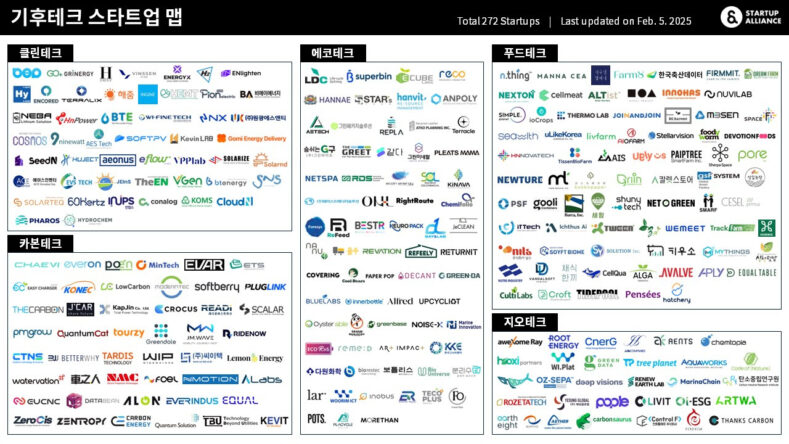
Startup Alliance (Director Lee Ki-dae) published an issue paper titled “Current Status of Domestic Climate Tech Startups: Focusing on Analysis of Current Status by Sector” on February 27. This report was published to analyze the current status of domestic climate tech startups by sector in preparation for the rapidly growing global climate tech trend and to suggest future directions for fostering climate tech startups.
Climate tech is an innovative technology for reducing greenhouse gases and responding to climate change. In Korea, the five major divisions of clean tech, carbon tech, eco tech, food tech, and geo tech proposed by the Presidential Committee on Carbon Neutrality and Green Growth 2050 in 2023 are generally used. Clean tech includes renewable energy and new energy industries, carbon tech includes carbon capture and mobility, eco tech includes resource recycling and eco-friendly material production, food tech includes alternative foods and eco-friendly agriculture, and lastly, geo tech includes carbon observation and emissions trading.
According to Startup Alliance's own statistics, as of February 2025, there are a total of 272 domestic climate tech startups. Of these, ecotech (25.7%) and foodtech (27.6%) fields account for more than half, which seems to be because startups are active in fields with relatively low entry barriers and small-scale startups such as waste recycling, eco-friendly materials, and eco-friendly agriculture. In contrast, geotech startups that require advanced technology and infrastructure, such as carbon observation using artificial satellites and emissions trading platforms, accounted for only 11.4%.
Looking at the investment status, we can see that while cleantech and carbontech are being invested in, geotech and ecotech are being relatively pushed back in terms of investment priorities. As a result of analyzing 209 startups with confirmed cumulative investment attraction amounts, the weighted average and standard deviation considering the investment amount by sector differed significantly from the arithmetic mean, showing that specific sectors with large investment amounts had a large impact. In particular, the cleantech and carbontech sectors were larger in both total and average investment amounts than other sectors, showing that the market's main funds were being concentrated in these sectors. A similar phenomenon is observed in the global market, and as a result of analyzing the top 100 global climate tech startups, 68% belong to the cleantech (33 companies) and carbontech (35 companies) sectors.
The report pointed out that quantitative goals such as “nurturing 10 climate tech unicorns” need to be reconsidered for the future growth of the domestic climate tech ecosystem. Our government has announced a plan to nurture 10 climate tech unicorn companies by investing a massive public-private investment of 145 trillion won by 2030. However, the report pointed out that “the birth of unicorn companies itself cannot be a policy goal for nurturing an industry sector,” and that it is more important to support the resolution of market uncertainty in the climate tech sector. This is because climate tech is a market where investment is determined by the size of the future risk of the climate crisis, not by the immediate market growth potential. It also argued that while it is important to focus on nurturing clean tech and carbon tech to secure global competitiveness, it is necessary to strengthen the competitiveness of eco tech and food tech, where many domestic companies are positioned, and provide balanced policy support.
Lee Ki-dae, the head of the Startup Alliance Center, said, “In order to solve the climate crisis, innovative startups based on new technologies are important. Most climate problems need to be solved through technology and policy. I hope this issue paper will help understand the current status of domestic climate tech startups and help formulate policies.”
The Startup Alliance Issue Paper is a report that focuses on legal, regulatory, and policy issues related to the startup ecosystem. The full paper can be downloaded for free from the Startup Alliance website.
- See more related articles
You must be logged in to post a comment.