



– Helping companies innovate their AX with the technology accumulated over 7 years
– Support for expert-level decision-making through agent-centric advancements
– Reasons for success in entering the Japanese market… Accessibility, localization, talent recruitment, market capture, SaaS provision
– Expanding beyond the financial sector to all industries
Allganize (CEO Lee Chang-soo) is growing rapidly while leading the AX (AI Transformation) innovation of companies. Founded in 2017, Allganize is providing AI solutions to approximately 390 companies in the US, Japan, and Korea through the ‘Alli’ platform. In particular, it is preparing to take another leap forward by promoting listing on the Japanese stock market in the fourth quarter of this year.
Allganize defines itself as an 'AX (AI Transformation) company'. This means that it goes beyond simply providing AI technology and provides comprehensive support so that companies can effectively utilize AI to achieve digital innovation. Under the vision of "innovating the lives of knowledge workers with AI", Allganize is supporting companies to achieve real change and sustainable growth through AI.
Vice President Lee Won-gang said, “There is an analysis that if AI is not utilized, the growth rate will decline. In a situation where the population is decreasing, improving productivity through AI is not an option but a necessity. Allganize is positioning itself as a partner that helps companies innovate with AI in line with this demand of the times.”
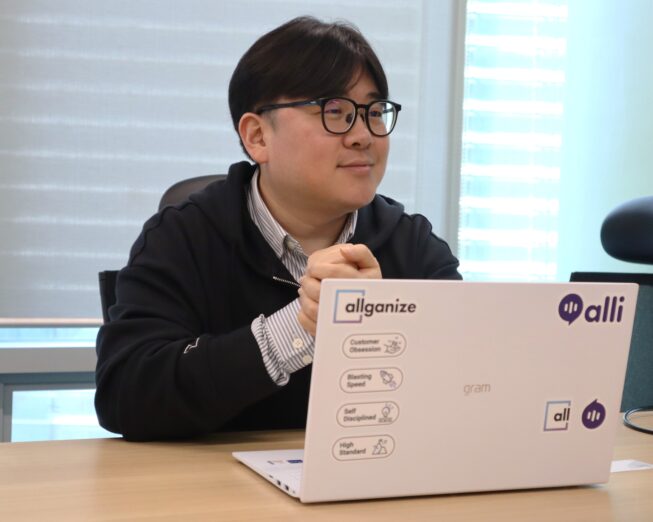
Through an interview with Vice President Lee Won-gang, we heard specific stories about Allganize's 'Ali Platform (RAG, LLM, app service)', the company's AX introduction strategy, and its Japanese listing plan.
■ Innovation in corporate productivity through RAG technology accumulated over 7 years
The biggest limitation of large-scale language models (LLMs) such as ChatGPT or Claude is that they can only answer within the range of the data they have learned. Since they do not know the information inside the company, they cannot provide answers based on information after a certain point in time or internal documents of the company.
To overcome these limitations, Allganize developed its own RAG (Retrieval-Augmented Generation) solution over the course of seven years. Allganize's RAG converts internal corporate documents into a computer-readable format, analyzes the document content, and then links it with LLM to generate accurate answers. With this solution, AI can understand all documents within the company, so it can immediately search for relevant information and respond to questions. For example, if a financial company employee asks, "Please recommend a product that costs less than 30,000 won per month among our company's golf insurance products," RAG technology extracts information that meets the conditions from the vast product documents and provides the optimal answer.
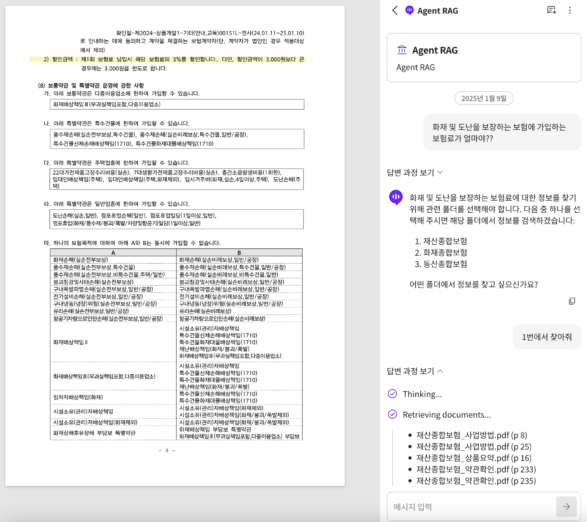
In particular, Allganize's RAG technology goes beyond simple keyword search and comprehensively analyzes page titles, contextual information within documents, etc. to increase the accuracy of search results. It can precisely extract necessary information even from documents composed of complex table formats, and provides reliability by highlighting the original document that is the basis of the answer. Through real-time feedback, the performance of the RAG model is continuously optimized, and the accuracy improves as the period of use increases. When initially introduced, it shows an accuracy level of about 70%, but as user feedback accumulates, the accuracy can be increased to 95% in just a few weeks.
■ Providing flexible corporate LLM solutions
Allganize provides flexible LLM solutions that companies can freely choose. Companies can choose external LLMs such as GPT or Claude, or introduce LLMs developed by Allganize, depending on their own situations and needs. They can make the optimal choice based on their company's data security policy or regulatory environment.
Regarding the reason why Allganize does not stick to a specific LLM, the vice president said, “Our goal is to help companies utilize AI well,” and “If a client prefers an external LLM, we evaluate which one is most suitable for the company and recommend it.” In fact, Allganize is disclosing benchmark results that compare and evaluate the performance of various LLMs.
The LLM developed by Allganize is based on Llama3, and performs initial learning using public domain data, and then conducts additional learning using the client's data. In this way, we provide an LLM optimized for the characteristics of each company.
■ Anyone can easily create and use apps
The app builder and app market provided by Allganize are key solutions that enable LLM to be practically implemented in corporate settings. The app builder allows even field workers without programming knowledge to easily develop AI apps necessary for their work, and the app market provides a variety of business-specific AI apps that can be used immediately.
The app market is organized into six categories: general, legal, human resources, customer support, and productivity. Currently, about 100 apps are provided, supporting various business areas, from document search to contract analysis, product comparison, and email writing.
App Builder is a no-code platform that allows you to create AI apps without development knowledge. Through this, the legal team can develop a contract review app and the CS team can develop a product recommendation app on their own to improve work efficiency. The intuitive drag-and-drop interface allows you to easily implement the necessary functions, and it also provides the flexibility to freely choose an LLM model that suits your work characteristics.
“Organize aims to ‘democratize AI tools’ through these app builders and app markets,” the vice president said. “Our goal is to help companies improve their overall productivity by enabling anyone, even non-professional developers, to utilize AI in their work.”
■ From in-house information search to management insights
Alli Answer is a representative app developed by Allganize. Alli Answer is characterized by AI understanding of a company's vast internal documents and providing accurate answers. Alli Answer uses RAG technology to generate accurate answers based on internal documents and provides citations to the original documents and highlighting of the answer source. In particular, it can find the necessary information even in scanned documents, and even in complex tables, it is possible to search not only by keywords but also by page titles, information within the page, etc., to find accurate answers.
The recently launched 'GenBI (Generative Business Intelligence)' is an app that analyzes corporate data to provide business insights. GenBI is a service that analyzes and visualizes related data when questions are asked in natural language by linking to the company's database. GenBI is designed especially for C-level executives to quickly obtain business insights for the company. It improves the efficiency of the decision-making process by allowing data-based insights to be obtained simply by asking natural language questions without the expertise of complex data analysis.
■ Help with expert-level decision-making as an agent
“LLM is not simply used for question-and-answer purposes, but is evolving into an agent that understands the user’s intention, finds the necessary information, and even produces results. Allganize aims to advance corporate AI utilization to the next level through this agent strategy.”
The vice president emphasized that Allganize is upgrading existing products to focus on agents. Agents are intelligent collaboration partners that support all aspects of work, dramatically increasing employee productivity.
In the case of Zenbi, the agent function was also applied. When a user requests, “Tell me last year’s monthly sales,” the information is retrieved by linking to the company’s database, and for an additional request, “Show me this as a graph,” a visualized graph is provided. It goes beyond simple data retrieval, understands the user’s intent, and processes and delivers information in the optimal form.
When agents are used to process civil complaints, they provide appropriate answers based on existing cases and legal information, provide evidence based on related laws, and support expert-level judgment by adjusting the level of the answer when necessary. Agents are also used for information disclosure requests, analyzing the Information Disclosure Act and existing cases to determine whether to disclose and the scope, and if partial disclosure is necessary, suggest the non-disclosed portion and its legal basis. Agents enable advanced decision-making beyond simple document search or response generation. Allganize is preparing for agents to be utilized in various work areas such as translation, resume analysis, and contract review.
■ Japanese market strategy and listing
Meanwhile, Allganize has been actively targeting the Japanese market. Thanks to Allganize’s efforts, the number of customers in Japan began to increase rapidly, especially from the end of 2022 to 2023. Regarding this, Vice President Lee said, “This was based on long-term preparation and thorough understanding of the local market. Japan is known as a conservative market when it comes to introducing IT products, but once a relationship is formed, it has the characteristic of maintaining a long-term partnership.”
The vice president cited the following as key elements of his strategy for success in the Japanese market:
First, accessibility. The fact that most of the Allganize staff were fluent in Japanese was a great help in concluding contracts with major Japanese clients in the early days. By lowering the language barrier, communication and trust were smoothly built.
Second, localization strategy. We hired about 20 local employees in our Japanese corporation to carry out marketing and sales activities specialized for the Japanese market. The local employees understand Japanese corporate culture and business practices, and they played a big role in building relationships with clients.
Third, recruiting local experts. We recruited experts with considerable influence in Japan and leveraged their networks and expertise.
Fourth, capturing market needs. Japan had a strong sense of crisis about falling behind in the AI market due to its lagging in the mobile market. This market atmosphere became a factor in accelerating the introduction of AI technology, and Allganize actively captured this market situation.
Fifth, the SaaS model-centered approach. Japanese companies preferred the SaaS model with low initial costs, which enabled Allganize to enter the market quickly. This was a characteristic that contrasted with the Korean market, which mainly preferred on-premise solutions.
Through this strategy, Allganize is currently generating about 60% of its sales and about 60% of its customers from the Japanese market, and based on this success, it is moving its headquarters to Japan and preparing for listing on the Tokyo Stock Exchange.
“The listing is not the end, but the beginning,” said the vice president. “We expect the AI market to grow even further, and the listing will serve as a foundation for securing talent and growth.”
■ Dreaming of a ‘Korean Palantir’
These efforts by Allganize are leading to the evaluation of 'Korea's Palantir'. Just as Palantir initially specialized in the defense sector and gradually expanded into various industries such as healthcare and ports, Allganize is also expanding its scope from the financial sector and public institutions to all industries.
The vice president stated, “Organize seeks expansion that is not limited to a specific industry. Like Palantir, an American data analysis company, our goal is to understand the characteristics of each industry and provide optimized AI solutions.”
You must be logged in to post a comment.