



– Innovative voice interface ‘Whispering’ implemented with proximity voice detection technology to be released in March
– “Dreaming of an interface that will change the world like a mouse”
– Attracting investment after launching Whispering
“We are now entering an era of conversation with AI, which began with ChatGPT. However, we are still only conversing with the keyboard. The essence of conversation is voice.”
Kim Seok-joong, CEO of Vtouch, pointed out the limitations of current voice interfaces. He pointed out that although ChatGPT has made natural conversations with AI possible, the input method is still stuck in the past.
Vtouch has been developing voice interfaces for over 10 years. At the time, with the advent of AI speakers, it was thought that voice would become the main interface. However, at the time, the AI performance was not up to the level where actual conversations were possible, so commercialization was not possible. Instead, it waited for the right time while securing related IPs, and when ChatGPT appeared, AI developed to the level where actual conversations were possible, and Vtouch introduced its voice interface technology to the world.
Vtouch's co-CEO Seok-Joong Kim founded an e-commerce company in 2002 while still in college and ran it for 10 years before founding Vtouch in 2012. Co-founder Do-Hyeon Kim is a management expert who served as the CEO of Lazada, the largest e-commerce company in Southeast Asia. Vtouch focuses on the development of next-generation interface technology, and is leading innovation in the voice interface field in particular. It has 71 registered patents and 55 pending patents, and its technological prowess has been recognized by winning consecutive innovation awards at CES. In 2024, it was selected for the 'AI Startup Accelerator 2' operated by SK Telecom and Hana Bank. Vtouch plans to attract Series A investment after launching WIZPR RING, which applies voice interface technology.
■ Preparing for the era of voice interfaces

The way computers and humans interact has constantly evolved. From the early command input method to the graphical user interface (GUI) and then to the touchscreen, it has defined the computing environment of each era. Now, in the AI era, voice is attracting attention as the new standard interface.
CEO Kim pointed out the current limitations, saying, “Desktops created a complete computing environment based on the keyboard and mouse, and mobile devices opened a new era of computing with multi-touch technology. However, conversations with AI are still confined to the framework of the keyboard.”
Voice is the most natural way for humans to communicate. It can effectively convey complex contexts and nuances, and anyone can use it easily without separate learning. In particular, as conversational interactions with AI, represented by ChatGPT, increase, voice is attracting attention as a new interface that can overcome the limitations of text input.
The changes brought about by voice interfaces are revolutionary. You can use your computer while walking or exercising, and you can communicate with AI naturally in your daily life in a hands-free manner without having to look at the screen. However, there were several technical barriers to popularizing voice interfaces. Representative problems included malfunctions due to ambient noise, concerns about privacy invasion, long response times and frequent recognition errors, and restrictions on use in public places.
VTouch solved this problem using physics principles. CEO Kim said, “Voice has the characteristic that its energy decreases inversely proportional to the square of the distance. By utilizing this physical principle, we overcame existing limitations by recognizing only nearby voices. Just as it took 20 years for GUIs to become commercialized, it takes a long time for new computing interfaces to become popular. We have been preparing for an era where voice becomes a natural interface, and we are confident that that time has now come.”
■ Whispering, Presenting a New Interface for the AI Era
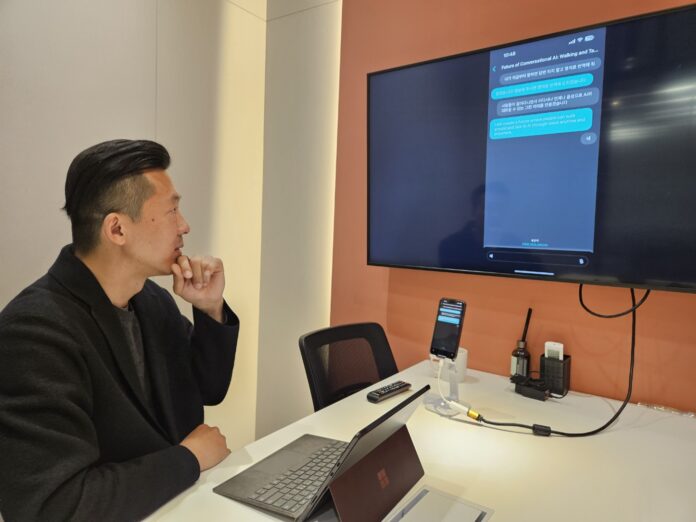
'Wizpering' (WIZPR RING), which uses voice interface technology, is scheduled to be released in March. Developed as a ring-shaped wearable device, Wizpering is an innovative voice interface that enables natural conversations with AI.
Even if your smartphone is in your pocket, you can send messages, control music, and manage your schedule using only your voice. You can freely communicate with AI in situations where it was difficult to use a computer in the past, such as walking, exercising, and driving. In particular, Whispering is characterized by natural interaction close to actual conversation, unlike existing voice assistants. Voice is converted into text in real time and displayed, and proper nouns and complex sentences are accurately recognized. It can also control various apps such as translation, schedule management, and music playback, so it is highly useful.
CEO Kim emphasized, “You can talk to AI while walking, exercising, or driving, and you can freely communicate with AI even in situations where it was difficult to use a computer in the past. This is the future we envision. Whispering is not just a product, but a solution that presents a new interface for the AI era.”
Whispering has already secured 200 million won worth of pre-orders through North American crowdfunding, and will begin official sales in March.
■ Application of proximity voice activity detection technology that accurately recognizes only the voice intended by the user
VTouch applied Proximity Voice Activity Detection (PVAD) technology to Whispering. PVAD is a technology that utilizes the physical characteristic that voice decreases inversely proportional to the square of the distance. For example, a voice at a distance of 5 cm has 100 times stronger energy than a voice at a distance of 50 cm. By utilizing this principle, it selectively recognizes only voices at a close distance, that is, the voices intended by the user.
PVAD technology offers a new interface that goes beyond simple voice recognition. While the existing push-to-talk method required pressing a button and speaking, PVAD implemented a close-to-talk method that allows voice recognition with just a close-up gesture. This allows natural interaction as if having a real conversation.
The core strengths of PVAD technology are accurate voice recognition and fast response speed. While existing voice recognition devices required 3-4 seconds of activation time, PVAD recognizes voices in real time. Another strength of PVAD is that it can accurately recognize even whispered voices. This allows you to freely communicate with AI while maintaining privacy even in public places. In addition, accurate recognition is possible even in noisy environments when speaking close to the device as if on the phone, so it is highly useful in actual usage environments.
■ “I want to be remembered as the first company to create a voice interface.”
“We don’t know who first invented the mouse, but we all know the changes that innovation brought. We want to make those changes,” said CEO Kim. “Our goal is to bring Whispering technology to the market with our own hands and successfully commercialize it. We want to create an era where people can naturally communicate with their voices while walking.”
In line with the growth of conversational AI represented by ChatGPT, Vtouch plans to expand its business area to a next-generation voice-based interface that goes beyond keyboards and touchscreens. At a time when the AI market is rapidly changing, the changes brought about by Vtouch’s voice interface innovation are noteworthy.
You must be logged in to post a comment.