



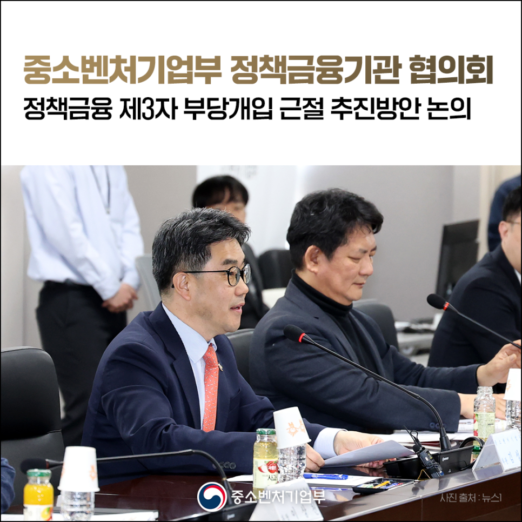
The Ministry of SMEs and Startups (Minister Oh Young-joo, hereinafter referred to as the Ministry of SMEs and Startups) announced that it held a kickoff meeting of the 'Ministry of SMEs and Startups Policy Finance Institutions Council' (hereinafter referred to as the Council) on the 6th at the SME Maru conference room of the Ministry of SMEs and Startups in Sejong, chaired by Vice Minister Kim Seong-seop.
The council was newly formed this year to coordinate and oversee the financial policies of the Ministry of SMEs and Startups and to improve their effectiveness and efficiency in response to the increasing financial difficulties faced by SMEs and small business owners. The Vice Minister of SMEs and Startups serves as the chairperson, the Director of Global Growth Policy serves as the secretary, and the vice-presidents of the four policy finance institutions under the Ministry of SMEs and Startups and the heads of the departments of the Ministry of SMEs and Startups in charge of the policy finance institutions serve as members.
The council will establish the direction for promoting tasks that require joint responses by policy finance institutions, such as eradicating unfair third-party intervention (brokers) in policy funds, devise a strategy for dividing roles and differentiating between institutions for similar work to enhance the effectiveness of the Ministry of SMEs and Startups’ financial policies, and inspect and discover additional tasks for inter-agency support, such as the Small Business Market Promotion Agency (SMA)-Small and Medium Venture Business Promotion Agency (SMB) linked relay fund. It is planned to hold regular meetings every quarter after this kickoff meeting.
In conjunction with the headquarters council, 13 regional SMEs and Startups Administrations (hereinafter referred to as regional SMEs and Startups Administrations) will also operate regional SMEs and Startups Policy Finance Institutions Councils (hereinafter referred to as regional councils). The regional councils will be chaired by the head of the regional SMEs and Startups Administration, and the heads of regional headquarters of the four policy finance institutions will participate as members.
The regional councils will identify areas for improvement in the Ministry of SMEs and Startups’ financial policies based on policy recommendations and difficulties from the field, while also identifying companies that require rapid and priority support in the region in the future and discussing support for collaboration between policy finance institutions. A kickoff meeting will be held within the first quarter for each regional office, and then held every other month.
The kickoff meeting of this council focused on discussing measures to eradicate unfair intervention by third parties (brokers) in policy finance.
Brokers are individuals or companies that have engaged in unfair practices, such as assisting or inducing the creation of false application documents in relation to policy financing applications, impersonating policy financing institutions, etc. Despite the policy efforts of the Ministry of SMEs and Startups and policy financing institutions, the need for active response has been continuously raised through the National Assembly and the media. The Ministry of SMEs and Startups has comprehensively reviewed external issues, etc., and has prepared a more systematic and effective response plan.
First, the Ministry of SMEs and Startups plans to establish a legal basis for dealing with brokers by revising laws under the Ministry of SMEs and Startups so that policy finance institutions can more systematically eradicate brokers.
The revision of the law will be reviewed along three directions. First, a legal definition of third-party unfair intervention will be newly established, and a review of the prohibition of third-party unfair intervention will be given priority. Next, a legal basis for allowing policy finance institutions to request submission of data when necessary to confirm third-party unfair intervention will be reviewed, and lastly, a legal basis for policy finance institutions to request broker sanctions, etc. from related institutions will also be reviewed.
Next, we will expand and strengthen internal and external collaboration to respond to brokers.
In order to actively crack down on brokers, a new cooperative system with the National Police Agency will be established. Starting in March, the Ministry of SMEs and Startups and the National Police Agency will operate a working-level consultative body to share broker-related information and discuss system improvements. The National Police Agency will review the contents of the request for investigation and establish a dedicated investigation team to conduct a rapid investigation process when policy finance institutions conduct their own inspections and request a batch investigation of suspected brokers to the National Police Agency.
A collaborative system with portal companies will also be fully operational to block broker portal advertisements suspected of being illegal. Specifically, if a dedicated team of a policy finance institution reports an Internet advertisement suspected of being illegal, such as impersonating a government agency, to Naver, Naver will promptly review it and take corrective action if necessary. In addition, the promotion of the official website of the Small and Medium Business Administration’s policy funds will be strengthened through the portal.
The policy finance institution’s own response system to third-party unfair intervention will also be supplemented and strengthened. In addition to detecting brokers through the current reporting center, a big data-based self-broker detection process will be established, and the joint response system against brokers will be strengthened through strengthening information sharing between policy finance institutions and joint inspections of suspected broker cases.
Lastly, we will work to improve the convenience and accessibility of policy funds so that small business owners and other policy customers can apply for and use policy funds more easily.
Starting in March, Sojin-gong will establish a call center dedicated to policy funds to support the entire process of funding support, from in-depth funding consultation and recommendation to guidance on how to write application documents and sharing progress and evaluation results. In addition, Sojin-gong plans to place loan application assistants at 77 regional centers to provide close support for vulnerable groups’ funding applications by providing advice and editing on writing application documents.
In addition, we plan to further simplify the documents that SMEs and small business owners must submit directly when applying for policy funds. We plan to gradually replace documents required to confirm the target requirements for each fund or documents that corporate companies have directly submitted to prove the status of their businesses when applying for funds with computerized searches to ease the burden of document submission. For example, when corporate companies apply for SME policy funds, the corporate registration transcript that had to be submitted will be directly searched by the SME Evaluation Data (KoDATA) review officer through computerized connection in the second half of 2025.
In addition, a mobile one-stop service for small business agency loans will be piloted starting this April based on collaboration with private financial institutions (Kookmin Bank). When the mobile one-stop service is introduced, small business owners will be able to process everything from policy fund applications to loan execution at once through a mobile app, which is expected to minimize the inconvenience of having to visit multiple financial institutions. In the case of local credit guarantee loans, convenience will be improved by expanding the number of banks that handle non-face-to-face guarantees where both guarantee applications and reviews are possible through a banking app.
Vice Minister Kim Seong-seop, who chaired the meeting of the council, said, “It is time for policy finance institutions to join forces to resolve the financial difficulties of SMEs and small business owners and to strengthen their competitiveness,” and added, “Through the newly launched council, we will think together with policy finance institutions about key pending issues, such as eradicating unfair intervention by third parties, and continue to make improvements.”
- See more related articles
You must be logged in to post a comment.