


As competition in the innovation industry around the world intensifies due to the emergence of China's generative artificial intelligence (AI) DeepSeek, there are voices calling for mid- to long-term policy support for open innovation to foster new export engines for our country.
According to the 'Report on the Current Status of Open Innovation in Korea and Policy Suggestions for Activation' published on the 5th by the Korea International Trade Association (KITA, Chairman Jin-sik Yoon), as the internal innovation inducing effect of open innovation has been proven, the participation of large domestic corporations has increased significantly, and startups have also been found to have attempted to expand their markets beyond the limitations of the narrow domestic market through linkages with exports.
In fact, the number of major open innovation programs and participating large companies has increased significantly by about 12 times over the past five years, from 7 cases and 18 companies in 2018 to 87 cases and 361 companies in 2023. The export performance of startups also varied depending on whether they participated in open innovation. Among companies in their 7th year of establishment, the average annual export growth rate of companies that did not participate in open innovation ('17-'23) was 39.5%, while the exports of participating companies increased significantly by 95.2%.
The field evaluation of open innovation is also generally positive. According to a survey conducted by the trade association, regarding the overall satisfaction with participation in open innovation (out of 5 points), large companies and intermediaries responded that they were ‘average to satisfied (3.58 points)’ and startups responded that they were ‘very satisfied (4.51 points)’. Large companies evaluated that although it is difficult to achieve results in the short term, it was helpful in making long-term investment decisions and that open innovation is essential in an era of rapid technological and political changes.
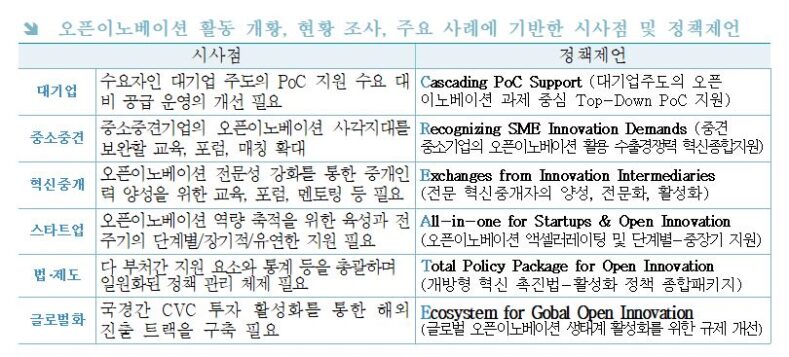
The report derived six (CREATE) policy recommendations based on the survey results and existing success stories. In particular, it emphasized that top-down open innovation should be led by large corporations that directly utilize the products and technologies. It also added that it is necessary to foster innovation intermediaries to reduce differences of opinion between large corporations and startups, establish inter-ministerial organizations and enact innovation promotion laws, and ease restrictions on corporate venture capital (CVC) investment.
Meanwhile, the trade association has been consistently promoting startup support projects since 2019, such as ‘Innobranch’, an online platform that matches domestic and foreign large corporations with startups, ‘StartupBranch’, a one-on-one startup meetup support center, and hosting ‘NextRise’, Asia’s largest startup fair. As a result, out of 578 startups that participated in a total of 207 projects, 125 companies contributed to achieving results such as contract conclusion, joint development, investment attraction, and buyer discovery.
Lee Myeong-ja, head of the Overseas Marketing Division at the Korea International Trade Association, emphasized, “Due to the nature of open innovation, it takes an average of 2 to 3 years to produce meaningful results, and even a 1:1 meetup takes about 7.2 or more attempts to succeed, so a mid- to long-term approach is necessary.” She added, “The synergy effects created through collaboration between large companies and startups will lead to product and business innovation, which will ultimately be of great help in diversifying the portfolio and enhancing export competitiveness.”
- See more related articles
You must be logged in to post a comment.