



-Overcoming the limitations of existing data centers with mobile modular data centers (AI PMDC)
-Shortening time and reducing costs with 10 years of accumulated technology… First CSAP IaaS certification in Korea
-Ellis Group, AI ecosystem innovation from AI education platform to AI cloud
Celebrating its 10th anniversary, Ellis Group (hereinafter referred to as Ellis) is standing out in the AI cloud field based on the technological prowess it has accumulated in its AI education practice platform. In particular, it is achieving innovative results, such as building the first portable modular data center (PMDC) equipped with NVIDIA B200 in Korea.
'Ellis Cloud', which provides the latest GPU performance, can be built in just 3 months and, in particular, can reduce costs by more than 77% compared to global clouds. With these advantages, Ellis Cloud recorded a 9-fold increase in the number of user organizations in just 6 months.
Ellis was the first in Korea to obtain CSAP IaaS certification for AI PMDC in March of this year. This has enabled it to expand its presence in the public sector, where physical security is important. The AI chatbot 'Helpi', an AI digital textbook for middle school information classes, is also operating on Ellis' security structure.
CEO Kim Jae-won emphasized, “In an era where AI has become a social necessity, it is important to localize the cloud and expand AI education for technological security.”
We met with CEO Jaewon Kim at the Ellis office in Gangnam-gu, Seoul, and talked about AI data centers and AI education necessary for building an AI ecosystem.

In the AI era, existing data centers have limitations
AI and data centers are like cars and roads. As AI develops, more powerful and specialized infrastructure is needed, but existing data centers are not able to meet the requirements of the AI environment, which is hindering the development of the AI ecosystem.
First, the power issue must be resolved. Since existing data centers have relatively low power consumption and manageable heat generation for CPU-based servers, air-cooling systems and standard power supply facilities were sufficient. However, GPUs, which have become essential in the AI era, consume 10 to 100 times more power than existing servers. Therefore, everything from power supply substations to distribution panels and cabling must be newly built. Cooling system construction is a critical task, as cooling costs alone account for 30-40% of total operating costs.
In particular, high-performance GPUs such as the H100 generate a lot of heat. It is difficult for the existing air-cooling system of the data center to handle this. Even if you try to convert to water cooling, the existing building structure often cannot withstand the load. Large-scale structural changes are required for the installation of piping, so construction at the level of new construction is inevitable.
AI learning requires real-time data exchange between thousands of GPUs. For this, ultra-fast network technology such as NVIDIA InfiniBand is essential, but to apply this, a network structure completely different from that of a general data center must be designed. In addition, since AI learning data often contains national secrets or personal information, physical security and data sovereignty are emerging as important considerations.
All of these problems combined to significantly delay the construction of Korea’s AI infrastructure and cause Korea to lag behind in the global AI competition. Ellis’ modular data center is considered an innovative alternative to solve these problems.
Mobile modular data center… Shortened construction time and reduced construction and operating costs
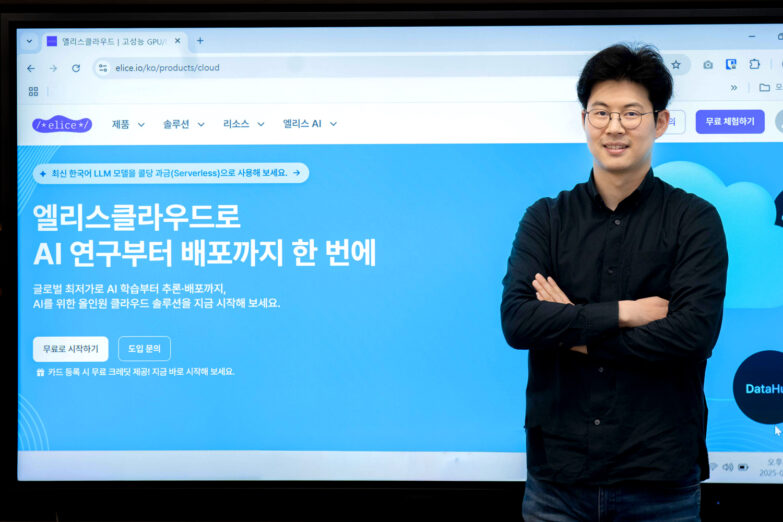
Ellis' core technology is AI PMDC. This technology, called the mobile modular data center, is evaluated as an innovative solution that overcomes the limitations of existing data centers.
“It takes 3-5 years to build an AI-specific data center using conventional methods. However, Ellis’ modular method can be built in just 3 months. This is possible because the equipment is installed inside a container and multiple modules can be flexibly combined.”
To build an AI-specific data center using the existing method, it takes a long time from site selection to design, construction, and equipment installation. On top of that, it has to go through a complicated permitting process. In a situation where time is competitiveness, you can't invest a lot of time in building a data center. Ellis' modular method is to load the necessary equipment into a pre-fabricated container, move the container to the desired location, install it, and connect the power and network to start operating immediately. It only takes three months to build and operate.
It greatly reduces the initial investment burden. Existing data center construction requires huge initial investments in land purchase, building construction, and cooling facility construction, but standardized containers allow for gradual expansion as needed. Modules can be added or rearranged according to changes in demand during operation, optimizing operating costs. Costs can be reduced by more than 77% under the same conditions as global clouds. What is the secret behind this groundbreaking price competitiveness?
“That’s because Ellis developed everything from A to Z in-house. We achieved cost optimization by independently developing cloud software, dynamic allocation technology (technology that allocates computing resources in real time as much as the user needs and returns them immediately when finished), and clustering technology for four years.”
In particular, clustering technology is key. Developing a large-scale language model (LLM) requires connecting thousands of GPUs, not just one or two. Ellis has built the largest clustering environment in Korea using NVIDIA’s InfiniBand technology. By bundling GPUs in units of 10, 100, and 1,000 through InfiniBand, it can meet the demands of various large-scale AI projects.
“Existing data centers are designed to meet the standards of general computer servers. However, AI data centers require 10 to 100 times more power per server than existing ones. A water cooling system is needed to efficiently cool this high power, but existing domestic data centers cannot withstand this load.”
Ellis' PMDC is equipped with a water-cooling system optimized for such high-power, high-heat environments. It efficiently handles heat that cannot be handled by existing data centers' air cooling while minimizing power consumption. In particular, it achieved a PUE (Power Usage Effectiveness Index) of 1.27, showing efficiency that is about half that of the domestic data center average of 2.3.
Another advantage of modularity is security. The container itself is a solid steel structure, making physical intrusion very difficult. Each container is an independent physical space, and since a completely separate container is provided for each customer, the servers and data inside are completely isolated. It is similar to the concept of having multiple separate safes. Thanks to the physical isolation space, it naturally meets the high level of security required by public institutions and financial companies that handle sensitive data or top secrets. This is a particularly strong competitive edge in the domestic environment where concerns about cloud security are high. CEO Kim emphasized, “The first reason for building a modular data center was security.”
Establishing a bridgehead for entering the public market with Korea's first CSAP IaaS certification
It is also thanks to this physical security structure that Ellis was able to receive the CSAP (Cloud Service Assurance Program, cloud service security certification) IaaS certification as the first domestic AI PMDC. CSAP certification requires evaluation of 116 control items in 14 fields, and physical security is one of the key evaluation factors. CSAP IaaS certification means that the security and reliability of AI-specific infrastructure have been officially recognized. With the acquisition of CSAP IaaS, Ellis is expected to expand its position in the public cloud sector in earnest.
“CSAP IaaS certification requires evaluation of 116 control items in 14 areas. Ellis is the only company to receive this certification exclusively for GPUs. Thanks to the certification, we can now participate in various national projects, including AI digital textbooks.”
Currently, Ellis' AI 'Helpi' chatbot in the AI digital textbook for middle school information classes is also operating on this security structure. Students' learning data and personal information are safely processed in a physically isolated environment.
Explosive growth, 9x increase in 6 months
Alice Cloud is growing rapidly. The number of user organizations increased more than ninefold in just six months from November last year to May this year. The number of users increased approximately 74-fold in just 21 months compared to June 2023, when the service was first launched.
“This year, the average monthly growth rate of user institutions is over 50%. As we provide GPUs, which are essential for AI research at domestic and international universities, at the lowest price and fastest, demand is increasing explosively.”
In fact, not only major domestic universities such as Seoul National University, KAIST, and Korea University, but also the University of Minnesota in the United States are conducting AI research using Alicecloud. A doctoral researcher at the University of Minnesota even used Alicecloud to submit a paper to NeurIPS, the world's most prestigious AI conference.
Synergy between education and cloud
The advantage of Ellis is the synergy between AI education and AI cloud. 'Ellis LXP' (Learning Experience Platform) is a next-generation education platform that provides learner-centered personalized education experiences, and all AI practice environments provided by Ellis LXP are built based on Ellis Cloud. This allows learners to practice in the latest GPU environment, and educational institutions can provide high-quality AI education without separate hardware investment.
' Ellis School ' , a leader in public education innovation
Ellis School currently supplies AI digital textbooks for middle school information classes. When students ask questions, the self-developed AI Helpy chatbot answers, and this chatbot is equipped with functions specialized for educational environments such as profanity filtering, hallucination suppression, and compliance with the guidelines of the Korean Educational Compilation Committee. For questions such as “Is Dokdo a disputed territory?”, foreign AI may give answers we do not want, but Ellis’ AI provides answers that fit Korea’s view of history and values. This is an empirical case that shows why AI sovereignty is important in the field of education.
' Ellistrack ' responds to changes in the job market
Ellistrack organizes its curriculum around new jobs emerging in the AI era. It provides training courses in new industries combined with AI, such as autonomous driving engineers, robotics experts, AI business developers, and data center operation experts. It provides experience in directly training AI models in the latest GPU environment using Elliscloud and solving problems that can be encountered in actual industrial sites.
' Ellis Enterprise ' for corporate employees
Ellis Enterprise is being used by over 7,100 companies, from large corporations such as SK, LG, and Hyundai Motors to small and medium-sized enterprises, and provides customized education tailored to the characteristics of each company's work. For example, it provides AI-based quality management or predictive maintenance education to manufacturers, and AI-based risk management or customer analysis education to financial companies.
“Need to create an environment for large-scale investment and human resource development”
CEO Kim emphasized that “cloud should be approached as a software industry, not as simple infrastructure,” and that “development of the software industry is essential to fostering a high value-added cloud industry.” He added that bold investment in the cloud is necessary.
“The cloud is a capital-intensive industry. The US and China have made bold investments in innovative AI cloud startups by governments and investors. However, it is not easy to introduce such innovative businesses in Korea.”
CEO Kim emphasized that the government’s role is important for the development of the Korean AI ecosystem. In particular, he saw the need for expanded support for innovative companies. “True technological innovation and cost innovation are possible only when innovative companies participate.”
He also pointed out that talent is the key to the development of the AI industry. “The AI industry requires complex support from various fields, and talent is one of them. The AI work environment is different from the manufacturing industry, so laws and systems that fit this are needed. It is urgent to create an innovative environment that prevents domestic talent from going to the United States.”
Ellis, Dreaming of an AI Powerhouse
Based on CSAP IaaS certification, Ellis plans to gradually expand its data center business to realize AI transformation (AX) in various national industrial fields such as education, healthcare, and manufacturing. Ultimately, the goal is to build a complete domestic AI infrastructure ecosystem by expanding domestic NPU support and cooperation with domestic AI semiconductor companies.
In the field of AI education, the goal is to expand from the current 100,000 people to 5 million people. The vision is to build a national AI education platform that starts with middle school information classes and expands to elementary and high schools, and further encompasses universities and lifelong education.
Ellis is also considering attracting investment for this purpose.
“I hope our country prospers in the AI era. That is Ellis’ mission and vision.”
President Kim dreams of our country becoming an AI powerhouse. He hopes that when our country is recognized as an AI powerhouse, Ellis will be at the center of it.
You must be logged in to post a comment.