



– Attracting Series A investment and preparing to enter the global market
-Improving research efficiency by reducing document work time and increasing experiment time
– Expansion into materials fields such as secondary batteries and semiconductors
Aant, a research data digitization company in the bio, nano, and chemical fields, is growing rapidly while improving inefficiencies in the research field.
Ant operates the research data management solution 'Labnote' and the AI research assistant 'Labnote Scholar'. Labnote is a tool that systematically records and manages research data through data structure templates, and Labnote Scholar is a service that searches accumulated research data and drafts documents using large-scale language models (LLM). Major research institutes and companies such as Seoul Asan Medical Center, Korea Research Institute of Chemical Technology, and LG Household & Health Care have adopted and are utilizing Ant's solutions.
The bio, nano, and chemical fields are still areas where digital transformation is insufficient, and R&D is expected to grow to approximately KRW 800 trillion by 2025, of which the data utilization market is expected to reach approximately KRW 8 trillion.
Ant has attracted 3 billion won in investment from Mashup Angels, Bluepoint, Strong Ventures, Base Investment, and Smilegate by 2022. In 2024, it was selected for the 'AI Startup Accelerator 2' operated by SK Telecom and Hana Bank and achieved performance close to the break-even point. Ant is currently preparing to attract Series A investment and enter the global market.
■ Improving the outdated analog research environment
Ant's co-founder, who met at KAIST Graduate School of Culture Technology (IT-Humanities Convergence Program), founded Ant in 2020 to improve the analog environment of research sites.
Most companies and research institutes still write research notes by hand. Even when using Word or Excel, each researcher writes in a different format and saves them on their personal computer, making it difficult to manage data systematically. In particular, in the case of handwriting, since researchers record randomly without a standardized format, key information is often omitted or readability is reduced. Research results are only shared through email or messenger, limiting the systematic accumulation and use of knowledge.
Ant CEO Lee Sang-yoon pointed out the inefficiency of the research field, saying, “Whether successful or failed, all research results must be systematically accumulated for follow-up research, but the current analog method does not allow for effective management or utilization of data.”
■ Research data record management… The beginning of digital transformation
In order to solve the problem of inefficiency in the research field, first of all, the digital transformation of research data is necessary. Ant's core competitiveness is the research data standardization technology that systematically manages research data by developing its own algorithm that classifies and tags the conditions of research experiments, materials used, and progress processes in detail, and structures it so that AI can effectively analyze it.
In order to systematically standardize research data, the following step-by-step approach is required. First, through an in-depth analysis of the research data held by the company, the purpose of the experiment, the main materials and equipment used, the research environment, and the process are comprehensively identified, and then the handwritten data is digitized using OCR technology and the research results (reports, papers, etc.) are systematically classified. Once the data organization is complete, a template customized for the company is designed, data tagging criteria are established, the data structure for search and utilization is designed, and a classification system reflecting the characteristics of each research field is established. Data classification is automatically classified using a self-developed algorithm, and accordingly, tagging is performed by experimental condition value, material, and process, and the relationships between data are mapped to convert them into a searchable form. Ant builds an infrastructure that can store and update standardized data in real time, and optimizes the user-friendly interface and linkage with the search and utilization system. Finally, a system for automatic standardization of new data is established, and the existing template and tagging system are continuously improved, data quality is monitored, and the system is advanced.
The representative explained the formalization process, saying, “The research note formatting algorithm records every element of the experimental process in detail. For example, when stirring a specific substance at 30 mm, it systematically classifies and records all experimental conditions, such as the material information, stirring speed, and process.” He also added, “Thesis data has an algorithm that automatically separates and tags the abstract, introduction, chapter, image and image description, and table, so that the necessary information can be accurately extracted.” Ant holds a patent for this data formatting technology.
Ant launched LabNote Mint, a research data management solution for bio, nano, and chemistry fields, and LabNote Orange, a non-clinical and pre-clinical research data management solution, in 2022 and 2023, respectively.
■ Search and report like a research assistant
In 2024, Ant launched LabNote Scala, an AI research assistant that efficiently supports various document tasks in the research process.
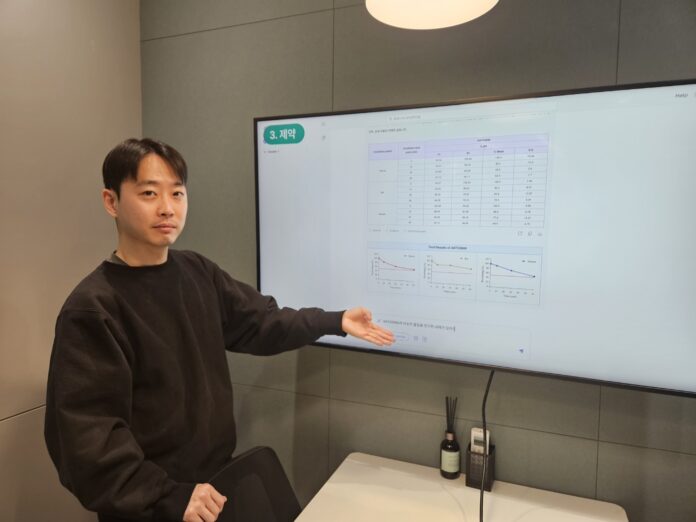
Researchers can automatically draft research notes, reports, and conference materials using LabNote Scala. It also provides functions to analyze research trends and visualize experimental results based on previously accumulated experimental data. In particular, it provides answers to researchers' searches and questions with accurate sources, and has a source management system to prevent hallucinations in AI models. LabNote Scala manages the company's internal research data in an independent environment for data security, and strictly separates and manages it so that it is not mixed with external data.
“When a researcher asks, ‘Please summarize last year’s experiment,’ we provide a standardized report in the form of a Word document,” the representative explained. “We act as an AI research assistant and research secretary for researchers in the bio and nano fields.”
■ Focus on experiments rather than document work
Labnotes have improved the efficiency of researchers' work and have enabled them to secure more than double the amount of time for experiments. According to Ant's research results, when Labnotes were introduced, experiment time increased by 55.8%, and the time for writing research notes, reports, and presentation materials was shortened by 38.2%.
The representative said, “Researchers are highly satisfied with the reduction in additional work. For example, a research paper review that used to take three hours can now be completed in 20-30 minutes. This has allowed researchers to think more deeply about experimental methods and conditions. In particular, they are most positive about the fact that administrative work time has been reduced, allowing them to invest more time in actual research.”
■ Team composed of bio, nano, and chemical experts
Ant has formed a team of experts in the fields of bio, nano, and chemistry. In particular, through a unique job group called ‘Product Specialist’ consisting of experts in the fields of bio, nano, and chemistry, Ant has established an innovative system that accurately identifies customer needs and reflects them in solutions. Product Specialists share specialized experimental terminology and in-depth knowledge during the onboarding and initial setup process for customers, and enable smooth communication between the research site and the service. The service planning team is also composed of experts in related fields, accurately understanding the needs of researchers and quickly reflecting them in service development. Ant is strengthening the overall professionalism of the organization by giving priority to selecting talents with professional experience or academic interest in the fields of bio, nano, and chemistry.
■ Series A investment attraction and full-scale global expansion
Ant plans to fully enter overseas markets this year with Series A investment. It has already successfully completed PoC with leading overseas research institutes such as Stanford and Berkeley, confirming the potential of the global market. Since research notes and research results are in English and the paper format is internationally standardized, Ant's solution has global compatibility. Based on the usability proven in the domestic market, it is expected to secure high competitiveness in the global market as well.
The representative said, “Ant’s value is expected to shine even brighter in overseas markets. In particular, overseas university research labs have higher sales potential because their research budgets are larger than domestic ones. While we have targeted companies as our main target in Korea, we plan to target university research labs as our main customers overseas,” explaining the global strategy.
Ant is currently actively reviewing expansion beyond the bio-chemical field to the materials field such as secondary batteries and semiconductors. The representative said, “The bio-chemical material market is very broad, and we can expand our service area to secondary batteries and semiconductors. There is a high possibility of advancement in the research note business, and ultimately, we aim to provide services for all institutions conducting experiments. Our mid-term strategy is to start with a standard framework for R&D research and develop it into a research note management tool,” he explained the roadmap.
■ “Supporting companies’ own algorithm development by providing high-quality data”
The representative said, “Ant’s ultimate goal is to provide high-quality data to help companies develop their own unique algorithms. The current ‘Labnote Scalar’ is just a small starting point, and we will continue to present innovative cases that companies can utilize AI in various ways in the future.” He continued, “The company name ‘Ant’ was inspired by the characteristics of ants. Ants can lift 10 times their own body weight and have excellent network collaboration capabilities. We, too, want to build an effective network of research data like these ants.”
You must be logged in to post a comment.