



-Madras Check, Celebrating 10th Anniversary, Declares Full-scale Transformation into an AI Company
-Building AI agent functions and new interfaces this year… Targeting 10,000 paid customers and 700,000 users
-“Goal of 200% productivity improvement through fusion of workflow and AI”
Madras Check, the developer of the leading domestic collaboration tool 'Flow', has declared a full-scale transformation into an AI company in celebration of its 10th anniversary. The goal is to build AI agent functions and new interfaces, and to surpass 10,000 paying customers and 700,000 users by this year.
Madras Check is a collaboration solution company founded in 2015. Its main service, 'Flow', and overseas 'Morning Mate' are used by 500,000 organizations in 55 countries around the world. It has attracted a cumulative investment of approximately 18 billion won to date, and has been selected for the Ministry of Science and ICT's Software High Growth Club for two consecutive years and has won the Korea Brand Award for four consecutive years, receiving recognition for its technological prowess and growth potential in the industry. It has overseas corporations in the UK, Japan, and the US, and is actively entering the global market.

'The power of connection makes work easier, faster and more valuable'
This is the phrase on the business card that CEO Lee Hak-jun handed me at the Madras Check headquarters in Yeongdeungpo-gu, Seoul. CEO Lee introduced, “Madras Check’s new mission is to make work easier, faster, and more valuable through the power of connection through AI.” This year, Masras Check established a new mission and declared Madras Check ‘Season 2.’
First, we heard about 'Season 1' from its founding to the present. The core of Season 1 can be summarized as survival, growth, and limitations. Season 1 is divided into 5 episodes.
Episode 1: The Mobile First New Market – Sensing the Changes in the Business Software Market with the Advent of the Smartphone Era
Episode 2: Monetization for Survival – Transitioning from a Free Service to a SaaS Business Model
Episode 3: The World Beyond the Firewall – Building a Barrier to Entry (Mot) by Providing Enterprise-Building Services
Episode 4: The Paradox of the Pandemic – The Expansion of Remote Work Due to COVID-19 and the Rapid Growth of the Collaboration Tool Market
Episode 5: Unsolvable Mysteries – Discovering New Problems Solvable with AI Technology
The survival, growth, and limitations of Madras Check
In 2010, CEO Lee was in charge of building internet banking at Webcash. In 2010, the mobile industry was starting to grow explosively. However, corporate communication tools were still PC-based. Employees had to endure the inconvenience of working in KakaoTalk group chats or Naver Band. Seeing this situation, CEO Lee founded Madras Check in 2015 with the concept of ‘Naver Band optimized for companies.’
Product Strategy : Workflow-based collaboration tool that values relationships
Flow was developed from the beginning to be workflow-based, taking into account the fact that the work environment began to change from a hierarchy-based work environment to a project-based work environment such as outsourcing, freelancing, and contracting.
“While competitors were moving towards messenger-centric collaboration tools, Madras Check focused on workflow management. Chat is important, but we thought it was more important to have tools that could manage and monitor who was doing what and by when.”
The representative defined Flow as a relationship-oriented project social media platform rather than a function-oriented software, explaining, “As the work environment has changed to a project-oriented one, Flow is aiming to invite diverse people and have them participate in projects together to produce results.”
The first two years of Flow’s launch were not smooth sailing. They had hoped to increase users through free services and generate advertising revenue, but the reality was harsh. While experiencing financial difficulties and stagnant growth, they heard the advice from the chairman of Webcash Group that “survival is more important than vision,” and declared a paid service.
Customer Expansion Strategy : Developing Products That Customers Want
As Flow began to grow, inquiries from large companies that had previously been reluctant to use cloud services for security reasons began to increase. Large companies have complex and demanding requirements that general SaaS companies cannot provide. These include requirements for installation inside the firewall, integration with existing in-house systems, strict security standards, and customization for large organizations. While other collaboration tool companies were focusing on SaaS, Madras Check began developing a product that met the demanding requirements of large companies.
When developing flow functions to meet the needs of large corporations, one principle was established. The goal was to meet the needs of the large corporations as much as possible, but also develop the product perfectly as a universal module that other companies could use. Based on his experience in common modular design planning, which involved understanding business logic and designing an expandable structure while working at Webcash, he developed the flow as a universal module that could be used by other customers while also developing it to meet the needs of a specific large corporation.
By meeting the demanding requirements of large companies, the stability, security, and technical capabilities of Flow have been greatly improved, which has soon become the product's competitiveness. Thanks to this common modular design, Masrascheck has been able to secure a variety of customers and currently has a 30% share of domestic large company collaboration tools.
Increase sales through cross-selling
Madras Check has been recording sales growth rates of 30% to 40% every year. One of the biggest factors in sales growth is the expansion of the value-added service business. As Flow became an essential collaboration tool within companies, B2B service companies began to reach out first, and as sales power grew, Madras Check jumped into the value-added service business in earnest.
Currently, Flow provides nine additional services, including office tools (MS Office), video conferencing (Zoom), electronic approval, electronic contracts (Sign Together), attendance management (Time In Out), expense management (Biz Play), mobile meal tickets (Bipple meal tickets), business platform (Gainji Campus), and document format provision (Yes Form). The free groupware function that allows the use of corporate email, electronic approval, and shared calendars at no additional cost is also an extension of this platform strategy.
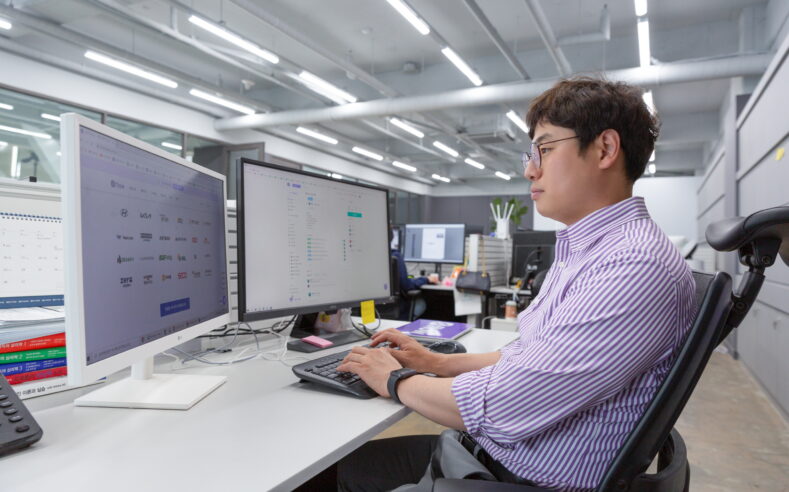
Madras Check, which seemed to be only going to continue to grow, is now faced with a problem that it still cannot solve.
- Difficulty getting started: Even with good tools, customers don’t know how to get started.
- Limitations of information retrieval: A lot of data is accumulated, but search functions are lacking.
- Manual Report Writing: Still Creating Weekly Reports in PowerPoint
- Reliance on existing tools: Unable to move away from familiar tools such as KakaoTalk and email
- Missed and unmonitored tasks: The problem of missing or poorly managed important tasks.
While we were pondering how to solve this problem, AI technology appeared.
“These problems were difficult to solve with technology until now, but AI is starting to solve them. The vision of Netflix’s founder was ‘to allow customers to conveniently watch movies at home.’ It started with DVD mail rental in 1997, and 10 years later, in 2007, it started the OTT service. As technology advanced, problems that had been unsolvable suddenly began to be solved.”
Just as Netflix transitioned from a DVD mail-in rental business to an OTT business as AI technology began to solve previously difficult problems, Flow is now entering its second season.
Season 2: Re-entrepreneurship in the AI Era
Flow 4.0 and Mate X Strategy
This year, Flow announced Flow 4.0, which features AI agents at its core. AI features are integrated into the brand called 'Mate X'.
“The Mate X organically integrates AI with Flow’s 10-year accumulated business/collaboration data structure. By combining GPT functions and RAG (Retrieval-Augmented Generation) technology, we maximized accuracy and effectiveness.”
Madras Check is currently developing five AI features and plans to launch them in September.
- AI Project Wizard: When you tell AI, “Prepare a pop-up store for the launch of a new cosmetics product,” it analyzes internal and external data, structures the necessary tasks, and even assigns people in charge.
- AI Smart Search: Searches and summarizes accumulated data such as chats, posts, and work history within the flow like Perplexity. If you say “Find the quotation I sent to Madras Check last year” using your voice on your mobile phone, it will provide search results immediately.
- AI Insight Report: Automatically generates reports like Claude. When you input the prompt “Write a weekly report,” it analyzes the work status and remaining tasks for each person in charge and provides a completed report.
- AI Omni Assistant: Automatically registers tasks that occur in emails or chats into the flow. When you receive an email asking you to “send a quotation for 100 people,” AI automatically registers the task of sending the quotation.
- AI Reminder: A personalized assistant function that reminds you of your schedule, deadlines, and priority tasks every morning.
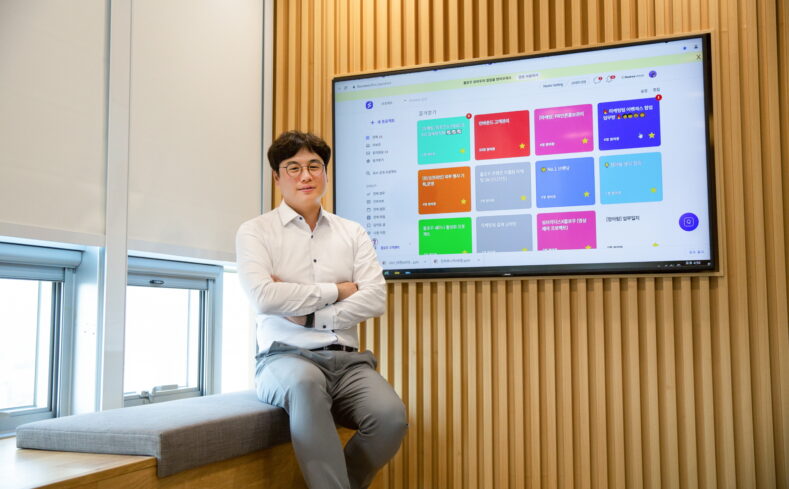
Essential Conditions for Re-establishment as an AI Company… UX Revolution
The representative defines AI as a completely new interface, not just an add-on.
“The logic of banking operations has not changed for 30 years. Basic functions such as transfers, inquiries, and automatic transfers remain the same. However, what was handled by tellers in the 1990s has changed to public certificates in the PC era, and to apps like Toss in the mobile era. Ultimately, it is a revolution in UX.”
The core business logic has been the same for 30 years, but the revolution in the interface has led to a completely different experience. The same goes for Flow. The CEO believes that the basic logic of conversation, workflow, and schedule management remains the same, but it needs to be transformed into a new AI-based interface.
“I didn’t think it was enough to just make Flow better by adding features. I thought Flow needed to be completely redesigned, and to do that, I thought I had to provide a new interface.”
In order to completely change the UX of the product, Madras Check changed its organization to an AI organization. Not only did all employees have to use AI tools, but the organizational culture was also changed, such as sharing AI use cases.
“If an AI company fails to utilize AI, I think it is fraud. We are actively encouraging the use of AI, and we reflect best practices in AI utilization in personnel evaluations and provide overseas training opportunities.”
“Now is a time of upheaval where Mot is weakening… High possibility of reversal”
“In these turbulent times, the absolute powers fall and new powers rise, and the tide changes. It is the point when the moat (moat. Originally referring to the moat (垓字) surrounding a medieval castle, it refers to a defensive ditch filled with water. In economic/business terms, it means competitive advantage and barriers to entry. It is also famous as an investment term frequently used by Warren Buffett, and means a sustainable competitive advantage that a company can protect itself from competitors.) is weakened.”
The representative said that there is a possibility of a reversal through AI in competition with existing powerhouses. He analyzed that existing powerhouses, like OOO, which had many functions but failed to optimize for mobile, may not be able to adapt to the AI era.
A new future created by the power of connection
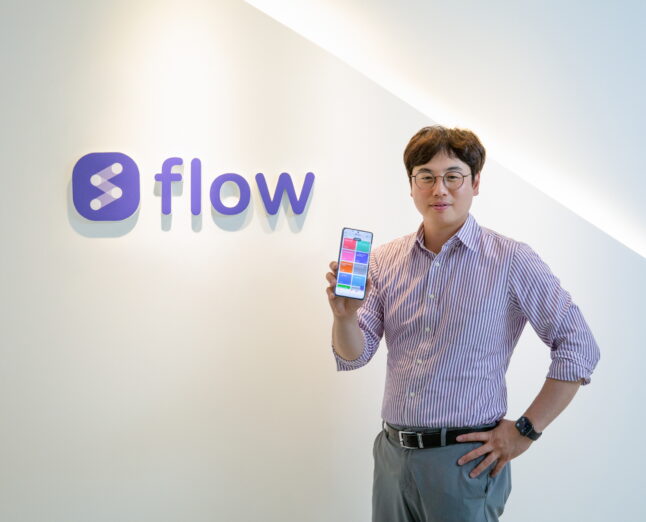
At the end of the interview, CEO Lee Hak-jun explained Flow’s ultimate vision as follows.
“Our mission is ‘making work easier, faster, and more valuable with the power of connection.’ Our goal is to improve productivity by 200% by converging workflows and AI with the power of connection through AI.”
Madras Check, which started as the first in-house venture of Webcash in 2015, has grown into a representative domestic collaboration tool in 10 years and has now declared its re-establishment as an AI company. This is not a simple evolution of the company. It is an expression of the will to fundamentally change the way of working itself.
“The 10th anniversary is not an end, but a beginning. We’re going to show you how Flow can change the way you work and make your entire organization more agile and smarter.”
The entrepreneur's dream becomes reality, and reality becomes the starting point of another dream. It remains to be seen what kind of innovation Madras Check Season 2 will bring, and how that innovation will change the way we work.
You must be logged in to post a comment.