



– Commercialization target for 2027… 1/5 the weight, 28% efficiency” Next-generation space solar cell development accelerated
– Presenting sustainable space energy solutions, from small satellites to deep space exploration
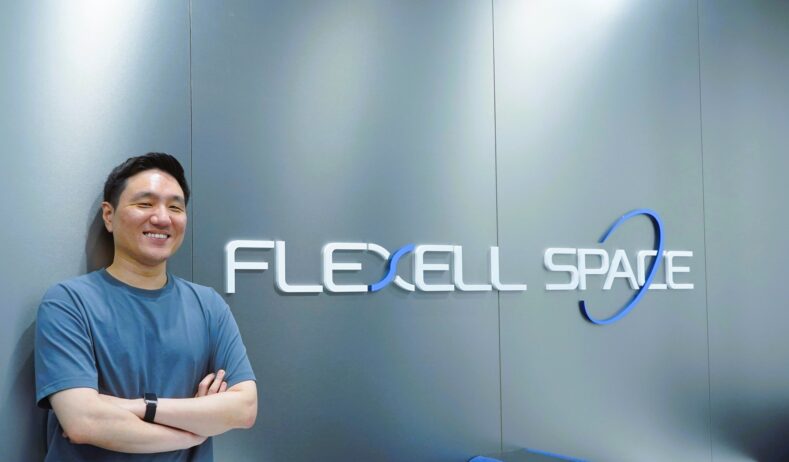
Bachelor of Science in Aerospace Engineering from Ohio, USA, laying the foundation with experience in the space industry
Flexelspace CEO Taehoon Ahn earned his Ph.D. in Aerospace Engineering from Ohio State University in the United States, building an academic understanding of space science and energy technology. Since then, CEO Ahn has gained extensive experience in the space solar cell market at Hanwha Corporation and Hanwha Systems. In August 2023, through Hanwha Systems’ in-house venture incubation program, his technological prowess and business potential were recognized, and he received equity investment from Hanwha Systems to establish Flexelspace.
‘ Ultra-light and flexible’ reduces launch costs and maximizes design freedom
In the interview, CEO Ahn clearly pointed out the chronic problems of existing space solar cells.
“Existing space solar cells are mainly made of gallium arsenide solar cells, which are expensive, can only be produced in small quantities over a small area, and are easily damaged. This not only greatly limits the freedom of satellite design, but is also a major cause of enormous costs during launch. In particular, in cases where efficient power generation is required within limited size and weight, such as small satellites or CubeSats, existing methods will inevitably reach their limits.”
Starting from this problem awareness, Flexcel Space succeeded in developing a 'flexible, ultra-light, high-power solar cell array optimized for the space environment'. CEO Ahn said, "Our core technology is that it is remarkably lighter than existing ones (one-fifth to one-tenth the weight), can be stored and deployed in a rollable or foldable form, and has the flexibility to be applied to various satellite structures. This contributes greatly to reducing launch costs by drastically reducing the launch mass and volume when launching a satellite, and drastically increasing the freedom of satellite design."
'High-efficiency, high-durability' technology that can withstand extreme space environments
Flexcelspace’s technological prowess does not stop at simple weight reduction and flexibility. “Space is a harsh environment with strong radiation, extreme temperature changes, and micrometeorite collisions,” said CEO Ahn. “Our solar cells are designed to operate stably and maintain high efficiency even in these extreme space environments. In particular, we applied our own technology to enhance radiation resistance and thermal stability, ensuring durability for long-term mission performance.”
CEO Ahn said the goal is to put solar cells on the market around 2027.
PlexelSpace's solar cells, which combine high-power power production capability with stability in extreme environments, are expected to be a new turning point in the new space era.
'Sustainable Space Energy Solutions' for ' Small Satellites and Deep Space Exploration'
FlexcelSpace's flexible solar arrays have unlimited potential for a variety of space activities beyond the small satellite market. Key applications include small satellites and CubeSats, space mobility (e.g., spacecraft propulsion systems), space probes, and future space stations and in-orbit servicing.
“By suggesting a new way to create energy in space, we aim to contribute to making space a sustainable space,” said CEO Ahn, emphasizing FlexelSpace’s vision. “FlexelSpace’s solar cells will help more satellites operate in space for longer periods of time, and will be a sustainable space energy solution that plays an essential role in expanding the scope of human space exploration. In particular, our flexible solar cells will play an even more important role in the future space industry where they are assembled or recycled in orbit.”
The ultimate goal of Plexelspace is not simply to develop solar cells for satellites, but to develop all solar cells used in space. “As space solar cell technology advances, we will be able to collect sunlight in space and transmit it to Earth,” said CEO Ahn. “Space solar cells will also be needed to supply energy through sunlight on the planets that humans will migrate to.”
You must be logged in to post a comment.