



-Revolutionizing the opaque waste industry structure with direct systems and digital tracking
– Strengthening customer trust with 'Earth-friendly', leap forward as a climate tech company based on AI and big data
“Processing is not the end, it’s the beginning.”
A heat supply facility located on one side of the Pocheon Industrial Complex in Gyeonggi Province. Behind the white smoke rising from the chimney, abandoned waste wood is reborn as steam, steadily supplying heat energy to 43 dyeing complex companies. Behind this site where waste becomes energy is Cheonil Energy, which practices the philosophy that “everything is energy.”
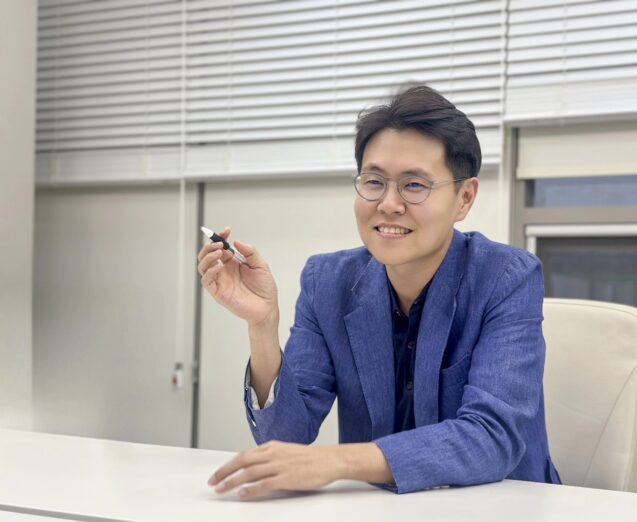
CEO Park Sang-won (45) says, “Waste is not about getting rid of it, but about making it come back.” Cheonil Energy has established a full-process direct waste treatment system that is rare in Korea. Therefore, it operates from collection to intermediate treatment to energy conversion with its own ERP and GPS-based tracking system. The key is to minimize landfill and incineration and to circulate all resources.
The reasons for choosing this system are clear.
“The more we rely on the consignment structure, the more opaque the processing process becomes, and structural problems such as illegal dumping, landfill dependence, and information disconnection are repeated,” explains CEO Park Sang-won. Cheonil Energy goes beyond these limitations and directly manages the entire process from collection and transportation to intermediate and final processing and heat energy conversion using a waste ERP system. In addition, it tracks and manages in real time using a digital system based on AI, big data, and GPS.
Answers found on site, confidence in 50 billion won investment
CEO Park Sang-won’s steps were ‘on-site’ from the beginning. After learning the entire company for four years at the planning office of Hanwha Group, he took charge of assembly and delivery at the Sihwa factory at the age of 29 to help his father’s lighting business. At that time, he gained the conviction that “all answers are in the field,” and his philosophy is at the center of his management.
After that, he purchased 50,000 pyeong of ginseng fields in Buan-gun, Jeollabuk-do and converted them into solar power plants, forming a connection with the energy industry. The turning point was the heat supply project in the Pocheon Dyeing Industrial Complex in 2011. “When I saw the structure where dyeing companies burn BC oil in individual boilers and integrate the harmful gases generated into a single chimney to process them in an eco-friendly way, I got the idea to use waste wood as fuel here.”
At that time, the cost of waste wood disposal from 800 furniture factories in the Pocheon area was a huge burden, reaching 100,000 won per ton. However, they saw the potential in using this waste wood as fuel to reduce disposal costs and supply eco-friendly steam. This is the background to investing approximately 50 billion won, which was a considerable amount for a small business, to establish and operate an incinerator.
“At that time, I traveled around the country to local governments to secure stable supply of waste wood. I personally designed a free treatment model that minimized distribution stages and costs. This experience became the starting point of Cheonil Energy’s current field-oriented execution philosophy of ‘seeing, moving, and solving directly.’”
Earth, a signal of change thrown into an opaque industrial structure
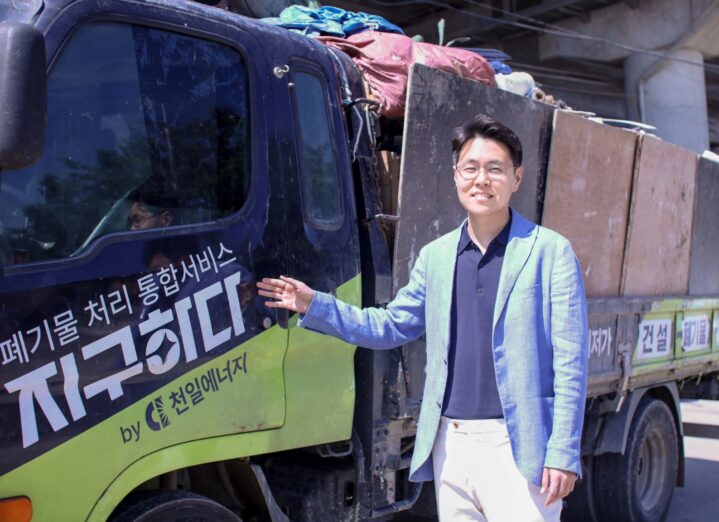
The brand you encounter on site is not 'Cheonil Energy' but 'Jiguhada'. Jiguhada, a subsidiary of Cheonil Energy, is a front-line brand that takes charge of everything from waste collection and transportation to reception and monitoring. On the other hand, the parent company Cheonil Energy operates collection centers, intermediate treatment plants, crushing plants, and power plants across the country, and is responsible for the back end to ensure that the waste collected by Jiguhada is safely recycled.
There is a structural reason for this brand separation. Before the advent of Jiguhada, the construction site waste disposal market was rife with outsourcing companies, illegal landfills, and incineration, centered around small and medium-sized sites. The estimation criteria were also unclear, and there was no way for customers to check whether or not actual disposal was being done. There were frequent cases of illegal disposal at low prices even after receiving disposal fees from customers. A representative example is the 170,000-ton 'garbage mountain' piled up in Uiseong, Gyeongbuk.
CEO Park Sang-won explained the reason for the brand division as “to break the information asymmetry and opacity that were major problems in the waste industry.” Since the introduction of Jiguhada, customers have been able to check the quotation, collection, and processing history in real time through a dedicated app and ERP. Unnecessary intermediate steps have been eliminated, resulting in cost reduction and trust restoration at the same time.
“Customers can check the status of estimates, receipts, collections, and processing all at once through a single window called Jiguhada, and behind that, Cheonil Energy takes responsibility for recycling and energy conversion with its nationwide network infrastructure to create actual ESG results.”
The collaboration with Alsquare is a representative example. By collecting waste less than 5 tons generated from construction sites, interior design sites, etc. as “construction site waste” according to legal standards and recycling all of it, a structure was created to achieve ESG goals. As a result, processing costs were reduced by an average of 5% or more, and carbon dioxide emissions were also significantly reduced.
Cheonil Energy operates centers (collection and transportation), hubs (temporary storage), and factories (intermediate/final processing) in 23 locations nationwide, including the metropolitan area. GPS-equipped dedicated collection vehicles and arm roll boxes, the headquarters’ integrated ERP, and the electronic transfer system are all connected to track the entire process from waste reception to collection, movement to collection and intermediate processing sites, and final processing in real time. Thanks to this, all flows, from where the waste is generated, through which route it moves, and how it is processed and recycled, are transparently recorded in compliance with legal standards.
When Digital Technology Meets ESG
The difference of Cheonil Energy comes from the synergy of digital technology and ESG. Recently, when a vehicle enters the parking lot, AI automatically analyzes the nature of the waste and data-processes the images captured by the camera to predict what type and how much waste has entered.
“Customers can see at a glance which waste is transported by which vehicle and where it is processed. They can directly verify that 100% of the waste is recycled and no unnecessary landfill or incineration occurs.”
Internally, by digitally connecting all collection, transportation, weighing, and processing data, we have reduced waste of manpower and duplicated costs, and increased on-site operational efficiency. Thanks to this, our customers can simultaneously reduce processing costs and secure ESG data, and based on this accumulated data, Cheonil Energy can prove for itself where waste is generated and how much of it has been recycled.
CEO Park Sang-won said, “In the future, we plan to establish ourselves as a climate tech company that manages resource flow based on AI and big data, rather than a simple waste disposal company.”
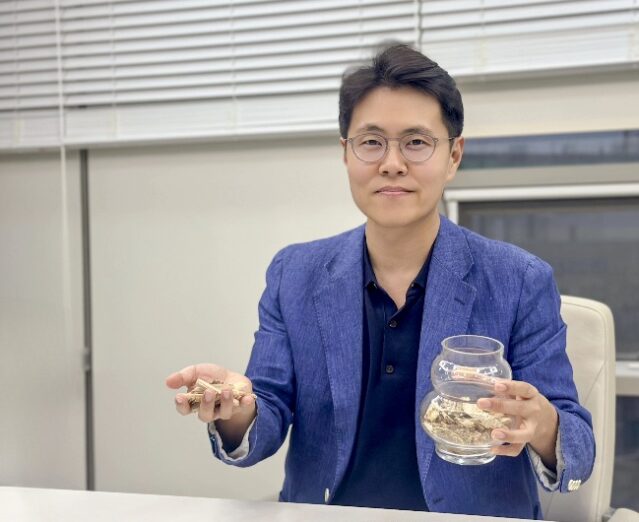
The final product, called wood chips, is also noteworthy. The wood chips processed by Cheonil Energy are divided into two types. The first is 'waste furniture wood', which is produced at a scale of about 2.5 million tons per year. It consists of large household waste discarded by citizens, by-products from furniture factories, and waste wood from demolition sites, and is processed into Bio-SRF (wood chips). The processed wood chips are used to produce steam at the Pocheon Power Plant, which is directly operated, and supplied to the dyeing complex, or as a fuel that can replace fossil fuels, they are supplied to the combined heat and power plant to produce heat and electricity.
The second is 'timber waste', which is generated at about 1 million tons per year. It is generated from national forests, private forests, and development sites. Recently, demand for unused forest biomass is rapidly increasing as it receives Renewable Energy Certificates (REC). Good wood is recycled into plywood or boards, and other unused wood byproducts are processed into wood chips and used as biofuel for coal-fired power plants.
“Wood chips made from waste wood produced domestically are not just byproducts, but are valuable resources that should be managed at the national level. These wood chips can not only replace imported wood pellets, but also contribute to reducing our dependence on coal and nuclear power plants, making them ‘good fuel.’”
Park Sang-won’s view on the greenwashing controversy is also clear. “It is encouraging that global companies and large corporations are actively implementing ESG campaigns,” he said, but emphasized that “in order to remove the stigma of greenwashing, it must ultimately lead to a ‘profitable structure.’” He said that this market can only open in earnest if products made by recycling waste discarded by these companies are competitive in price with products made from new materials.
Small and fast organization, field-oriented execution capability
Cheonil Energy’s internal organizational culture is also unique. CEO Park Sang-won said, “We aim to be a small and fast organization.”
“The waste management industry may seem simple, but it is actually a field where field experience, complex permits, and resource management technology are all intertwined. Someone called this industry ‘experience engineering,’ but it is an area that cannot be easily approached without first-hand experience sorting waste, encountering regulations, and solving problems.”
So, rather than perfection, we value fast execution and problem-solving skills. Small mistakes are allowed, but talents who can quickly improve and move forward are well-integrated into the organization. Internally, we reduce unnecessary reporting procedures and give maximum authority to practitioners so that they can make quick decisions on the spot. At the same time, we share feedback on decisions without delay, and operate in a way that balances individual responsibility and organizational flexibility.
“Ultimately, the talent we value is a person with the ability to execute, who is not afraid to face challenges in the field and solves problems as if they were ‘their own work.’ Safety and sustainability are the basics, and we believe that trust with customers is built on this attitude and philosophy.”
The image of Cheonil Energy 10 years from now, as envisioned by CEO Park Sang-won, is clear. The domestic waste market is officially estimated to be worth about 100 trillion won, but it could actually be more than that. This is because there are many areas that are not captured in statistics due to cash-based voice transactions and opaque distribution structures.
“Cheonil Energy wants to contribute to legalizing and legitimizing the waste market, which has been rife with illegality and inefficiency, to the level where it is recognized as a national infrastructure industry such as roads, ports, and airports. Our goal is to make waste respected as an ‘industry’ and establish it as a sustainable industry group.”
He believes that the responsibility of a company is to ‘create jobs’ and diagnosed that the waste industry was established through the efforts of the first generation of seniors, but is now becoming an industry that is increasingly avoided as it transitions to the second generation. “If we leave this trend unattended, it will be a great loss for the country in terms of maintaining employment. That is why we are working to improve the poor on-site environment and create quality jobs where anyone can work with a sense of mission.”
A recent example is the agreement with Korea Expressway Corporation. By disposing of timber waste free of charge, the company has achieved an annual budget saving of approximately 50 million won. At the same time, it has set a good precedent for ESG practices by donating 10 million won to the Expressway Scholarship Foundation and creating a structure to return part of the profits from waste recycling to society.
“I hope that even in 10 years, Cheonil Energy will be remembered as a company that ‘makes discarded resources reusable.’ I believe that waste should not be eliminated, but should be returned, and that this flow should be visible to everyone.”
CEO Park Sang-won said, “We want to remain as a company that sets the standard for resource circulation in Korea.” “We want to create a ‘standard for resource circulation’ so that discarded resources can brighten the city and the process can be proven to everyone without being hidden. I think that is the role that Cheonil Energy should play in the future.”
As we approach the era of total ban on direct landfill of household waste in the metropolitan area by 2026, the 'Everything is Energy' philosophy practiced by Cheonil Energy is gaining attention as a realistic alternative for a sustainable future, rather than a simple slogan.
You must be logged in to post a comment.