


– ‘COLO AI’ and ‘FD’… Realizing flexibility and on-site presence, which are the core values of logistics
– Innovative model utilizing existing warehouse network, average annual growth of 191% over 6 years
– Digital transformation of existing warehouses and establishment of 53 global bases… Challenge to become a logistics hub in the Pacific region
Colosseum Corporation (hereinafter referred to as Colosseum) is an innovative model that digitally transforms existing warehouse resources and idle manpower, and has established a network of 53 logistics centers around the world. It is also innovating complex logistics processes with its self-developed SaaS solution 'COLO AI' and logistics expert 'FD (Fulfillment Director)' services.
Even amidst the recent investment wave, it attracted KRW 27 billion in Series B investment, ranking third in the amount of investment attracted in the logistics and distribution sector in the first half of 2025. This is the result of remarkable achievements such as KRW 100 billion in cumulative sales and 6 million monthly logistics processing. In particular, it achieved the triple crown of innovation certifications such as Innobiz (technological innovation), ISO (quality and environmental management), and Mainbiz (management innovation) along with overwhelming quality indicators such as delivery accuracy of 99.9% and inventory error rate of 0.02%. It is also accelerating its global expansion by operating 12 overseas bases including the US, Japan, and Southeast Asia.
How did the Colosseum grow so much in just six short years?
“When I personally checked the logistics site, I found that the warehouses were being operated in an outdated manner, at a level from 20-30 years ago. The distribution industry is rapidly developing into e-commerce, but the logistics system is not keeping up.”
Distribution is rapidly evolving through digital innovation, but logistics is still stuck in the analog way. The startup team found an opportunity here. They began to think about how to solve the gap between rapidly growing distribution and stagnant logistics. That is how Colosseum was born.
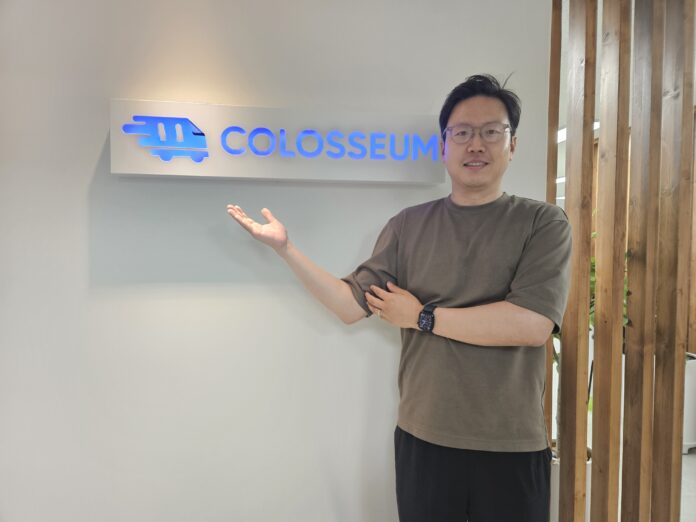
We met with CEO Jin-soo Park at the Colosseum office in Gangnam, Seoul, to talk about Colosseum’s six-year journey, its logistics innovation services, and future plans.

The core values of logistics are flexibility and on-site presence.
“Sellers create and sell products that the market wants. However, logistics only provides services within the scope of their capabilities, and often predetermines what they can and cannot do. I think logistics must somehow realize what the customer wants.”
Unlike existing warehouse companies that only provide logistics within their own capabilities, Colosseum actively seeks out logistics methods to realize customer requirements. This philosophy on logistics is in line with Colosseum’s mission of ‘leading customers’ businesses to success through logistics.’
Mr. Park emphasized ‘flexibility’ and ‘on-site presence’ as the necessary logistics to help business owners succeed. Flexibility and on-site presence are the concepts that form the basis of Colosseum’s technology strategy.
Flexibility means the ability to respond quickly to the diverse and changing needs of customers. This is the reason why we built an 'intelligent logistics ecosystem' that detects changes in customer needs in real time and automatically finds and provides the optimal solution. Field-sufficiency is the concept that logistics systems and processes must operate smoothly and be practical in the actual field. No matter how excellent a system is, its utility will inevitably vary depending on how it is used. In order for field workers who are responsible for a wide range of tasks from customer response to delivery to effectively use the system, it is essential to accurately understand the field situation.
'COLO AI' and 'FD (Fulfillment Director)' are Colosseum's technologies and systems that realize flexibility and on-site presence in logistics.
Adding Flexibility to Logistics… COLO AI Creates Logistics Innovation
Colo AI analyzes massive data accumulated in the field (product information, sales data, inventory data, delivery data) in real time to provide the optimal solution. It is a system that integrates order management (OMS), warehouse management (WMS), and transportation management (TMS), optimizing the entire logistics process based on AI to flexibly respond to various situations.
The key is data. A large amount of data is accumulated throughout the entire process of goods being received, stored, and shipped. Product information, sales data, inventory data, and delivery data are accumulated and analyzed in real time, and logistics methods appropriate to the situation are recommended.
“The order requests that need to be processed in the warehouse are different every day. We analyze the order data and the data processed previously to recommend the picking (picking up products) and packing (packaging) method that can process the orders most efficiently that day.”
The optimization functions provided by Colo AI are very specific and practical.
- Picking and Packing Optimization: Data-based recommendations for the most efficient product collection and packing method, considering the characteristics of same-day orders
- Automatic box size recommendation: Selects the smallest yet safe box size by considering the number of packages, weight, and handling precautions.
- Real-time shipping cost optimization: In cases like the US, shipping costs change in real time, so we recommend the lowest shipping cost to reflect this.
- Transport route optimization: Optimization that considers load factor rather than simply the shortest distance
- Automatic settlement system: Records logs of all operations and automatically settles the entire process from receipt to shipment and return.
The results of this technology are proven in numbers. The amazing figures of 99.9% delivery accuracy and 0.02% inventory error rate are far higher than the industry average. In addition, through logistics data integration and value chain efficiency, work hours are reduced by approximately 50%.
“The process of handling logistics must be digitized in order to solve current problems as well as more difficult problems in the future. The value that Colosseum provides to customers is to optimally handle logistics with solutions, software, and data as the foundation.”
Communicate with the 'FD' who knows the field best
Another innovation of Colosseum is the creation of a new job title called FD (Fulfillment Director). The role of FD is a unique position not found in the existing logistics industry, and is a professional coordinator who connects the two areas of warehouse work and customer service. They are in charge of communication between field workers and customers and play a key role in problem solving. CEO Park explained the main job of FD as “managing the overall logistics process with COLO AI solution, monitoring areas that software cannot cover, and solving various actual issues.”
The triangular communication structure between 'customer-FD-warehouse' brings benefits to all participants. Customers receive intensive customized services from logistics experts, which increases their satisfaction, and warehouses can focus solely on logistics work without the burden of customer service, which maximizes efficiency. FDs also use their professional experience to provide value to both parties, which leads to high job satisfaction.
FD is a professional with practical experience in the logistics field, and has in-depth understanding and know-how about the industry. Colosseum has built a system that automatically matches the most suitable FD by comprehensively analyzing the characteristics of the product handled by the customer, the delivery method, and the industry.
Colosseum operates a systematic training program to strengthen the capabilities of FDs. It provides various training courses to help them grow into all-weather logistics experts, and continuously improves their expertise through customized onboarding programs whenever their work area expands, such as global logistics or new product group management. Currently, about 40 FDs are active.
Building a global logistics network
The system alone has its limitations. In order to deliver the products customers want, in the way they want, to the places they want, an organic network of logistics centers with various locations and functions is essential.
Colosseum does not build its own logistics center, but forms an efficient network by forming strategic partnerships with warehouses that are already in operation. Colosseum’s logistics network is based on a global alliance of more than 53 logistics centers around the world. Of these, 12 bases are operated overseas, with six in the United States and the remaining six strategically located in Japan and Southeast Asia.
The domestic logistics center network has a total storage capacity of 246,000 pallets in a total area of 581,000 square meters (approximately 176,000 pyeong), including 157,000 pallets for room temperature storage and 89,000 pallets for low temperature storage. It consists of 8 locations in Seoul and Incheon, 22 locations in southern Gyeonggi, 6 locations in northern Gyeonggi, 2 locations in Chungcheong, and 27 locations in Gyeongsang. These centers have specialized functions such as packaging, warehouse and miscellaneous goods, and hazardous materials, responding to various logistics needs of customers.
The most notable part of the overseas network strategy is the expansion into the US market. Currently, six centers are being operated in California in the western US, but by 2025, they plan to expand to New Jersey, Atlanta, Chicago, and Texas in the eastern US, thereby establishing a network at the US-wide level. If LA serves as the gateway to Asian logistics, the eastern New York region is the key market with the largest population and highest purchasing power in the US.
We are also actively expanding in the Asian region. We are currently pursuing the establishment of a Japanese corporation, and we plan to establish a Singapore corporation in the second half of 2025. We are also accelerating our entry into the Southeast Asian market by securing bases in Thailand, Vietnam, Malaysia, and Taiwan.
All of these logistics centers are managed in an integrated manner through Colosseum's self-developed SaaS solution, 'COLO AI'. Here, approximately 40 logistics experts FD coordinate and optimize the operation of each center in real time.
Through this innovative network model, Colosseum has built a differentiated competitive edge by providing global logistics services without the burden of high fixed costs, while at the same time providing customized logistics solutions tailored to the characteristics of each region.
Dreaming of becoming the best logistics hub in the Pacific
“Colosseum aims to grow into the best logistics company between countries located in the Pacific.”
Colosseum aims to become a cross-border logistics DX platform that most efficiently connects the U.S. market with major Asian markets such as Japan, China, and Korea. With the global popularity of K-culture, K-goods, and K-beauty, Korea’s excellent quality products are continuously being exported overseas, and Colosseum’s vision is to build a logistics service optimized for global e-commerce and cross-border trends.
Colosseum is gradually securing 100 global logistics bases with specialized functions such as cold storage, cosmetics handling, and customized packaging.
Colosseum, which recently succeeded in attracting 27 billion won in Series B investment, plans to use most of the investment for global expansion. It plans to strategically invest in all areas necessary to establish a position in the global market, including technology development, local recruitment, local marketing, sales activities, and employee travel expenses.
“We plan to expand our domestically proven solutions overseas. The logistics industry has a much larger market size and growth potential on the global stage than in the domestic market. We believe that the IT solutions and SaaS solutions we have developed are sufficiently competitive for overseas logistics warehouses, distributors, and manufacturers, and our goal is to fully enter the global logistics IT market.”
Colosseum, which continues to grow rapidly, has incorporated two core values into its organizational culture: promise and collaboration. Colosseum considers thorough fulfillment of all promises, including sales plans, business expansion, and lead time promises to customers, as core values of the organization. In addition, since it is structured to secure space and operate logistics business through cooperation with general warehouses or warehouse operators, collaboration is the most essential foundation. Based on the philosophy that smooth collaboration should be achieved internally as well as externally, it is strengthening the culture of collaboration through empathy, communication, active questions, and discussions.
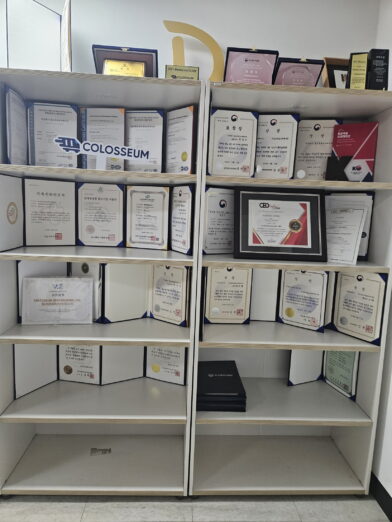
It is by no means a coincidence that Colosseum, which views logistics as a core element of business success beyond the concept of simple transportation or storage, has grown into a company that leads AI-based logistics innovation by operating 53 bases around the world. This can be said to be an inevitable result of an organizational culture of keeping promises and collaboration.
Colosseum’s vision of leveraging Korea’s geopolitical location to become a logistics hub in the Pacific region is noteworthy. The goal of helping global businesses succeed through digital innovation in the logistics industry is becoming a reality.
You must be logged in to post a comment.