



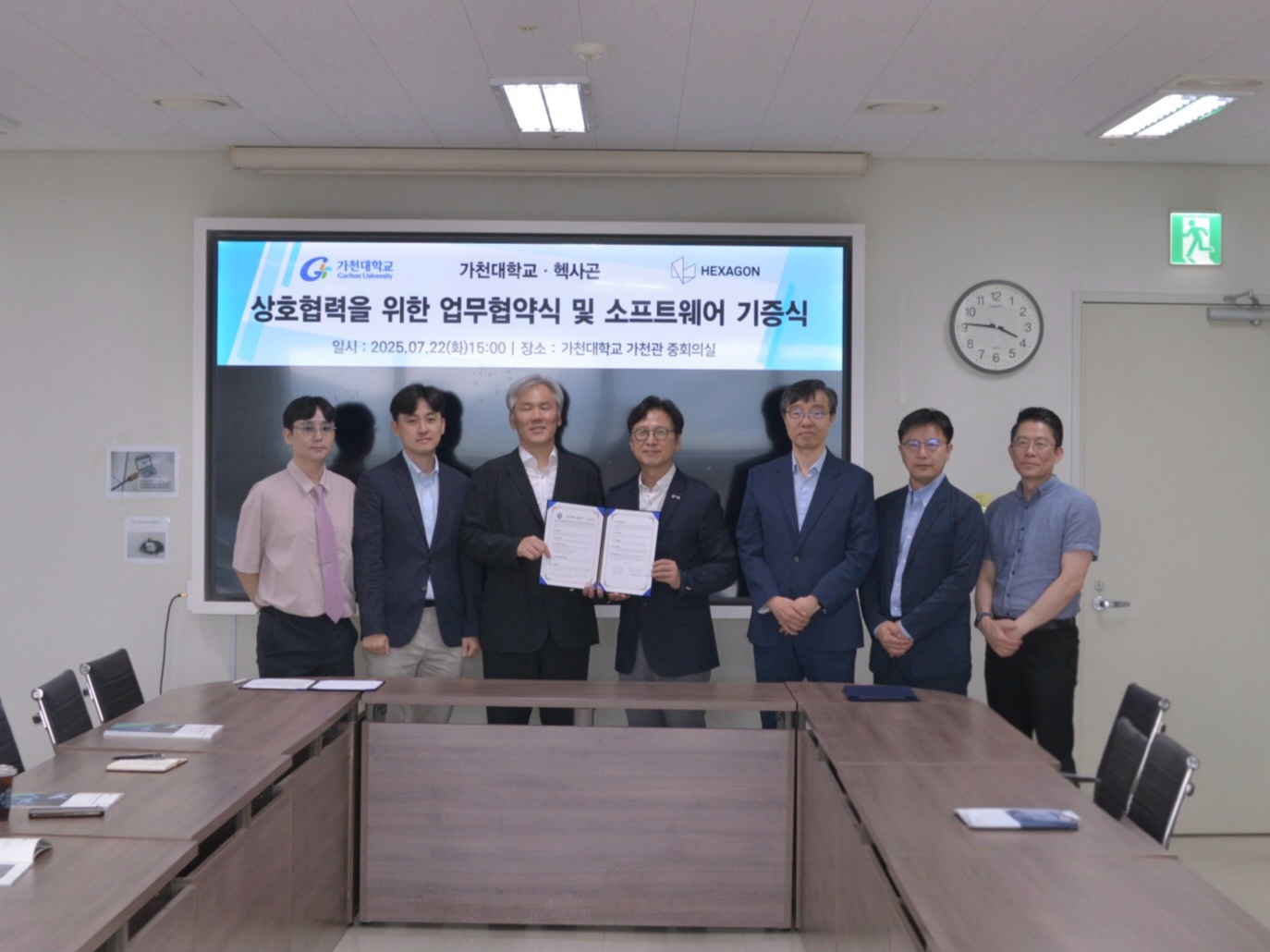
Hexagon Manufacturing Intelligence (Hexagon) announced on the 22nd that it signed a Memorandum of Understanding (MOU) with Gachon University (Gachon University) for industry-academic cooperation to foster specialized talents in the field of 3D-based design and analysis.
The signing ceremony was held in the medium conference room of Gachon Hall at Gachon University, and was attended by Dean Dae-ho Lee of the Department of Mechanical Engineering at Gachon University, Professors Kyung-jun Lee and Pyeong-sik Ma, as well as Director of Channel Sales Group Hong Heung-seop and Director of Technology Headquarters Jeon Wan-ho of Hexagon Design & Engineering (D&E) Division, who discussed future cooperation plans.
Through this agreement, Hexagon will provide its integrated engineering simulation software, MSCOne, to Gachon University. The two parties will jointly design a practical curriculum that reflects industry demand and operate a practice-oriented education so that students can acquire the practical capabilities required in industrial settings.
'MSCOne' is an integrated simulation solution that can respond to the design and analysis needs of various industries, and includes ▲'Cradle CFD' for fluid analysis, ▲'Actran' for noise analysis, ▲'MSC Nastran' for structural analysis, ▲'Adams' for multi-body dynamics simulation, ▲'Simufact' for manufacturing process simulation, ▲'Digimat' for composite material analysis, etc. These tools support various functions such as multi-physics analysis, virtual manufacturing simulation, material-based analysis, and AI-based simulation.
Lee Dae-ho, Dean of the Department of Mechanical Engineering at Gachon University, said, “As the importance of digital manufacturing technology and simulation capabilities grows, this agreement will provide a foundation for students to systematically develop practical skills through hands-on experience with cutting-edge software.”
Hong Heung-seop, head of Hexagon D&E division, said, “Through this collaboration, we plan to continuously support Gachon University students so that they can broadly experience technologies utilized in actual industrial sites, from design and analysis to manufacturing, materials, and AI-based technologies,” adding, “We will contribute to fostering future manufacturing industry talent by activating practical education through industry-academia cooperation.”
- See more related articles
You must be logged in to post a comment.