



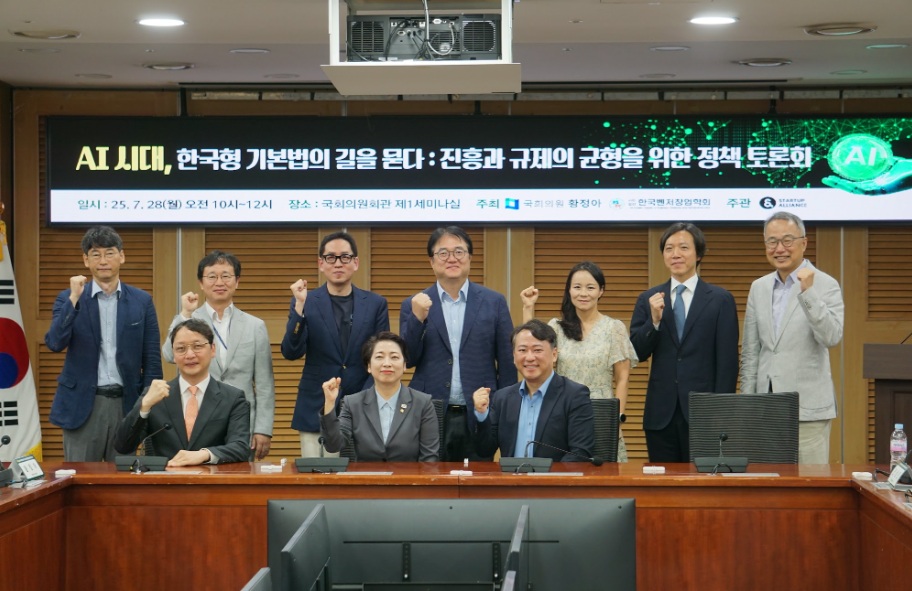
Startup Alliance (Director Lee Ki-dae) , together with Democratic Party of Korea Rep. Hwang Jeong-ah and the Korea Venture Startup Association, held the 'AI Era, Asking the Path of a Korean-Style Basic Law: Policy Discussion for the Balance of Promotion and Regulation' at the 1st Seminar Room of the National Assembly Members' Hall on the 28th. This discussion was organized to review the main issues of the 'Basic Act on the Promotion of Artificial Intelligence and Creation of a Trust Base' (hereinafter, the "AI Basic Act") scheduled to be implemented in January 2026, and to seek policy directions suitable for the era of global technological hegemony competition.
Rep. Hwang Jeong-ah of the Democratic Party of Korea, who hosted this discussion, emphasized, “AI is a general-purpose technology that is breaking down industrial boundaries even at this moment, and hasty regulations can rather hinder growth.” She added, “Now, just before the enforcement of the Framework Act on AI, is the golden time for the Republic of Korea to leap forward again, and we must open up an opportunity for the startup ecosystem and ventures and startups to freely take on challenges through elaborate legal design.” She continued, “AI and science and technology are the core driving forces of future growth, and regulations should not be like filling sandbags for athletes who are just starting out.”
Lee Ki-dae, the head of the Startup Alliance Center who hosted the discussion, said, “The current basic AI law is creating a regulatory framework rather than suggesting the direction of technology,” and “At a time when capable domestic entrepreneurs are considering the U.S. as an option, these regulations could end up pushing entrepreneurs out.” He also emphasized, “In order not to lose the innovators who will take charge of the future Republic of Korea, a more cautious approach is needed in introducing regulations.”
The first presenter, Professor Jeon Seong-min of the Department of Business Administration at Gachon University, gave a presentation on the topic of “Enforcement of the Framework Act on AI and Strategies to Respond to Global Technological Hegemony,” emphasizing that “AI competitiveness is no longer limited to algorithms.” He pointed out that “platform capabilities that connect cloud, operating system, and app store are the core of the AI ecosystem, and Korea is vulnerable in both models and infrastructure compared to the global market.” He added that “a three-year regulatory grace period is merely a stopgap measure, and a platform-centered ecosystem strategy should be implemented in parallel with legal and institutional reforms.” He also explained that “big tech companies, which are key players in the global AI hegemony competition, have also grown in the startup ecosystem, and the way AI is led is also closely linked to platforms and startups.” Professor Jeon suggested that “the Framework Act on AI focuses on supporting small and medium-sized enterprises in relation to startup activation, and fails to consider connections with the platform industry,” and that “in order for AI startups to grow properly, a legal and institutional foundation that encompasses the entire ecosystem is necessary to enable collaboration between startups and platforms.”
The second presentation, Professor Park Sang-cheol of Seoul National University Law School, presented “The Necessity of Passing the Three-Year Grace Period for Regulatory Provisions in the Framework Act on AI and the Future Direction of Revision,” and emphasized that “AI regulations should be applied differentially depending on the context.” He said, “The current Framework Act on AI, which directly follows the EU-style horizontal regulation, does not fit the reality of Korea,” and argued that “there are many concerns, such as the uniform notification and labeling obligation for generative AI, the ambiguity and excessive regulation of the concept of ‘high-impact AI,’ and the high-performance AI standards that do not reflect the flow of technology. Therefore, it is necessary to gracefully postpone the regulatory provisions and redesign them to reflect the industry and reality.” He also said, “Most countries are in the process of postponing or re-examining the implementation of their horizontal and comprehensive regulatory systems,” and “Canada’s AI and Data Act, which Korea referenced, has been repealed, and there are constant discussions about postponing the implementation of the EU AI Act. In the case of the United States, there was an attempt to ban AI regulations at the state and local levels for the next 10 years through the ‘One Big Beautiful Bill Act,’” and emphasized, “It is time for our country to adjust the current pace of regulation and redesign an industry-friendly approach.”
In the comprehensive discussion that followed, Professor Yoo Byeong-jun of Seoul National University's Graduate School of Business served as the moderator, and in-depth discussions between academia and industry on the direction of the AI Basic Act and ways to improve the system continued.
Professor Lee Hae-won of Kangwon National University Law School argued, “We need to fundamentally reflect on whether there is any practical benefit to rushing to implement the law ahead of the EU.” He pointed out, “Among the core elements (GRID) that make up AI, Korea is significantly lacking in research and development (R), infrastructure (I), and data (D), but the current basic law focuses only on strengthening governance (G), so there are structural limitations in securing industrial competitiveness.” He continued, “Like Japan’s AI strategy, bold legislation that emphasizes industrial promotion should be the focus, as well as full-scale investment and support for practical foundations such as research and development, infrastructure, and data.”
Kim Joo-hee, a professor at Dongduk Women’s University’s College of Cultural Knowledge Convergence, pointed out that “since the basic AI law is focused on ethics and securing trust overall, the provisions related to promotion remain at a declarative level.” In particular, she expressed concern that “the high-impact AI standards are vague, and imposing excessive labeling obligations on generative AI could have a chilling effect on the entire content industry,” and that “it is highly likely to hinder the competitiveness of K-content and the creative ecosystem.” She continued, “If the reliability certification system is also introduced without specific standards, startups will face long-term verification procedures and high costs,” and emphasized that “we need to go beyond simple regulatory deferrals and combine realistic institutional design with policy investments.”
Lim Jeong-geun, CEO of BHSN, emphasized, “These days, technology changes so quickly that it is difficult to predict, and things that are taken for granted now may no longer be applicable in a month.” He added, “In this environment, rather than having fixed systems, a foundation must be established that allows for flexible judgment in response to rapid changes.” He also added, “Rather than fixed prior regulations, it is urgent to establish self-regulation based on transparency and to establish a central control tower that can mediate conflicts of interpretation between ministries.”
Jeong Jun-hwa, a legislative research officer at the National Assembly Research Service, pointed out that “the Basic AI Act has a structure that lists promotion and regulation in parallel, with promotion focused on R&D, and the AX (AI transformation) strategy that expands the people’s experience of utilizing AI is missing.” He said, “True promotion should not stop at creating GPUs and LLMs, but create an environment in which the people can experience and use AI in their daily lives.” He added, “Currently, there is an absence of promotion provisions for creating an AI market, and there is no specific implementation strategy in place to move toward AX, so legislative and policy supplements are urgently needed.” He also said, “Now is the time to go beyond postponing regulatory provisions and systematically reorganize all AI-related regulations,” and “The regulatory sandbox system also places excessive burden of proof on businesses, so a shift in regulatory methods is required.”
Kim Kyung-man, the director general of the Ministry of Science and ICT’s Artificial Intelligence-based Policy Bureau, said, “AI policy should fundamentally focus on promotion, and more than 90% of the Ministry of Science and ICT’s work is to support this,” and expressed agreement with the opinion that Korea also needs a flexible and consistent approach rather than hasty regulations, given that even the EU has delayed the implementation of the AI law. He continued, “We are currently preparing an enforcement decree, two public notices, and five guidelines, and are considering a balance between legal clarity and administrative flexibility,” adding, “We will arrange another opportunity to hear opinions from the industry in the future.”
Finally, Professor Yoo Byung-jun said, “There are even more concerns because we have experienced many cases in the past where new laws are created, additional regulations are added, and regulations with different interpretations are created when the person in charge changes,” and concluded the general discussion by urging, “Please be careful in designing the system so that innovative companies can continue to grow in Korea.”
- See more related articles
You must be logged in to post a comment.