



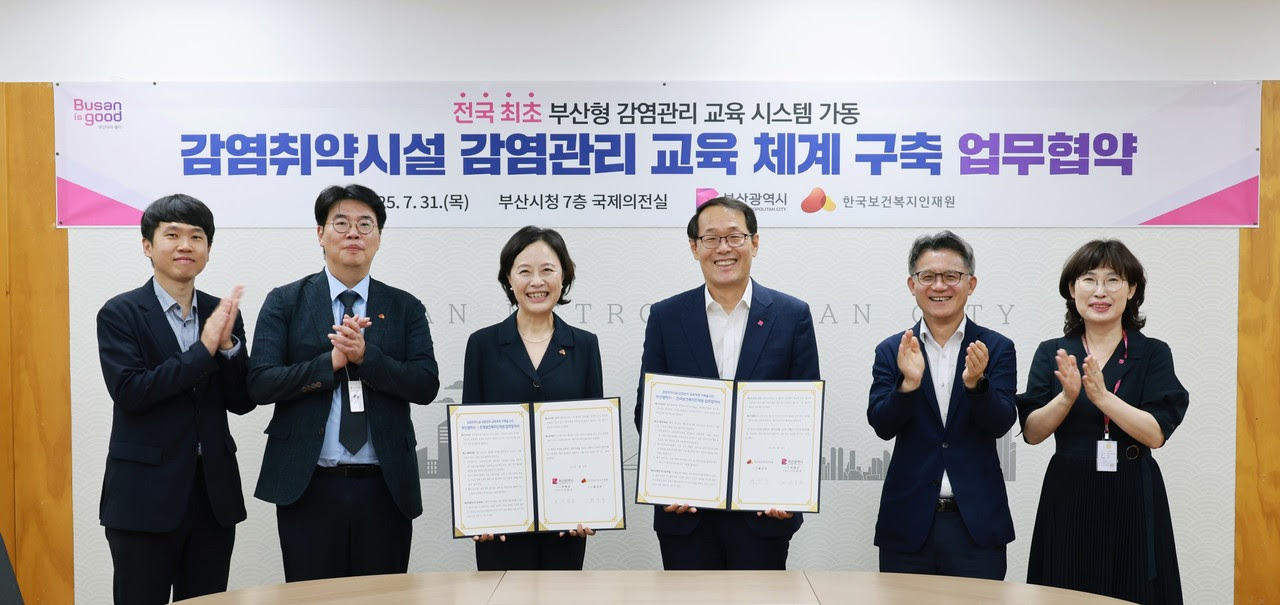
The Korea Human Resources Development Institute (KHRDI, President Bae Geum-ju, hereinafter referred to as the HRDI) announced on Thursday, July 31st that it signed a memorandum of understanding (MOU) with the Busan Metropolitan City (Mayor Park Hyeong-jun, hereinafter referred to as the Busan City) to establish an infection control education system for infection-vulnerable facilities and develop a practical training model.
This agreement aims to strengthen infectious disease response capabilities within vulnerable facilities and establish a systematic educational foundation to enhance the expertise of infectious disease prevention education. The two organizations plan to strengthen their cooperation by focusing on: establishing a customized education system for vulnerable facilities; providing information and policy support related to education and training; and promoting infectious disease prevention education.
Based on this agreement, the Human Resources Development Institute plans to operate a customized training program for practical personnel, including quarantine managers at infection-prone facilities, district and county health center staff, and infection control field advisors. Specifically, the program will focus on strengthening the capabilities of infection control managers through hands-on, practical training and enhancing the community's overall infectious disease response capabilities.
Busan City plans to strengthen the local infectious disease safety net through this education system and develop it into a "Busan-style infection control education model" that can be expanded to other cities and provinces in the long term.
Lee Jun-seung, Vice Mayor of Busan City, said, “This education system will serve as a core foundation for realizing ‘Busan, a city safe from infectious diseases 365 days a year.’ We will gradually develop it to increase the completeness of the project and expand it as a national best practice.”
Bae Geum-ju, president of the Korea Human Resources Development Institute, said, “We expect to be able to enhance our practical infectious disease response capabilities by combining the institute’s experience in specialized infection control education with local infrastructure,” and added, “We will continue to strive to provide education and foster specialized personnel to establish national and regional infection control systems.”
- See more related articles
You must be logged in to post a comment.