



Energy democratization led by Greenie, turning even non-experts into ESG experts.
Turning carbon into an asset, dreaming of a global ESG infrastructure that goes beyond South Korea.

"Carbon can be an asset, not a cost. Through data-driven, precise measurement and AI automation, we aim to create an era where everyone can participate in the ESG transition."
The future envisioned by Lee Ho-jun (47), CEO of Korea Green Data, is clear: a world where complex energy management is entrusted to AI chatbots, and efficiency is maximized through precise predictions rather than vague savings.
A data innovator with accumulated Silicon Valley experience
The industrial workplace remained breathless. Faced with countless meters, managers relied on Excel to quantify energy usage late into the night, and carbon emissions measurement was considered mandatory. Despite the massive wave of ESG transformation, the workplace floundered in the swamp of analog.
In 2020, a startup emerged that began to crack this wall. Korea Green Data, with the vision of "innovating energy with data," is at the center of this effort. At its center is CEO Lee Ho-jun, who gained expertise in AI and data systems in Silicon Valley.
After majoring in computer engineering at Hanyang University, he moved to the US to pursue his master's and doctoral degrees, honing his AI expertise. He then worked at two energy startups in Silicon Valley. At the first, he led the North American branch, witnessing how technology transformed the industry paradigm. At the second, he oversaw product development and operations, leading the company to attract significant investment.
"In Silicon Valley, I've seen how data can simultaneously drive industrial efficiency and sustainability. Beyond simple automation, I've seen how data-driven decision-making reduces energy waste and creates new value."
However, upon returning to Korea, the reality he encountered was quite different. Manual energy management and unmeasured carbon emissions were still rampant in Korea. This is why he founded Korea Green Data with the goal of solving these problems through technology.
GreenOS: Democratizing Energy Management
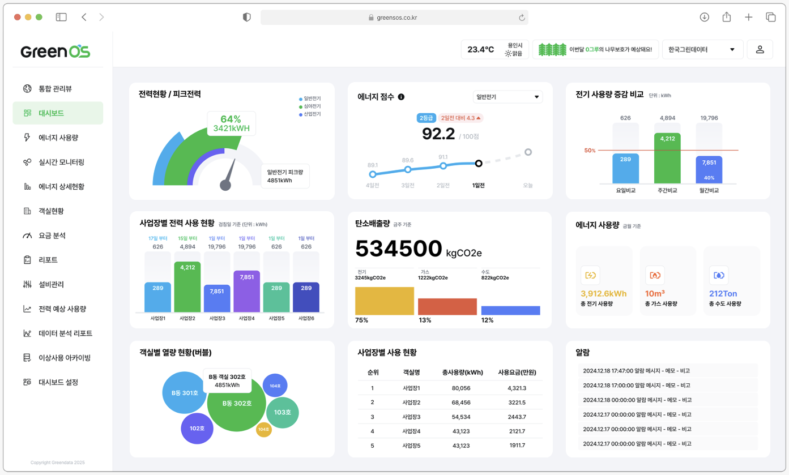
CEO Lee Ho-jun defines GreenOS as "a platform that democratizes energy and carbon data management." While existing energy management systems have been limited to tools for experts, GreenOS is designed to enable anyone, even non-experts, to make data-driven decisions and actions.
GreenOS has three core values. First, accessibility. Real-time analysis is possible without installing separate sensors, and energy and carbon data can be accessed via an AI chatbot anywhere on the web or mobile. Second, automation. Equipped with advanced power prediction algorithms such as LSTM, TCN, and TFT, as well as NILM-based facility-specific analysis technology, it automates the entire process, from anomaly detection to carbon reporting. Third, scalability. As a SaaS-based platform, it can be flexibly applied to a variety of spaces, from offices to factories and local government buildings.
Of note is the multimodal chatbot "Greenie." It responds in real time to user queries on topics such as energy management, carbon emissions, rate simulation, and ESG disclosures in natural language, and automatically generates complex reports using generative AI technology.
"The AI analytics dashboard learns your energy patterns and provides optimal operating guidelines. Using a time-series forecasting model, it predicts hourly load with over 96% accuracy."
The actual results are impressive. Ananti Resort reduced energy costs by approximately 7% annually by optimizing heating and cooling for each room using Greenie and an AI dashboard. Furthermore, integration with Samsung Electronics' SmartThings Pro platform reduced administrator work time by 70%.
Proven technology from public to private sector
Korea Green Data's technological prowess was further validated in the Goyang City Smart City Project, conducted in collaboration with the Korea Institute of Civil Engineering and Building Technology (KICT). By incorporating a proprietary M&V (Measurement and Verification) system into GreenOS, the company quantified energy savings before and after facility improvements. As a result, an average energy savings of 18.6% was achieved, with a payback period of 3.2 years.
"Public institutions place importance on verifying the effectiveness of their investments before they invest. The case of Goyang City provided a compelling response through objective data and verification by a public certification agency."
Collaboration with Samsung Electronics was also a key turning point. Through the C-Lab Outside program, we enhanced our global SaaS scalability and UI/UX. Furthermore, we integrated GreenOS's generative AI reporting engine into the SmartThings Pro platform as a microservice. This laid the foundation for future collaborations with Hyundai Engineering & Construction, LS ELECTRIC, Megazone, and KICT.
Expanding globally and securing credibility by joining the Carbon Accounting Alliance.
Korea Green Data plans to actively expand into the US and Southeast Asia in the first half of next year. It is currently testing a GreenOS-based high-frequency power data analysis platform at Honolulu Airport in Hawaii with Johnson Controls. It is also participating in the Hanoi Smart City Master Plan in Vietnam. In Indonesia, it is collaborating with the Korindo Group to develop a proof-of-concept (PoC) for the introduction of an energy optimization solution.
In particular, joining the Carbon Accounting Alliance (CAA) is a key driver of global expansion. CAA works with international ESG disclosure standard-setting bodies such as CDP, IFRS, TCFD, and PCAF to concretize Scope 1, 2, and 3 data structures.
"By joining the CAA, we've moved from being a recipient of international ESG disclosure regulations to a partner collaborating with their designers. This is a significant turning point, laying the foundation for our evolution into a universal technology platform for the global carbon accounting market."
Designing a Future That Converts Carbon into an Asset
Korea Green Data's ultimate goal is to go beyond simply being a provider of energy-saving solutions.
He emphasizes that “we will evolve into a ‘Total Enterprise Carbon Planning’ platform that connects the entire carbon transition process of companies, governments, and cities.”
GreenOS has achieved energy savings of 7-20% on average and has played a role in creating "data-driven carbon reduction." However, carbon neutrality is not achieved through reduction alone. Measured reduction data must be quantified and verified (MRV) and linked to third-party markets to create economic value. To this end, the company is building a carbon emissions certification platform and a data-driven carbon trading platform.
The three changes proposed by CEO Lee Ho-jun are as follows:
Carbon neutrality made easy for everyone: By democratizing complex certification systems and accounting standards through AI and automated reporting, we enable startups, SMEs, and educational institutions to implement ESG management.
Turning carbon into an asset, not a cost: Transform carbon data into verifiable reduction performance and economic credits, rather than mandatory disclosure requirements, to realize assetization in various sectors, including finance, procurement, and exports.
Global expansion of the Korean carbon platform: By leveraging technology to expand to countries with inadequate carbon accounting infrastructure, such as Southeast Asia, the Middle East, and South America, Korea's digital carbon platform will establish itself as a global ESG infrastructure.
A Bold Journey Towards a Sustainable Future
"Korea Green Data's ultimate goal is to move beyond 'carbon reduction technology' to 'creating infrastructure that structures carbon and transforms it into tradable data, enabling an ESG economy.'"
Carbon neutrality is not simply a technological advancement; it involves transforming the social structure. Therefore, Korea Green Data has expressed its commitment to serving as a key partner in this transformation. Korea Green Data is embarking on a bold journey to create a future where waste disappears and efficiency flourishes in a space where data thrives.
Headquartered in Gangnam, Seoul, Korea Green Data operates with a team of 13. More than half of its members are technical professionals focused on developing AI, data engineering, and ESG reporting automation technologies.
You must be logged in to post a comment.