



Hospitals often witness pharmacists, often highly paid, individually package small pills. These pills are all prescription drugs, and even a single mistake can be dangerous to the patient. But how long can this practice continue? What if we could use AI to sort pills in real time and use robotic equipment to automatically package them?
Through these considerations, an AI-powered pill sorting robot has been developed that promises to dramatically improve the efficiency of hospital pharmacies, attracting attention in the domestic health tech market. The startup behind this innovation is Medi Node (CEO Hwang Seon-il), which developed "PillBot," a robot that automates hospital pharmacy tasks using deep learning pill identification technology.

Pharmaceutical and IT industry experts join forces to launch a health tech startup.
MediNode CEO Hwang Seon-il majored in industrial engineering at Inha University and then worked in technical sales at Hanmi Pharmaceutical. His expertise in technical sales of pharmacy automation equipment (ATC) is now a key competitive edge for his business.
CEO Hwang explained his motivation for starting the company, saying, "Seeing the rapid transformation of the industrial landscape by AI, I became convinced that combining AI with my specialty, pharmacy automation equipment, would allow me to join the wave of the Fourth Industrial Revolution." He founded Medi Node in February 2021 and recruited design control and AI experts to build a team. After three years of trial and error, he was able to launch "PillBot," a machine learning-based automatic pill sorting robot, in late 2024.
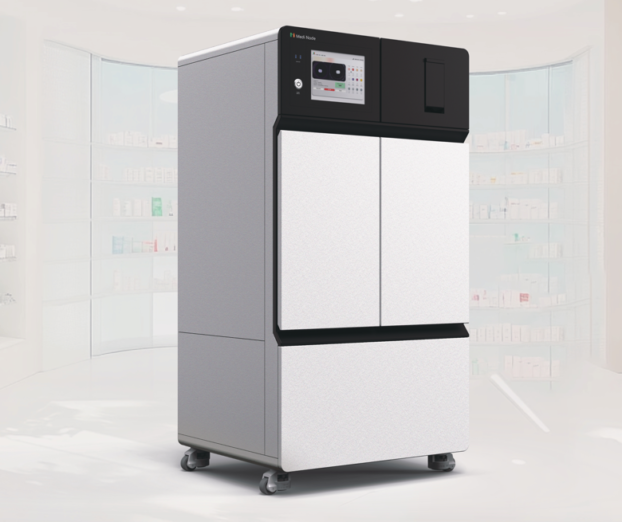
"Fast and accurate" market verification completed through delivery to major hospitals.
PillBot's core technology is a pill identification system utilizing deep learning-based AI vision technology. In large hospital pharmacies, three to four pharmacists spend three to five hours each day manually reclassifying returned prescription medications. This task is outside of their primary duties and is often cited as a factor in why pharmacists avoid working in hospitals. PillBot uses AI vision technology to identify and classify pills, eliminating the manual process. This allows pharmacists to focus on their core duties, significantly increasing efficiency and minimizing human error. The market response has been enthusiastic, as manual reclassification has been a common challenge for pharmacists at nearly all large hospitals.
PillBot proved its effectiveness in the market with its first delivery to Soonchunhyang University Cheonan Hospital in February 2025. By July of this year, several large hospitals had successfully completed demo tests, and hospitals nationwide are competing to secure budgets to introduce PillBot. Notably, PillBot was recently designated as an innovative product by the Public Procurement Service, paving the way for large hospitals to adopt PillBot with the Public Procurement Service's budget starting next year. CEO Hwang predicts that the number of hospitals adopting PillBot will rapidly increase starting next year.
The health tech market is increasingly turning to AI to address inefficiencies.
MediNode offers new possibilities to domestic meditech startups, which have previously focused solely on advancement and specialization. Combining expertise in existing industries with cutting-edge AI technology, it effectively transforms outdated methods in the market, earning praise from both hospitals and professionals alike.
In the narrow but distinct field of hospital pharmacy, 'Medi Node' is gaining attention as a solution that has drastically reduced the manual work time of highly skilled pharmacists and is also helpful to medical staff, patients, and hospital management.
You must be logged in to post a comment.