



“The quality of conversation has changed”… Sprinkler's paradigm shift in corporate communication
From overcoming translation barriers to building a knowledge base, AI solutions optimized for practical use.
– Evolution into a next-generation business platform, completed with 'JANDI Home' and 'MCP'
Toss Lab, the company behind the collaborative tool JANDI, is garnering attention for its AI solution, Sprinkler, which was launched in March. Sprinkler uses AI to analyze the vast amounts of data accumulated in JANDI, enhancing the efficiency and accuracy of work communication.
Launched in 2015, JANDI is a messenger-based collaboration tool and a cloud-based service that enhances individual and organizational productivity. Its key differentiating factors include localization and ease of use, providing an intuitive interface accessible to everyone from new employees in their 20s to executives in their 60s. As a result, JANDI has established itself as a leading collaboration tool, with 2.87 million users across over 420,000 companies, including Lotte Department Store, Nexen Tire, and Hanssem. Toss Lab, offering JANDI in over 70 countries, including Taiwan, Japan, and Vietnam, has grown beyond Korea into a leading B2B SaaS company in Asia.
Sprinkler, conceived two years ago, underwent a proof-of-concept (PoC) last year, and was officially launched in the first half of this year. CTO Seo Jun-ho, who led the development of Sprinkler, is a messenger expert who previously developed instant messaging at Empas and NateOn at SK Communications. After founding Waterbear Soft in 2009, a time of transition for the mobile paradigm, and successfully exiting the company, he joined Toss Lab in 2018 and has since led the technological development of JANDI.
Toss Lab has been steadily improving its functions by introducing the 'JANDI' drive in 2019, the 'Gift' service in 2021, and the AI function 'Sprinkler' in 2025 to adapt to the changing work environment, such as the spread of remote work due to COVID-19, the new work culture of the MZ generation, and the emergence of AI technology.
We met with CTO Seo Jun-ho to hear about the achievements of Sprinkler in the six months since its launch and its future direction.
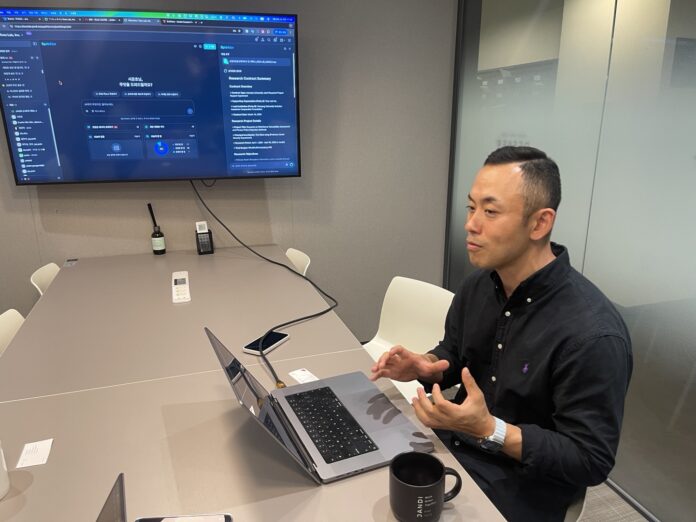
Developing 'Sprinkler' to solve customer problems
Toss Lab launched JANDI ten years ago to address corporate communication challenges. Now, ten years later, what problem has Toss Lab solved with Sprinkler?
'Sprinkler' was born to solve a new problem that arose from the success of 'JANDI'. As 'JANDI' established itself as a corporate communication tool, the number of users and usage rapidly increased, but paradoxically, the problem of reduced communication efficiency occurred due to data accumulation. 'Toss Lab' developed 'Sprinkler' to fundamentally solve this problem of reduced efficiency. The name 'Sprinkler' itself reflects this. 'Sprinkler' was derived from the meaning of spraying the necessary amount of water at the right time to help 'JANDI' grow lushly. In other words, 'Sprinkler' is a tool that helps corporate communication flow more smoothly by watering the 'JANDI', the 'grass' of corporate communication.
As usage grew, over 670 million data items were accumulating on JANDI daily. Over time, as this data accumulated, we observed a gradual decline in communication efficiency. In particular, when the person in charge of a task changed, it became difficult to trace communication history. We began to consider how to address these customer concerns.
This happened two years ago. As JANDI usage increased, data volumes increased, leading to a decline in information retrieval and work efficiency. CTO Seo, driven by the need to address this issue for customers, turned to generative AI.
Toss Lab's consistent philosophy throughout the development of Sprinkler was "customer-centricity." Throughout the development process, Toss Lab met with customers, collected feedback, and actively incorporated it into the development process. After developing Sprinkler in 2023, closed beta testing began in early 2024. Over the course of a year, Toss Lab meticulously analyzed the usability and effectiveness in real-world work environments, continuously improving the product based on the feedback gained.
CTO Seo bluntly stated that Sprinkler wasn't developed to solve grand problems. He emphasized that Sprinkler is solving small, specific problems that companies need to address right now.
Company A, a JANDI customer, is tasked with converting invoices in various languages into Korean format every day. A critical issue for Company A is converting invoices into Korean format. Solving this task requires a deep understanding of the company's actual business processes, including how many people are involved and the order in which tasks are performed. Toss Lab delves deeply into these customer challenges, understands them, and then proposes solutions.
Toss Lab has consistently listened to its customers' voices and developed JANDI to address their immediate needs. This is why it has been upgraded hundreds of times a year. Sprinkler is no exception. It focused on the problems customers wanted to solve right now.
CTO Seo considered two key factors when developing Sprinkler. The first was to connect individual AI use with organizational efficiency. "No matter how much AI an individual uses, if it's used solely for personal gain and not at the organizational level, it ultimately won't lead to organizational efficiency," Seo explained. "I believed it was crucial to connect individual efficiency with organizational performance."
The second is minimizing hallucinations. CTO Seo emphasized, "The most important thing in enterprise AI services is accuracy."
This is the reason why Sprinkler was designed to be an integrated AI system that improves the collaboration efficiency of the entire organization, rather than an individual AI tool, and to utilize JANDI's topic-based structured information system to enable AI to generate answers based on actual data.
Improving the quality of conversation
After analyzing Sprinkler usage for six months, CTO Seo says Sprinkler has changed the quality of conversations.
"Everything begins and ends with conversation, but that leads to countless misunderstandings, searches, and significant costs. At Toss Lab, we believe that increasing this efficiency is key to securing an organization's competitiveness."
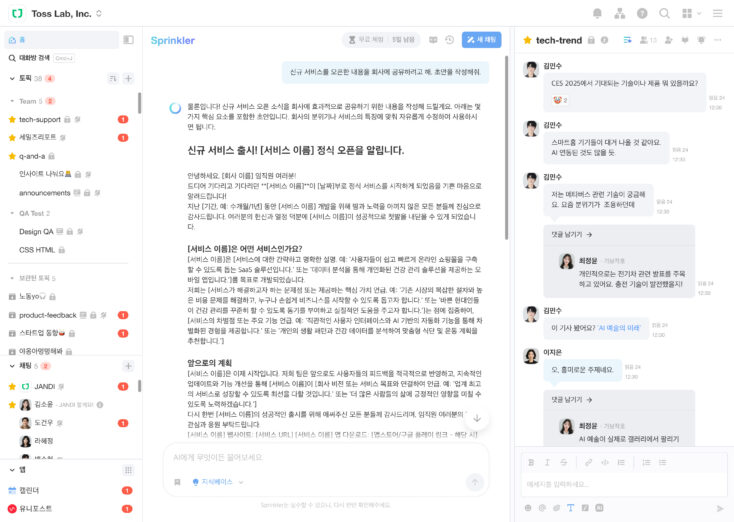
According to the CTO, the content of conversations changed when the 'JANDI' team started using 'Sprinkler'. The most core function of 'Sprinkler' is chat room summarization. AI analyzes and summarizes the contents of messages exchanged in 'JANDI' topics (chat rooms by topic) and chats, and provides answers to questions based on that content. Users simply specify the desired topic, enter a question in natural language along with the desired period of time for the summary. For example, if you request, "Summarize my work for the past week" or "Create a to-do list based on messages written by 'JANDI' Kim," the AI will immediately provide a relevant answer.
What's revolutionary about this feature is that it goes beyond simple keyword search to understand the context and flow of a conversation. In the past, searching for "What was Manager Kim's last message?" would yield dozens of results, requiring careful review. Now, AI understands the context and provides an accurate answer. Users can now summarize long-accumulated data in one place, significantly improving their workflow and improving the quality of conversations.
Breaking down communication barriers
Japan's Vision Mobile has seen communication barriers disappear since adopting Sprinkler. Previously, communication relied on copying and pasting Google Translate text, but now translations are instantaneous with just two clicks in the message input field. Global fashion company The Nature Holdings also saw significant improvements in work efficiency when verifying architecture documents developed at its Hong Kong branch in Korea, enabling technical comments to be provided simultaneously with the translation.
Sprinkler supports real-time communication. AI naturally corrects what you type in the message input field and translates it into 15 languages. The sentence improvement feature helps smooth awkward expressions, and the translation feature instantly converts your message into a variety of languages, including Korean, English, Japanese, and Chinese.
Ask anything
“What is our company’s vacation policy?”
These are questions employees constantly wonder about and frequently ask. HR teams are constantly answering the same questions, distracting them from truly important tasks.
"Every company has its own unique terminology and culture. That's why we introduced Retrieval-Augmented Generation (RAG) knowledge base. AI references a company's unique data to provide personalized answers."
It's simple to use. Simply drag and drop files to upload them to the JANDI knowledge drive, and it automatically builds a vector database. By uploading information like personnel policies, work manuals, product descriptions, and company regulations, you can receive accurate answers to any questions you have, 24 hours a day, 365 days a year.
HWP (Hangul) files are also supported. This allows for the creation of RAG files, which are widely used by associations and public institutions, meeting the practical needs of Korean companies.
Use generative AI right within the platform
JANDI also includes generative AI capabilities that can be used directly within the app. Activating AI mode in the message input window allows users to interact with conversational AI like ChatGPT. Users can input questions in natural language and receive real-time answers, and all tasks can be completed within JANDI without having to navigate to a separate service or copy-and-paste.
This feature can be used for a wide range of tasks, from answering general questions to document creation, brainstorming ideas, and searching for information. In particular, AI-generated answers can be used directly as messages or edited and shared with team members, significantly improving work efficiency.
'Toss Lab' plans to introduce a policy that allows users to experience some of the 'Sprinkler' features in all plans starting from the end of August.
Transforming AI-Powered User Experiences
“What can individuals do with AI?
Six months after launching Sprinkler, a solution that improves the accuracy and efficiency of corporate communications, CTO Seo asked a fundamental question again.
"Because 'JANDI' was a messenger-based collaboration tool, the first thing users thought when they accessed it was, 'Who should I talk to?' In other words, the basic workflow involved finding a conversation, selecting a chat room, and exchanging messages. However, in the age of AI, I believe this paradigm itself needs to change. Users should be able to move beyond the mindset of, 'I need to start a conversation first,' and experience, 'I can go into 'JANDI' and start working according to my work priorities.'"
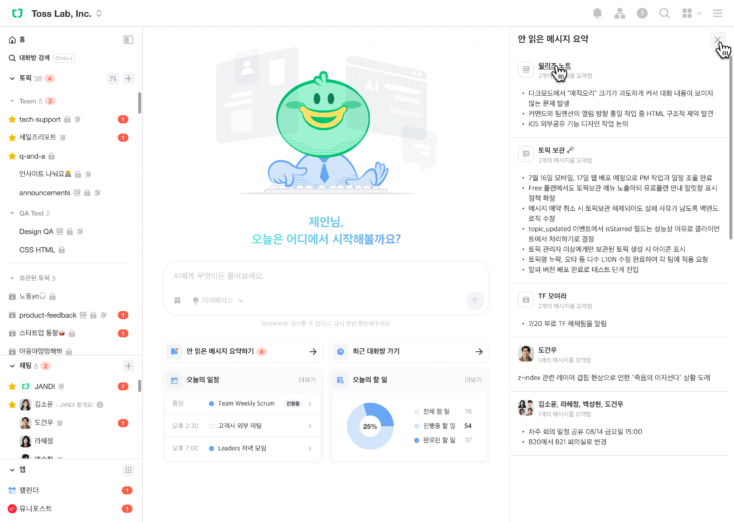
The answer to this is JANDI Home. The core idea of JANDI Home is to expand the user experience from the team realm to the individual realm. JANDI Home provides a space where individuals can directly handle their own work. For example, instead of having to manually check countless unread messages, AI automatically summarizes them, allowing users to quickly grasp the key content. It also provides functions to quickly jump to a desired chat room among numerous chat rooms and view personal schedules at a glance.
What users want is accurate answers to real-time, up-to-date questions like, "What's the weather today?" or "Who is the current president?" However, existing AI systems face a fundamental problem: they cannot accurately provide this information due to the limited time available in their training data. To address this, Toss Lab leveraged MCP (Model Context Protocol) technology. This technology connects in real time with search engines and external servers via a specific protocol, enabling the immediate retrieval of up-to-date information.
With the 'JANDI' home for personal work and the MCP function that solves the Knowledge Cutoff (a temporal boundary point in the data learned by the AI language model, after which the model does not know information) problem, 'JANDI' is expected to be an important turning point in transforming from a simple messenger-based collaboration tool to a comprehensive work platform with AI as its core.
The 'JANDI' home will be released at the end of August, and the MCP function will be updated in September.
Evolving beyond a collaboration tool into an AI company
‘Sprinkler’ has now gone beyond a simple function and is becoming the ‘core layer’ of ‘JANDI’.
"The user experience of existing software is starting to change. Whereas previously it involved navigating menus and pressing buttons, now it's using natural language. I believe it should be able to perform tasks like, 'Create a schedule for a certain date in a certain month,' 'I want to create a certain report,' or 'Generate a document based on specific content in a group conversation.'"
Various functions required for corporate work, such as HR services and electronic approval, will be integrated around "Sprinkler." Toss Lab plans to evolve "Sprinkler" from a simple add-on to a core platform that serves as the foundation for all services. Once this transition is complete, Toss Lab will transform from a company that "creates JANDI" to a company that "creates a business platform based on AI and Sprinkler."
A look at the journey of 'Toss Lab' reveals a consistent philosophy of accurately identifying the core issues facing businesses at each point and presenting solutions to address them.
The launch of JANDI in 2015 began with a fundamental challenge in corporate communication. The goal was to improve work efficiency by transitioning corporate communication from email and phone to a real-time messaging platform. As a result, JANDI has built a solid foundation with 2.87 million users and 420,000 companies.
The launch of "Sprinkler" in 2025 was an attempt to address a new problem created by the success of "JANDI." As JANDI usage grew, the accumulated data paradoxically reduced information retrieval and communication efficiency. A particularly serious issue was the lack of proper history management when task managers changed. "Sprinkler" addressed this issue through AI, going beyond simple search to understand the context and flow of conversations, revolutionizing the quality of conversation itself.
Toss Lab aims to transform the existing user experience from "finding a menu and pressing a button" to "making requests using natural language," creating a comprehensive work platform that integrates all business functions, including HR services and electronic approvals, with AI. This represents a new work paradigm that goes beyond mere collaboration tools and places AI at the heart of everyday work.
The launch of JANDI Home and MCP promises to revolutionize the user experience in the AI era. JANDI Home shifts JANDI's paradigm from a messenger-centric platform to a personal workspace, while MCP overcomes knowledge limitations and ensures accuracy through real-time information integration.
Throughout this evolution, Toss Lab's consistently pursued vision remains clear: "Technology for solving customer problems, not technology for technology's sake." As CTO Seo Jun-ho puts it, "Rather than being caught up in the keyword 'AI' and starting with AI, we chose AI to better address those problems, building on our experience solving customer problems with B2B software."
Ultimately, Toss Lab's vision is to "fundamentally innovate work through AI," but it differentiates itself from other AI companies in that its starting point always begins with "problems customers are actually experiencing."
You must be logged in to post a comment.