




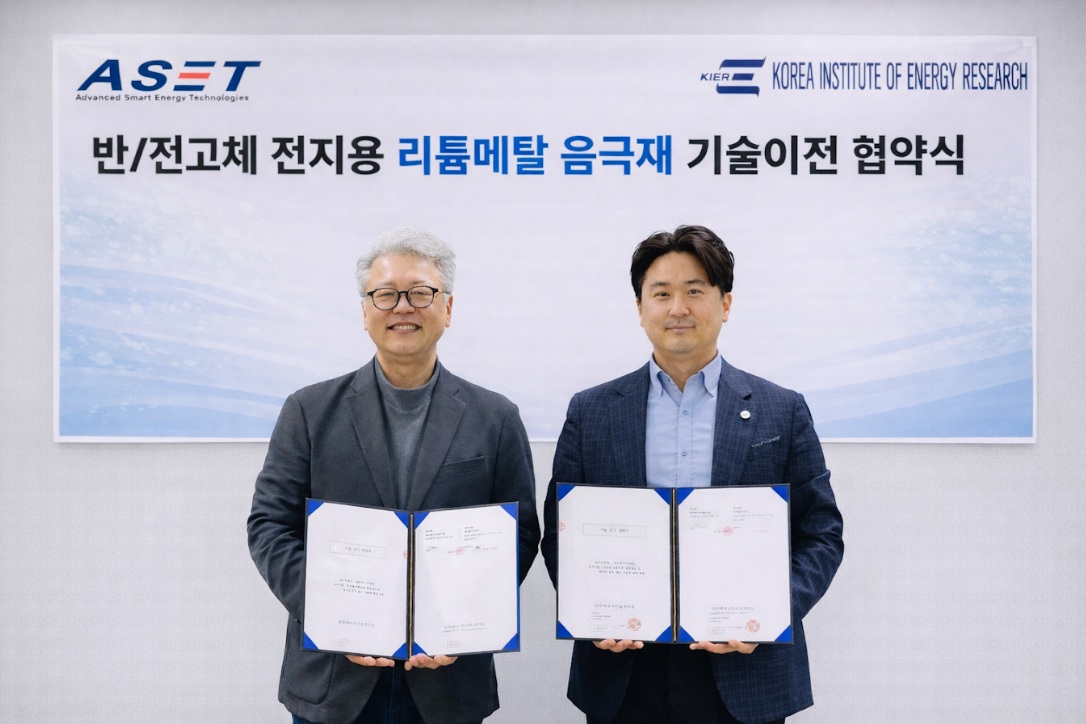
차세대 이차전지 소재 전문기업 에이에스이티(ASET, 대표이사 박석정)는 한국에너지기술연구원과 차세대 이차전지용 리튬금속전지 관련 핵심 기술에 대한 2차 기술이전 계약을 체결했다고 6일 밝혔다.
이번 계약은 지난 5일 체결됐으며, 한국에너지기술연구원이 개발한 리튬금속 음극 안정화 기술, 계면 제어 기술, 차세대 전극 구조 설계 기술 등을 포함한다. 해당 기술들은 반·전고체 전지 구조에서 핵심적인 요소기술로, 고에너지밀도와 고안전성을 동시에 구현할 수 있는 차세대 배터리 기술로 평가받고 있다.
앞서 에이에스이티는 2023년 한국에너지기술연구원과 차세대 이차전지용 전고체전해질 핵심 기술에 대한 1차 기술이전 계약을 체결한 바 있다. 현재는 이를 기반으로 반·전고체 전지용 전고체전해질막의 기술 고도화와 사업화를 추진 중이다.
이번 2차 기술이전 계약은 기존 전고체전해질 기술에 리튬금속 음극 및 차세대 전극 기술을 결합함으로써, 반·전고체 전지의 주요 구성 요소를 단계적으로 내재화하기 위한 전략적 행보로 풀이된다.
에이에스이티는 두 차례의 기술이전 계약을 통해 확보한 기술을 바탕으로, 전고체전해질과 리튬금속 음극을 모두 내재화한 반·전고체 전지를 2030년까지 상용화한다는 중장기 로드맵을 수립했다. 회사는 올해부터 시제품 개발과 성능 검증을 시작으로 단계적인 기술 고도화와 실증을 거쳐 상용화 단계에 진입할 계획이다.
박석정 대표이사는 이번 기술이전 계약이 반·전고체 전지 상용화를 위한 핵심 기술 포트폴리오를 완성하는 계기가 될 것이라며, 고안전·고에너지 차세대 배터리 시장에서 경쟁력을 확보하겠다고 밝혔다.
에이에스이티는 향후 반·전고체 전지를 중심으로 전고체전해질막과 리튬금속 기술을 통합한 차세대 배터리 핵심 소재·시스템 기업으로 도약한다는 전략 아래, 국내외 연구기관 및 글로벌 파트너와의 협력을 지속 확대할 방침이다.
- 관련 기사 더 보기
AST Signs Second Technology Transfer Agreement with Korea Institute of Energy Research for Core Lithium Metal Battery Technology
ASET (CEO Park Seok-jeong), a next-generation secondary battery materials specialist, announced on the 6th that it has signed a second technology transfer agreement with the Korea Institute of Energy Research for core technologies related to lithium metal batteries for next-generation secondary batteries.
This contract, signed on the 5th, includes lithium metal anode stabilization technology, interface control technology, and next-generation electrode structure design technology developed by the Korea Institute of Energy Research. These technologies are considered core elements in semi- and all-solid-state battery structures and are considered next-generation battery technologies capable of simultaneously achieving high energy density and high safety.
Previously, ASAT signed a first-stage technology transfer agreement with the Korea Institute of Energy Research (KIER) in 2023 for core technology in all-solid-state electrolytes for next-generation secondary batteries. Building on this agreement, ASAT is currently pursuing technological advancement and commercialization of all-solid-state electrolyte membranes for semi-solid-state and all-solid-state batteries.
This second technology transfer agreement is interpreted as a strategic move to gradually internalize key components of semi- and all-solid-state batteries by combining existing solid-state electrolyte technology with lithium metal cathode and next-generation electrode technology.
Based on the technology acquired through two technology transfer agreements, ASAT has established a mid- to long-term roadmap to commercialize semi- and all-solid-state batteries that incorporate both solid-state electrolytes and lithium metal cathodes by 2030. Beginning this year with prototype development and performance verification, the company plans to move into the commercialization phase through gradual technological advancement and verification.
CEO Park Seok-jeong stated that this technology transfer agreement will serve as an opportunity to complete the core technology portfolio for commercializing semi- and all-solid-state batteries, and that the company will secure competitiveness in the high-safety, high-energy next-generation battery market.
AST plans to continuously expand cooperation with domestic and international research institutes and global partners under the strategy of becoming a next-generation battery core materials and systems company that integrates all-solid-state electrolyte membrane and lithium metal technology, focusing on semi-solid-state and all-solid-state batteries.
- See more related articles
A.S.、韓国エネルギー技術研究院とリチウム金属電池コア技術2次技術移転契約締結
次世代二次電池素材専門企業エイエスイティ(ASET、代表取締役パク・ソクジョン)は、韓国エネルギー技術研究院と次世代二次電池用リチウム金属電池関連核心技術に対する二次技術移転契約を締結したと6日、明らかにした。
今回の契約は去る5日締結され、韓国エネルギー技術研究院が開発したリチウム金属陰極安定化技術、界面制御技術、次世代電極構造設計技術などを含む。当該技術は、半・全固体電池構造において核心的な要素技術であり、高エネルギー密度と高安全性を同時に実現できる次世代バッテリ技術として評価されている。
これに先立ち、A.S.は2023年、韓国エネルギー技術研究院と次世代二次電池用全固体電解質核心技術に対する一次技術移転契約を締結した。現在はこれを基に、半・全固体電池用全固体電解質膜の技術高度化と事業化を進めている。
今回の二次技術移転契約は、既存の全固体電解質技術にリチウム金属陰極及び次世代電極技術を結合することにより、半・全固体電池の主要構成要素を段階的に内在化するための戦略的歩みと解釈される。
ASは、2回の技術移転契約を通じて確保した技術をもとに、全固体電解質とリチウム金属陰極を共に内在化した半・全固体電池を2030年まで商用化するという中長期ロードマップを樹立した。同社は今年から試作品開発と性能検証をはじめ、段階的な技術高度化と実証を経て商用化段階に参入する計画だ。
パク・ソクジョン代表取締役は今回の技術移転契約が半・全固体電池の商用化のための核心技術ポートフォリオを完成するきっかけになるだろうとし、高安全・高エネルギー次世代バッテリー市場で競争力を確保すると明らかにした。
ASは、今後半・全固体電池を中心に全固体電解質膜とリチウム金属技術を統合した次世代バッテリー核心素材・システム企業に跳躍するという戦略の下、国内外の研究機関及びグローバルパートナーとの協力を持続拡大する方針だ。
- 関連記事をもっと見る
AST与韩国能源研究院签署第二份核心锂金属电池技术转让协议
下一代二次电池材料专家ASET(CEO朴锡正)于6日宣布,已与韩国能源研究院签署第二份技术转让协议,涉及下一代二次电池锂金属电池的核心技术。
该合同于5日签署,内容包括韩国能源研究院开发的锂金属负极稳定技术、界面控制技术以及新一代电极结构设计技术。这些技术被认为是半固态和全固态电池结构的核心要素,也是能够同时实现高能量密度和高安全性的新一代电池技术。
此前,ASAT于2023年与韩国能源研究院(KIER)签署了第一阶段技术转让协议,涉及下一代二次电池全固态电解质的核心技术。基于该协议,ASAT目前正致力于推进半固态和全固态电池用全固态电解质膜的技术研发和商业化。
第二项技术转让协议被解读为一项战略举措,旨在通过将现有的固态电解质技术与锂金属阴极和下一代电极技术相结合,逐步实现半固态和全固态电池关键部件的内部化。
基于通过两项技术转让协议获得的技术,ASAT制定了中长期路线图,目标是在2030年前实现采用固态电解质和锂金属正极的半固态和全固态电池的商业化。该公司计划从今年开始进行原型开发和性能验证,并通过逐步的技术进步和验证进入商业化阶段。
CEO朴锡正表示,这项技术转让协议将为完善半固态和全固态电池商业化的核心技术组合提供契机,公司将借此确保在高安全性、高能量的下一代电池市场中的竞争力。
AST计划根据其战略,不断扩大与国内外研究机构和全球合作伙伴的合作,成为一家集全固态电解质膜和锂金属技术于一体的下一代电池核心材料和系统公司,重点发展半固态和全固态电池。
- 查看更多相关文章
AST signe un deuxième accord de transfert de technologie avec l'Institut coréen de recherche énergétique pour une technologie de base des batteries au lithium métal.
ASET (PDG Park Seok-jeong), spécialiste des matériaux pour batteries secondaires de nouvelle génération, a annoncé le 6 avoir signé un deuxième accord de transfert de technologie avec l'Institut coréen de recherche énergétique pour les technologies de base liées aux batteries au lithium métal destinées aux batteries secondaires de nouvelle génération.
Ce contrat, signé le 5, porte sur la technologie de stabilisation des anodes en lithium métal, la technologie de contrôle d'interface et la technologie de conception de structures d'électrodes de nouvelle génération développées par l'Institut coréen de recherche énergétique. Ces technologies sont considérées comme des éléments clés des structures de batteries semi-solides et tout-solides et représentent les technologies de batteries de nouvelle génération capables d'atteindre simultanément une densité énergétique élevée et une sécurité optimale.
En 2023, ASAT a signé un accord de transfert de technologie de première phase avec l'Institut coréen de recherche énergétique (KIER) portant sur une technologie clé relative aux électrolytes entièrement solides pour les batteries secondaires de nouvelle génération. Forte de cet accord, ASAT poursuit actuellement le développement technologique et la commercialisation de membranes électrolytiques entièrement solides pour les batteries semi-solides et entièrement solides.
Ce deuxième accord de transfert de technologie est interprété comme une démarche stratégique visant à internaliser progressivement les composants clés des batteries semi-solides et entièrement solides en combinant la technologie d'électrolyte solide existante avec la cathode en lithium métal et la technologie d'électrode de nouvelle génération.
S’appuyant sur la technologie acquise grâce à deux accords de transfert de technologie, ASAT a établi une feuille de route à moyen et long terme pour commercialiser d’ici 2030 des batteries semi-solides et entièrement solides intégrant à la fois des électrolytes solides et des cathodes en lithium métal. Dès cette année, avec le développement de prototypes et la vérification de leurs performances, l’entreprise prévoit de passer à la phase de commercialisation par le biais d’avancées et de vérifications technologiques progressives.
Le PDG Park Seok-jeong a déclaré que cet accord de transfert de technologie offrira l'opportunité de compléter le portefeuille de technologies de base pour la commercialisation de batteries semi-solides et entièrement solides, et que l'entreprise assurera sa compétitivité sur le marché des batteries de nouvelle génération à haute sécurité et haute énergie.
AST prévoit d'étendre continuellement sa coopération avec les instituts de recherche nationaux et internationaux et les partenaires mondiaux dans le cadre de sa stratégie visant à devenir une entreprise de matériaux et de systèmes de base pour batteries de nouvelle génération intégrant la technologie des membranes électrolytiques entièrement solides et du lithium métal, en se concentrant sur les batteries semi-solides et entièrement solides.
- Voir plus d'articles connexes
You must be logged in to post a comment.