




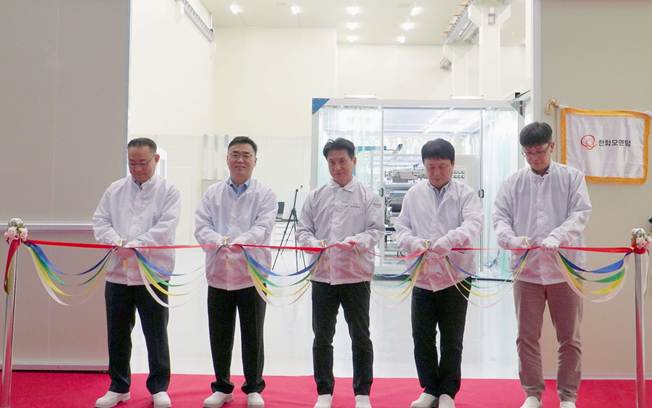
한화모멘텀은 첨단 배터리 장비 개발을 위해 이차전지 R&D센터 공정 연구소를 신설하고 본격 가동에 들어갔다고 밝혔다.
이차전지 R&D센터 내 공정 연구 개발을 전담하는 조직이 새로 생기면서 ‘꿈의 배터리’로 불리는 전고체 배터리와 건식 공정 등 차세대 배터리 장비 및 제조 공정 기술 개발에 속도가 붙을 것으로 전망된다.
13일 충남 아산 사업장에서 열린 현판식에는 류양식 한화모멘텀 대표, 류희연 이차전지 R&D센터장, 이형섭 전공정실장을 비롯한 임직원 30여 명이 참석했다.
이차전지 R&D센터가 있는 한화모멘텀 아산 사업장 내 조성된 공정 연구소는 전고체 배터리와 건식 공정과 같은 차세대 배터리 장비 및 공정 기술 연구 개발을 전담한다.
설비 제작업체가 직접 공정 연구까지 하는 건 흔치 않은 일로 연구소 신설로 고객 맞춤형 서비스 강화는 물론 보다 효율적인 공정을 새롭게 제안하는 등 고객과의 협업 범위가 훨씬 커질 전망이다.
건식 공정은 차세대 배터리 제조 기술로 주목을 받고 있으며, 기존 습식 공정 대비 비용 절감 효과와 친환경적 기술로 평가받고 있다.
글로벌 기업들도 관련 기술 도입에 속도를 내고 있다. 테슬라는 2019년 맥스웰 인수를 통해 건식 전극 기술을 확보했으며, 중국의 CATL과 BYD, 일본의 파나소닉도 파일럿 라인을 운영하고 기술 개발을 진행하고 있다.
전고체 배터리는 기존 리튬이온 배터리 대비 안전성과 에너지 밀도가 높아 전기차 주행거리를 획기적으로 늘릴 수 있는 기술로 평가받는다. 다만 제조 비용이 높고, 초고압 기압 등으로 인한 소재 손상 등으로 인해 양산이 까다롭다는 단점이 있다.
한화모멘텀은 이번 공정 연구소 신설을 기점으로 배터리 장비 시장에서 선도적 입지를 다진다는 목표이다. 이차전지 R&D센터를 통해 배터리 장비 공정 노하우를 확보하고 연구개발 프로젝트 운영 비용의 효율화도 꾀할 예정이다. 글로벌 기술 경쟁력 강화를 통해 시장 선점에도 적극 나선다.
앞서 한화모멘텀은 올해 초 건식 공정 기술 개발 연구에 대한 장비를 센터 내에 구축했다. 배터리 기술 특허 자료와 건식 배터리 재료 등도 전시하고 있다. 올해 하반기에 배터리 셀 품질 및 안정성 평가와 전고체 공정 연구 공간을 추가로 구축할 예정이며, 연구 인력도 충원할 계획이다.
류희연 이차전지 R&D센터장은 “새롭게 구축된 공정 연구소를 통해 고객 서비스를 대폭 강화하고 한단계 높은 장비 기업으로 도약할 것”이라고 말했다.
- 관련 기사 더 보기
Hanwha Momentum Establishes Secondary Battery R&D Center ‘Process Research Institute’
Hanwha Momentum announced that it has established a secondary battery R&D center process research lab to develop cutting-edge battery equipment and has begun full-scale operations.
With the creation of a new organization dedicated to process research and development within the Secondary Battery R&D Center, the development of next-generation battery equipment and manufacturing process technologies, such as all-solid-state batteries and dry processes, dubbed the “dream battery,” is expected to accelerate.
About 30 executives and employees, including Ryu Yang-sik, CEO of Hanwha Momentum, Ryu Hee-yeon, head of the Secondary Battery R&D Center, and Lee Hyeong-seop, head of the Process Management Division, attended the unveiling ceremony held at the Asan plant in South Chungcheong Province on the 13th.
The process research institute established within Hanwha Momentum’s Asan plant, which houses the secondary battery R&D center, is dedicated to research and development of next-generation battery equipment and process technologies, such as all-solid-state batteries and dry processes.
It is not common for a facility manufacturer to conduct process research directly, so the establishment of a new research center is expected to significantly expand the scope of collaboration with customers, including strengthening customized services and proposing new, more efficient processes.
The dry process is attracting attention as a next-generation battery manufacturing technology, and is evaluated as a cost-saving and eco-friendly technology compared to the existing wet process.
Global companies are also accelerating the introduction of related technologies. Tesla acquired dry electrode technology through the acquisition of Maxwell in 2019, and China’s CATL and BYD, and Japan’s Panasonic are also operating pilot lines and conducting technology development.
All-solid-state batteries are evaluated as a technology that can dramatically increase the driving range of electric vehicles due to their safety and higher energy density compared to existing lithium-ion batteries. However, they have the disadvantage of being difficult to mass-produce due to high manufacturing costs and material damage caused by ultra-high pressure.
Hanwha Momentum aims to establish a leading position in the battery equipment market starting with the establishment of this new process research center. Through the secondary battery R&D center, it plans to secure battery equipment process know-how and improve the efficiency of R&D project operation costs. It will also actively pursue market dominance by strengthening global technology competitiveness.
Earlier this year, Hanwha Momentum built equipment for dry process technology development research within the center. Battery technology patent data and dry battery materials are also on display. In the second half of this year, it plans to build additional battery cell quality and stability evaluation and all-solid-state process research spaces, and also plans to hire more research personnel.
Ryu Hee-yeon, head of the Secondary Battery R&D Center, said, “Through the newly built process research center, we will significantly strengthen our customer service and leap forward as a next-level equipment company.”
- See more related articles
ハンファモーメンタム、二次電池R&Dセンター「工程研究所」新設
ハンファモーメンタムは、先端バッテリー機器開発のために二次電池R&Dセンタープロセス研究所を新設して本格稼働に入ったと明らかにした。
二次電池R&Dセンター内の工程研究開発を専担する組織が新たに生まれ、「夢のバッテリー」と呼ばれる全固体電池と乾式工程など、次世代電池装置および製造工程技術の開発にスピードがつくものと見込まれる。
13日、忠南(チョンナム)牙山事業場で開かれた県板式には、リュ・ヤンシクのハンファ・モメンタム代表、リュ・ヒヨン二次電池R&Dセンター長、イ・ヒョンソプ全工程室長をはじめとする役員30人余りが参加した。
二次電池R&Dセンターがあるハンファモーメンタム牙山事業場内に造成された工程研究所は、全固体電池や乾式工程などの次世代電池装置および工程技術研究開発を専担する。
設備製作業者が直接工程研究までするのは珍しいことで、研究所の新設で顧客のカスタマイズサービスの強化はもちろん、より効率的な工程を新たに提案するなど、顧客とのコラボレーション範囲がはるかに大きくなる見通しだ。
乾式工程は次世代バッテリー製造技術として注目を集めており、従来の湿式工程に比べコスト削減効果と環境に優しい技術で評価されている。
グローバル企業も関連技術の導入に速度を出している。テスラは2019年マックスウェル買収を通じて乾式電極技術を確保し、中国のCATLとBYD、日本のパナソニックもパイロットラインを運営して技術開発を進めている。
全固体電池は従来のリチウムイオン電池に比べ安全性とエネルギー密度が高く、電気自動車の走行距離を画期的に増やすことができる技術で評価されるが、製造コストが高く、超高圧気圧などによる素材損傷などにより量産が厳しいという欠点がある。
ハンファモーメンタムは今回のプロセス研究所の新設を起点にバッテリー機器市場で先導的立地を固めるという目標だ。
これに先立ち、ハンファモーメンタムは今年初めの乾式工程技術開発研究に対する装備をセンター内に構築した。
リュ・ヒヨン二次電池R&Dセンター長は「新しく構築された工程研究所を通じて顧客サービスを大幅に強化し、一段階高い装備企業に跳躍するだろう」と話した。
- 関連記事をもっと見る
Hanwha Momentum成立二次电池研发中心“工艺研究所”
Hanwha Momentum宣布已建立二次电池研发中心工艺研究实验室,以开发尖端电池设备,并已开始全面运营。
随着二次电池研发中心内新设立的工艺研发机构的成立,被称为“梦想电池”的全固态电池、干式工艺等下一代电池设备和制造工艺技术的开发有望加速。
韩华Momentum代表柳洋植、二次电池研发中心长柳熙延、工艺管理本部长李亨燮等约30名董事及员工出席了13日在忠南牙山工厂举行的授牌仪式。
位于韩华Momentum牙山工厂内的工艺研究所设有二次电池研发中心,致力于全固态电池和干式工艺等下一代电池设备和工艺技术的研发。
设备制造商直接进行工艺研究的情况并不常见,因此新研究中心的建立有望显著扩大与客户的合作范围,包括加强定制服务和提出新的、更高效的工艺。
干式工艺作为下一代电池制造技术备受关注,与现有的湿式工艺相比,被评价为是一种节省成本且环保的技术。
全球企业也正在加速引进相关技术。特斯拉于2019年通过收购Maxwell获得了干电极技术,中国的宁德时代、比亚迪以及日本的松下也正在运营试验线并进行技术开发。
全固态电池由于其安全性和比现有锂离子电池更高的能量密度,被评价为一项可以大幅增加电动汽车行驶里程的技术。但由于制造成本高,且超高压会造成材料损坏,因此其缺点是难以大规模生产。
Hanwha Momentum 旨在通过建立这一新工艺研究中心,确立其在电池设备市场的领先地位。通过二次电池研发中心,我们计划确保电池设备工艺技术诀窍,并提高研发项目运营成本的效率。我们还积极寻求通过加强全球技术竞争力来占领市场。
今年早些时候,Hanwha Momentum 在该中心安装了用于干法工艺技术开发研究的设备。还展出了电池技术专利资料、干电池材料等。今年下半年,我们计划增建电池单元质量稳定性评估和全固态工艺研究的空间,并增加研究人员。
二次电池研发中心负责人柳熙延表示:“通过新建的工艺研究中心,我们将大幅加强客户服务,跃升为更高水平的设备公司。”
- 查看更多相关文章
Hanwha Momentum crée un centre de recherche et développement sur les batteries secondaires, le « Process Research Institute ».
Hanwha Momentum a annoncé la création d'un laboratoire de recherche sur les processus de recherche et développement de batteries secondaires pour développer des équipements de batteries de pointe et a commencé ses opérations à grande échelle.
Avec la création d'une nouvelle organisation dédiée à la recherche et au développement de processus au sein du Centre de R&D sur les batteries secondaires, le développement d'équipements de batteries de nouvelle génération et de technologies de processus de fabrication, telles que les batteries entièrement solides et les processus secs, surnommées la « batterie de rêve », devrait s'accélérer.
Environ 30 cadres et employés, dont Ryu Yang-sik, PDG de Hanwha Momentum, Ryu Hee-yeon, directeur du centre de recherche et développement sur les batteries secondaires, et Lee Hyeong-seop, directeur de la division de gestion des processus, ont assisté à la cérémonie de remise des plaques qui s'est tenue à l'usine d'Asan, dans la province du Chungcheong du Sud, le 13.
L'institut de recherche sur les procédés établi au sein de l'usine Asan de Hanwha Momentum, qui abrite le centre de R&D sur les batteries secondaires, est dédié à la recherche et au développement d'équipements de batteries et de technologies de procédés de nouvelle génération, tels que les batteries entièrement solides et les procédés secs.
Il n’est pas courant qu’un fabricant d’installations mène directement des recherches sur les procédés. La création d’un nouveau centre de recherche devrait donc élargir considérablement le champ de collaboration avec les clients, notamment en renforçant les services personnalisés et en proposant de nouveaux procédés plus efficaces.
Le procédé sec attire l’attention en tant que technologie de fabrication de batteries de nouvelle génération et est considéré comme une technologie économique et respectueuse de l’environnement par rapport au procédé humide existant.
Les entreprises mondiales accélèrent également l’introduction de technologies connexes. Tesla a acquis la technologie des électrodes sèches grâce à son acquisition de Maxwell en 2019, et les sociétés chinoises CATL et BYD, ainsi que le japonais Panasonic, exploitent également des lignes pilotes et développent des technologies.
Les batteries entièrement solides sont considérées comme une technologie capable d’augmenter considérablement l’autonomie des véhicules électriques en raison de leur sécurité et de leur densité énergétique plus élevée par rapport aux batteries lithium-ion existantes. Cependant, il présente l’inconvénient d’être difficile à produire en masse en raison des coûts de fabrication élevés et des dommages matériels causés par la très haute pression.
Hanwha Momentum vise à établir une position de leader sur le marché des équipements de batteries grâce à la création de ce nouveau centre de recherche sur les processus. Grâce au centre de R&D sur les batteries secondaires, nous prévoyons de sécuriser le savoir-faire en matière de processus d'équipement de batterie et également d'améliorer l'efficacité des coûts d'exploitation des projets de R&D. Nous cherchons également activement à dominer le marché en renforçant notre compétitivité technologique mondiale.
Plus tôt cette année, Hanwha Momentum a installé des équipements pour la recherche sur le développement de technologies de procédés à sec au sein du centre. Les données de brevets sur la technologie des batteries et les matériaux des batteries sèches sont également exposés. Au cours du second semestre de cette année, nous prévoyons de construire un espace supplémentaire pour l'évaluation de la qualité et de la stabilité des cellules de batterie et la recherche sur les processus entièrement solides, et également d'augmenter le personnel de recherche.
Ryu Hee-yeon, directeur du centre de recherche et développement sur les batteries secondaires, a déclaré : « Grâce au nouveau centre de recherche sur les procédés, nous renforcerons considérablement le service client et progresserons en tant qu'entreprise d'équipement de niveau supérieur. »
- Voir plus d'articles connexes
You must be logged in to post a comment.