




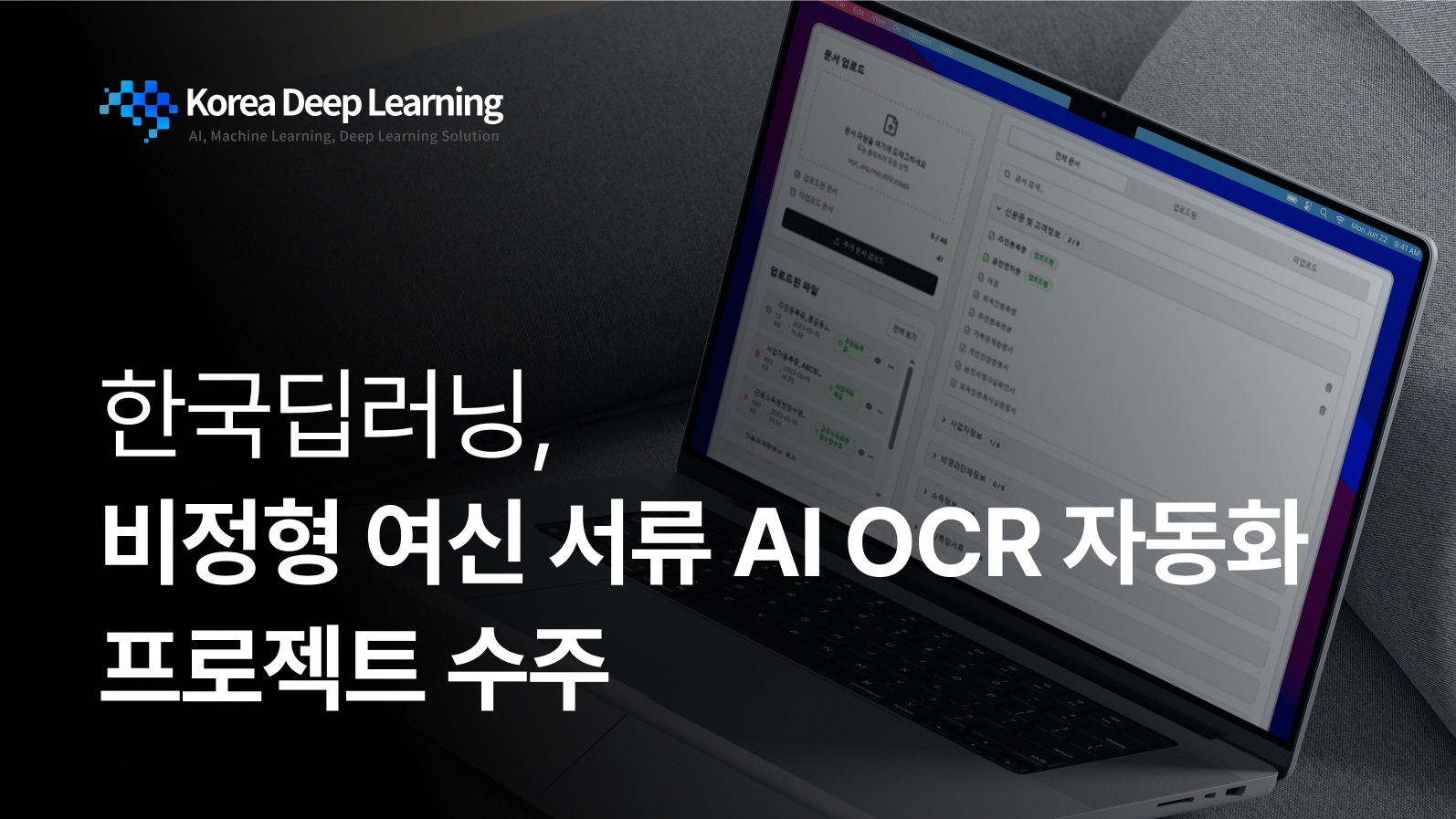
시각지능 기반 AI 솔루션 기업 한국딥러닝은 국내 대형 금융사에 ‘비정형 여신 서류 AI OCR 자동화’ 프로젝트를 수주했다고 22일 밝혔다.
이번 프로젝트는 단순한 광학문자인식(OCR)을 넘어, 문서의 의미를 분석하고 판단할 수 있는 인공지능 기술을 금융 업무에 적용한 사례다. 한국딥러닝이 제공하는 ‘DEEP OCR+’는 자가 학습(Self-Training) 기능을 갖춘 문서 이해 특화 모델로, 처리 정확도와 속도를 지속적으로 개선할 수 있도록 설계됐다.
해당 금융사는 여신 심사 과정에서 총 46종의 신청 및 증빙 서류를 하나의 PDF로 수령하고 이를 수기로 분류 및 입력해왔다. 이에 따라 문서 누락, 오탈자, 업무 병목 등의 문제가 반복적으로 발생해왔으며, 한국딥러닝은 이러한 수기 업무 프로세스의 자동화를 목표로 DEEP OCR+를 도입했다.
DEEP OCR+는 광학문자인식 기능을 기반으로, 문서 내 구조와 문맥을 함께 분석해 핵심 정보를 추출할 수 있는 시각지능 모델이다. 한국딥러닝이 자체 개발한 문서 이해 특화 비전-언어 모델(VLM, Vision-Language Model)은 5년간 축적된 약 4억 건 이상의 이미지 및 텍스트 데이터를 학습한 기반 위에 구축되었으며, PDF, HWP, 워드 등 다양한 문서 형식을 동시에 처리할 수 있다.
이번 프로젝트에서는 병합된 PDF 내 서류를 자동 분할 및 분류하고, 핵심 데이터를 추출한 후 기업 내 전산 시스템에 연동하는 프로세스를 자동화했다. 이를 통해 수작업에 의존하던 문서 확인 및 입력 과정을 효율적으로 개선할 수 있다는 설명이다. 결과는 실시간 검증 대시보드를 통해 확인할 수 있으며, RPA(로봇 프로세스 자동화)와 연동돼 업무 효율을 높이는 구조로 운영된다.
한국딥러닝은 이번 프로젝트를 시작으로 금융 분야 외에도 보험, 공공기관, 제조업 등 문서 기반 업무가 많은 산업 분야로의 기술 확대를 추진하고 있다.
김지현 한국딥러닝 대표는 “AI가 다양한 산업에 도입되기 위해서는 ‘보는 능력’이 선행되어야 한다”며 “시각지능 기반 문서 이해 기술은 다양한 자동화 과제에 적용 가능하며, 기업의 디지털 전환을 가속화하는 핵심 요소로 자리잡을 것”이라고 말했다.
- 관련 기사 더보기
Korea Deep Learning wins contract for 'non-standard goddess document AI OCR automation'
Korea Deep Learning , a visual intelligence-based AI solution company, announced on the 22nd that it had won a contract for the 'non-standard loan document AI OCR automation' project from a major domestic financial institution.
This project is an example of applying artificial intelligence technology that can analyze and judge the meaning of documents beyond simple optical character recognition (OCR) to financial work. 'DEEP OCR+' provided by Korea Deep Learning is a document understanding specialized model with self-training functions, designed to continuously improve processing accuracy and speed.
The financial institution received a total of 46 types of application and supporting documents as a single PDF during the credit review process and classified and entered them manually. As a result, problems such as document omissions, typos, and work bottlenecks repeatedly occurred, and Korea Deep Learning introduced DEEP OCR+ with the goal of automating this manual work process.
DEEP OCR+ is a visual intelligence model that can extract key information by analyzing the structure and context within a document based on the optical character recognition function. The Vision-Language Model (VLM) specialized in document understanding developed by Korea Deep Learning was built on the basis of learning over 400 million image and text data accumulated over 5 years, and can simultaneously process various document formats such as PDF, HWP, and Word.
In this project, the process of automatically splitting and classifying documents in merged PDFs, extracting key data, and then linking them to the company's computer system was automated. This is said to efficiently improve the document verification and input process that used to depend on manual work. The results can be checked through a real-time verification dashboard, and it is operated in a structure that improves work efficiency by linking with RPA (Robotic Process Automation).
Starting with this project, Korea Deep Learning is pushing to expand its technology to industries with a lot of document-based work, such as insurance, public institutions, and manufacturing, in addition to the financial sector.
Kim Ji-hyun, CEO of Korea Deep Learning, said, “In order for AI to be introduced to various industries, the ‘ability to see’ must come first,” and “Visual intelligence-based document understanding technology can be applied to various automation tasks and will become a key element in accelerating the digital transformation of companies.”
- See more related articles
韓国ディープラーニング、「非定型女神書類AI OCR自動化」受注
ビジュアルインテリジェンスベースのAIソリューション企業韓国ディープラーニングは、国内大型金融会社に「非定型女神書類AI OCR自動化」プロジェクトを受注したと22日明らかにした。
今回のプロジェクトは、単純な光学文字認識(OCR)を超えて、文書の意味を分析して判断できる人工知能技術を金融業務に適用した事例だ。韓国ディープラーニングが提供する「DEEP OCR+」は、自己学習(Self-Training)機能を備えた文書理解特化モデルで、処理精度と速度を継続的に改善できるように設計された。
当該金融会社は、女神審査過程で合計46種の申請及び証明書類を1つのPDFに受け取り、これを手記に分類及び入力してきた。これにより文書欠落、誤奪者、業務ボトルネックなどの問題が繰り返し発生しており、韓国ディープラーニングはこうした手書き業務プロセスの自動化を目標にDEEP OCR+を導入した。
DEEP OCR+は、光学文字認識機能に基づいて、文書内の構造とコンテキストを一緒に分析して核心情報を抽出できる視覚インテリジェンスモデルである。韓国ディープラーニングが自ら開発した文書理解特化ビジョン言語モデル(VLM、Vision-Language Model)は、5年間蓄積された約4億件以上の画像やテキストデータを学習した基盤の上に構築されており、PDF、HWP、ワードなど多様な文書形式を同時に処理することができる。
今回のプロジェクトでは、マージされたPDF内の書類を自動分割および分類し、コアデータを抽出した後、企業内の計算システムに連動するプロセスを自動化した。これにより、手作業に依存していた文書確認や入力処理を効率的に改善できるという説明だ。結果はリアルタイム検証ダッシュボードを通じて確認でき、RPA(ロボットプロセス自動化)と連動して業務効率を高める構造で運営される。
韓国ディープラーニングは今回のプロジェクトをはじめ、金融分野の他にも保険、公共機関、製造業など文書基盤業務が多い産業分野への技術拡大を推進している。
キム・ジヒョン韓国ディープラーニング代表は「AIが多様な産業に導入されるためには「見る能力」が先行されなければならない」とし「視覚知能ベースの文書理解技術は多様な自動化課題に適用可能で、企業のデジタル転換を加速化する核心要素として位置づけるだろう」と話した。
- 関連記事をもっと見る
韩国深度学习公司赢得“非标准女神文档AI OCR自动化”合同
视觉智能型AI解决方案企业韩国深度学习22日宣布,赢得了韩国大型金融机构“非标准贷款文件AI OCR自动化”项目订单。
该项目是将超越简单的光学字符识别(OCR)的能够分析并判断文档含义的人工智能技术应用于财务工作的一个例子。韩国深度学习提供的‘DEEP OCR+’是具有自我训练功能的文档理解专用模型,旨在持续提高处理精度和速度。
在贷款审核过程中,金融机构收到共计 46 类申请及证明文件,以单个 PDF 文件的形式,并进行手动分类和输入。因此,文件遗漏、拼写错误、工作瓶颈等问题反复出现,韩国深度学习引入了DEEP OCR+,旨在实现这些手动工作流程的自动化。
DEEP OCR+ 是一种视觉智能模型,它可以通过基于光学字符识别分析文档中的结构和上下文来提取关键信息。韩国深度学习所开发的文档理解专用模型“视觉语言模型”(VLM)是在五年来积累的超过4亿张图像和文本数据学习的基础上构建的,可以同时处理PDF、HWP、Word等各种文档格式。
在这个项目中,我们实现了合并 PDF 中文档的自动拆分和分类、提取关键数据以及将其链接到公司 IT 系统的过程的自动化。这解释了如何有效地改进过去依赖手工工作的文档验证和输入流程。可以通过实时验证仪表板检查结果,并且通过与RPA(机器人流程自动化)连接来提高工作效率。
以该项目为起点,韩国深度学习正在努力将其技术扩展到金融领域以外的保险、公共机构、制造业等大量基于文档的工作的行业。
韩国深度学习代表金智贤表示,“要将AI引入各行各业,首先必须具备‘看’的能力”,“基于视觉智能的文档理解技术可以应用于各种自动化任务,将成为加速企业数字化转型的关键要素”。
- 查看更多相关文章
Korea Deep Learning remporte un contrat pour « l'automatisation OCR de documents déesse non standard par IA »
Korea Deep Learning , une société de solutions d'IA basées sur l'intelligence visuelle, a annoncé le 22 avoir remporté un contrat pour le projet « d'automatisation OCR de documents de prêt non standard par IA » auprès d'une grande institution financière nationale.
Ce projet est un exemple d’application de la technologie de l’intelligence artificielle qui peut analyser et déterminer la signification des documents au-delà de la simple reconnaissance optique de caractères (OCR) au travail financier. « DEEP OCR+ » fourni par Korea Deep Learning est un modèle spécialisé de compréhension de documents avec fonction d'auto-formation, conçu pour améliorer en permanence la précision et la vitesse de traitement.
Au cours du processus d’examen du prêt, l’institution financière a reçu un total de 46 types de demandes et de documents justificatifs sous forme de fichier PDF unique et les a classés et saisis manuellement. En conséquence, des problèmes tels que des omissions de documents, des fautes de frappe et des goulots d'étranglement au travail se sont produits à plusieurs reprises, et Korea Deep Learning a introduit DEEP OCR+ dans le but d'automatiser ces processus de travail manuel.
DEEP OCR+ est un modèle d'intelligence visuelle capable d'extraire des informations clés en analysant la structure et le contexte d'un document basé sur la reconnaissance optique de caractères. Le modèle Vision-Language (VLM), un modèle spécialisé de compréhension de documents développé par Korea Deep Learning, a été construit sur la base de l'apprentissage de plus de 400 millions de données d'image et de texte accumulées sur cinq ans et peut traiter simultanément divers formats de documents tels que PDF, HWP et Word.
Dans ce projet, nous avons automatisé le processus de division et de classification automatique des documents au sein de PDF fusionnés, en extrayant les données clés, puis en les reliant aux systèmes informatiques de l'entreprise. Ceci explique comment le processus de vérification et de saisie des documents, qui dépendait auparavant du travail manuel, peut être amélioré efficacement. Les résultats peuvent être vérifiés via un tableau de bord de vérification en temps réel et sont structurés pour augmenter l'efficacité du travail en se connectant à RPA (Robotic Process Automation).
À partir de ce projet, Korea Deep Learning s'efforce d'étendre sa technologie aux secteurs nécessitant beaucoup de travail basé sur des documents, tels que les assurances, les institutions publiques et l'industrie manufacturière, en plus du secteur financier.
Kim Ji-hyun, PDG de Korea Deep Learning, a déclaré : « Pour que l'IA soit introduite dans divers secteurs, la « capacité de voir » doit être la priorité », et « la technologie de compréhension de documents basée sur l'intelligence visuelle peut être appliquée à diverses tâches d'automatisation et deviendra un élément clé pour accélérer la transformation numérique des entreprises. »
- Voir plus d'articles connexes
You must be logged in to post a comment.