


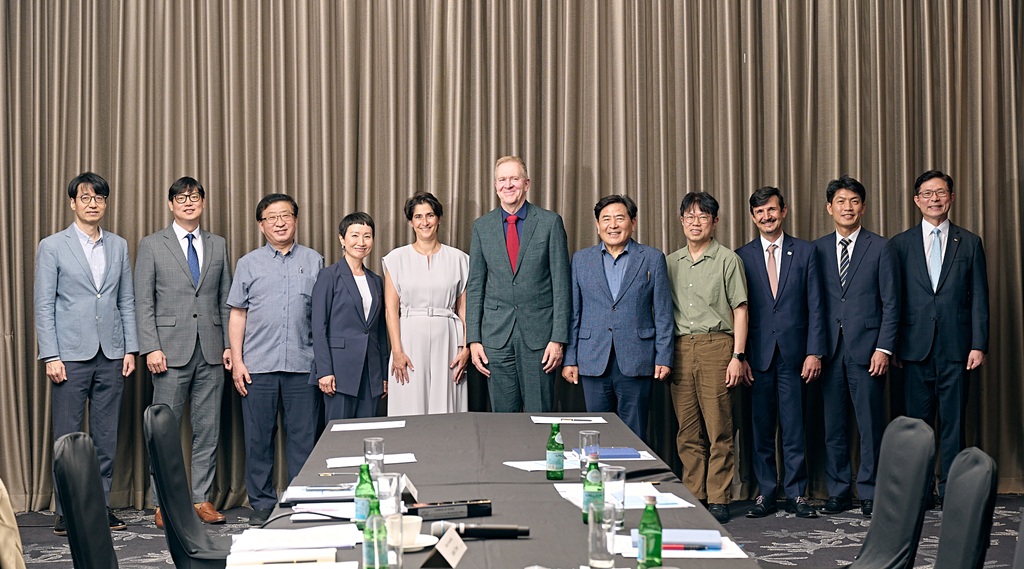
Noul Co., Ltd. (CEO Chan-Yang Lim, hereinafter referred to as “Noul”), an AI-based blood and cancer diagnostics company, announced that it attended a global health conference co-hosted by the Gates Foundation and the Wright Foundation and discussed the role of AI technology in the field of international health and future directions for cooperation.
This meeting was organized to share the latest achievements and future global health plans of Wright Foundation member companies, as well as to explore the Gates Foundation's global health R&D strategy and potential collaborations with Korean companies. Notably, Noul's participation in the meeting, coinciding with Bill Gates' visit to Korea, drew attention as a leading Korean medical AI company.
The meeting was attended by Trevor Mundell, Chairman of the Gates Foundation's Global Health Division; Kim Han-i, CEO of the Wright Foundation; and executives from major domestic bio and diagnostic companies, including Noul, SK Bioscience, and LG Chem.
The Gates Foundation views the adoption and expansion of AI technology as an urgent task for improving global health equity in low- and middle-income countries. Noul CEO Lim Chan-yang presented a case study of overcoming medical infrastructure shortages and limited professional resources through the company's self-developed "miLab" platform.
MyLab is an on-device AI diagnostic platform that operates without a network or large-scale servers. It automates everything from preprocessing of blood and tissue samples to imaging and analysis, thereby increasing the efficiency and cost-effectiveness of on-site diagnostics and contributing to improved access to healthcare in low-income countries.
CEO Lim Chan-yang said, “For the past 10 years, we have been working to improve healthcare accessibility through the commercialization of ‘MyLab,’ an on-site AI diagnostic laboratory,” and “Based on this discussion with the Gates Foundation, we plan to strengthen cooperation to solve global health challenges.”
Trevor Mundell, Chairman of the Gates Foundation's Global Health Division, said, "We are supporting AI projects in various fields, including global infectious disease prediction, early diagnosis, and chronic disease management, and we hope to achieve health equity in low-income countries through collaboration with Korean companies with excellent technological capabilities."
- See more related articles
You must be logged in to post a comment.