



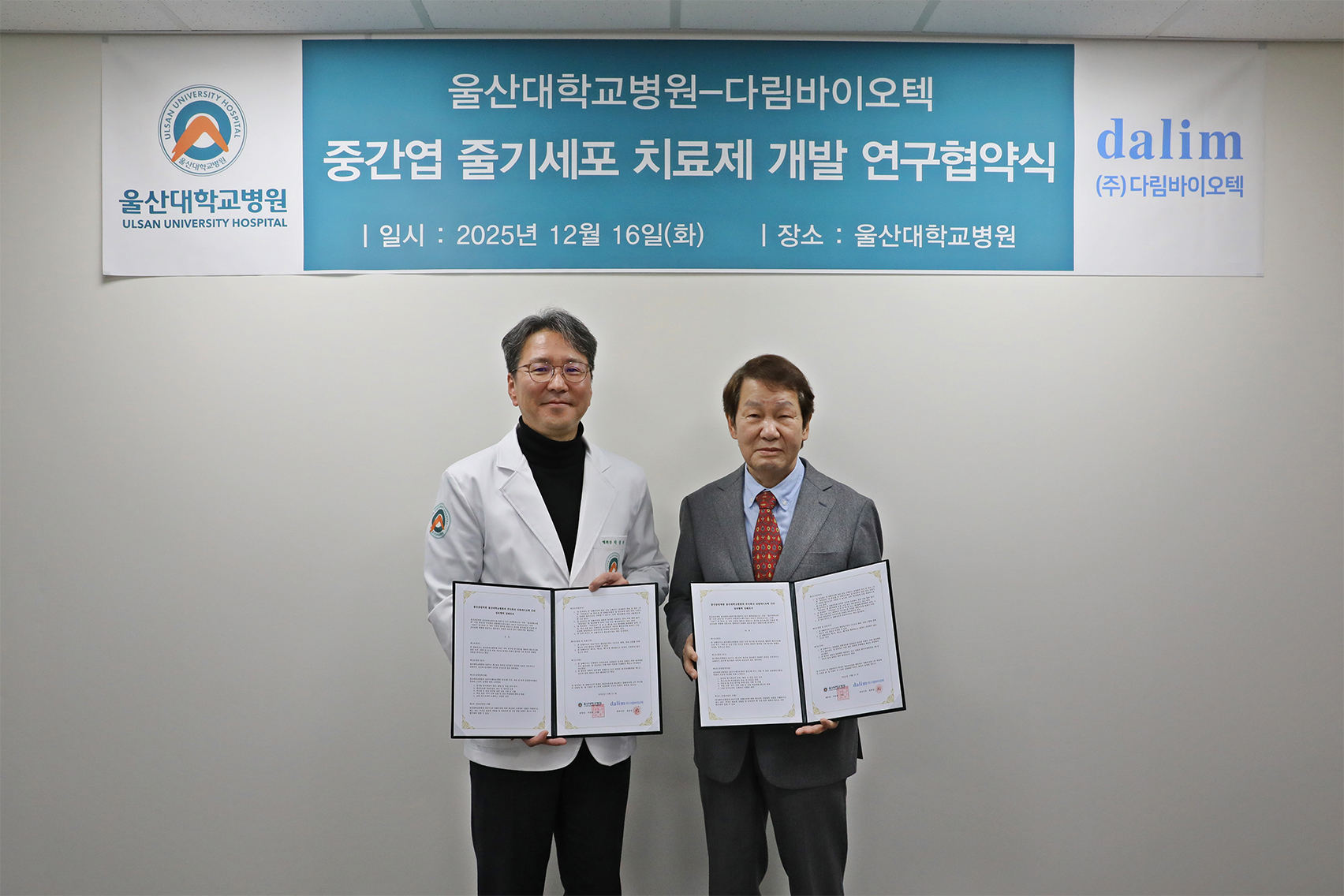
Darim Biotech (CEO Jong-Seop Jeong) announced on the 17th that it will begin joint research and development of cell therapies to treat intractable diseases in partnership with Ulsan University Hospital. The two organizations signed a memorandum of understanding (MOU) on the 16th at the hospital's annex for joint research and development of cell therapies utilizing mesenchymal stem cells.
Under this agreement, the two organizations plan to establish a cooperative system across the entire process of cell therapy development, including stem cell isolation, culture, and characterization; verification of the efficacy and safety of cell therapy candidates; joint performance of preclinical and clinical trials; academic exchanges and exchange of research personnel; and management of outputs and technologies.
Jeong Jong-seop, CEO of Dalim Biotech, said, “Placental and umbilical cord-derived mesenchymal stem cells are an attractive source with immune-regulating capabilities, regeneration-promoting capabilities, and safety that is advantageous for therapeutic development.” He added, “We expect that the combination of Ulsan University Hospital’s clinical-based research and Dalim Biotech’s development capabilities will significantly accelerate the development of therapeutic technologies.”
At the heart of this agreement is the 'Development of a therapeutic agent based on human placenta and umbilical cord-derived mesenchymal stem cells' project, jointly promoted by the research team of Professor Kim Jeong-sook (Department of Obstetrics and Gynecology) at Ulsan University Hospital and the research team at Darim Biotech.
Mesenchymal stem cells are considered a key platform in the field of regenerative medicine due to their biological properties, including regeneration of damaged tissue, alleviation of inflammation, and immune regulation. The two institutions plan to conduct research on treating intractable diseases based on this.
Na Seung-won, director of the Biomedical Research Institute at Ulsan University Hospital, said, “Stem cells derived from the placenta and umbilical cord have excellent differentiation and proliferation capabilities, so they have great potential in regenerative medicine research,” adding, “We hope that this collaboration will advance the development of cell therapy for patients with intractable diseases to the next level.”
- See more related articles
You must be logged in to post a comment.