



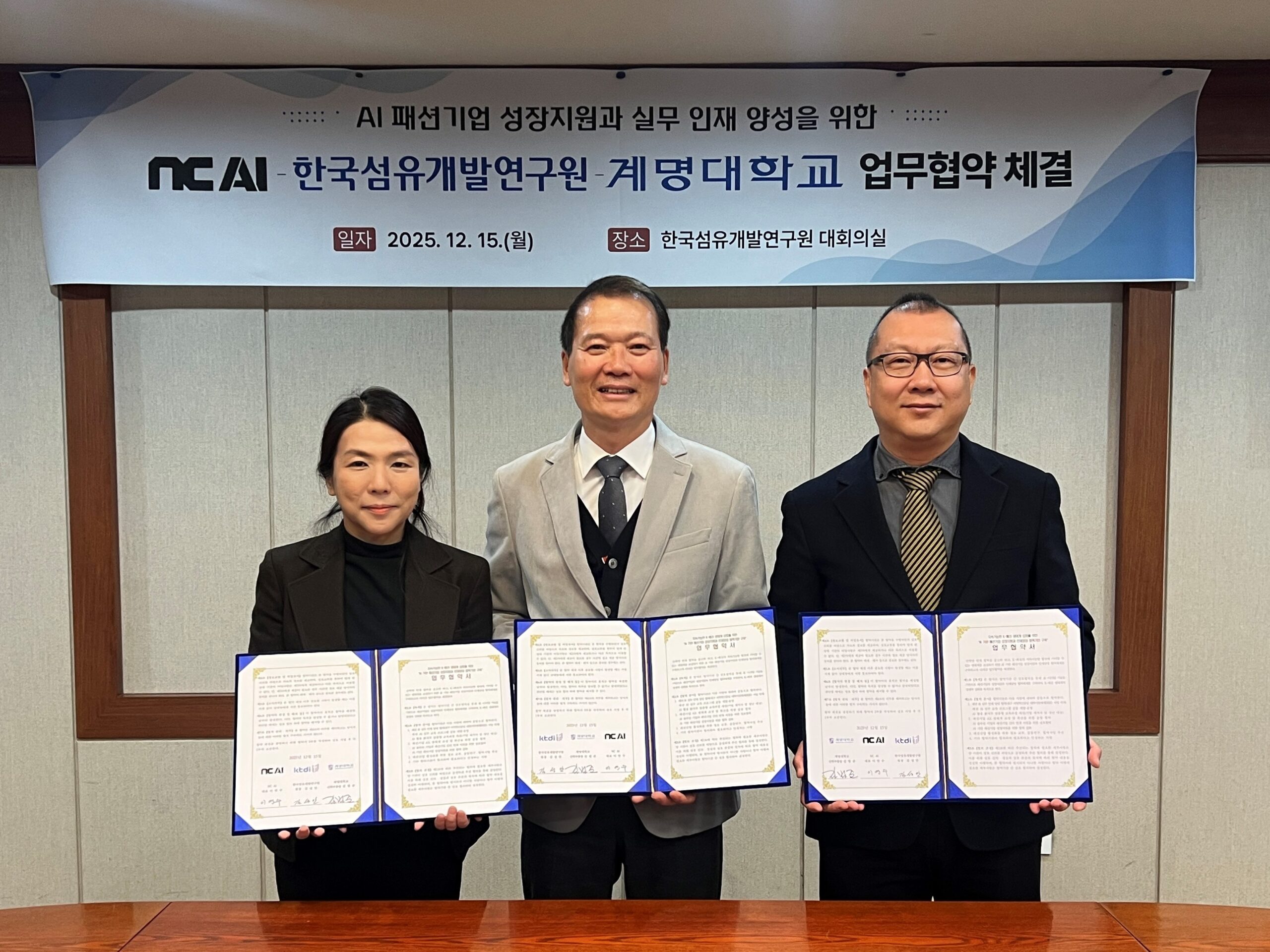
NC AI, a leading AI company in Korea, announced on the 16th that it signed a Memorandum of Understanding (MOU) with the Korea Textile Development Institute (KOTII) and Keimyung University to strengthen the sustainable K-fashion ecosystem, support the growth of AI-based fashion companies, and establish a cooperative foundation for talent development. The signing ceremony was held at the Korea Textile Development Institute (KOTII) in Daegu, and was attended by key officials including NC AI Chief Business Officer Lim Su-jin, Korea Textile Development Institute President Kim Seong-man, and Keimyung University Vice President for Industry-Academic Cooperation Kim Beom-joon.
The key objectives of this agreement include fostering practical AI talent in fashion, fostering mutual cooperation to foster the AX ecosystem for fashion companies, and joint research and information exchange to revitalize the fashion industry. The three organizations aim to strengthen the competitiveness of local fashion companies through AI and digital technologies and establish a collaborative industry-academia-research system to cultivate practical AI talent required in the industry.
In particular, the fashion AI education program will be operated in conjunction with the Regional Innovation-Oriented University Support System (RISE) project, promoted by the Keimyung University Jisan Academic Talent Center and the Department of Fashion Marketing in the College of Fine Arts. Furthermore, a new job-focused AI curriculum will be launched for corporate employees and young people, and a practical industry-academia collaboration model utilizing NC AI's Barco Art Fashion will be expanded.
Barco Art Fashion is a generative AI solution specialized for the fashion industry. It learns from professional fashion images, fabrics, and trend data to support design draft generation and fabric/pattern synthesis. Furthermore, in the marketing field, it can be used to create image content with a variety of concepts without the need for actual photography, enhancing the efficiency of the entire design and marketing process.
Through this agreement, fashion companies can expect to reduce content production costs by leveraging AI and improve profitability through virtual consumer response testing. In educational settings, students will be able to utilize AI-based tools to gain practical design experience and acquire skills immediately applicable to the industrial workplace.
The three organizations believe this collaboration will foster digital innovation and sustainable growth in the local fashion industry, and contribute to strengthening industry competitiveness by fostering AI-based talent.
- See more related articles
You must be logged in to post a comment.