



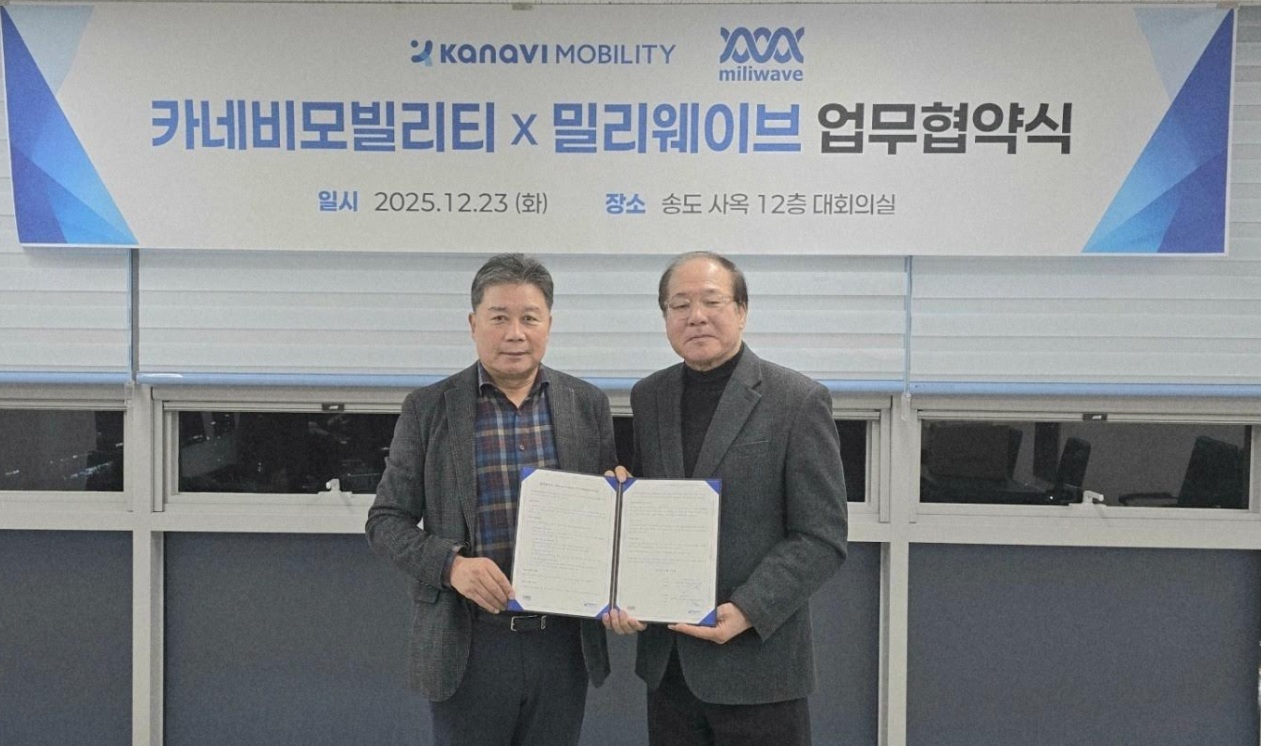
Smart mobility specialist Kanevi Mobility and wireless communications specialist Milliwave announced on the 23rd that they signed a business agreement for the joint commercialization of a 60GHz ultra-high-speed wireless communications solution dedicated to next-generation mobility.
This agreement was pursued to supply next-generation communication-based mobility solutions to the market by combining the technological prowess and business capabilities of both companies, amidst the growing demand for high-speed, low-latency wireless communications in various mobility fields such as robots, ships, and railways.
Under the agreement, the two companies will jointly apply and demonstrate 60GHz ultra-high-speed wireless communication solutions and related sub-modules applicable across the mobility industry, including robotics, ships, and railways. Furthermore, based on Milliwave's supply of wireless communication sub-modules, the two companies will collaborate on product planning, system integration, quality assurance, and commercialization. Furthermore, they will strengthen exchanges on technical information, market trends, and business strategies. They will also refine their joint business model through role-sharing discussions and pursue follow-up projects.
Through this agreement, Canevi Mobility plans to secure highly reliable, high-speed wireless communication technology applicable across core mobility components and systems, thereby strengthening its technological competitiveness in the smart mobility and special mobility markets. Milliwave anticipates creating new business opportunities and expanding its market by applying its accumulated wireless communication technology to the mobility sector.
Jeong Jong-taek, CEO of Canevi Mobility, said that this agreement will be the starting point for commercializing ultra-high-speed, low-latency wireless communication technology required in the next-generation mobility environment, and that they will implement differentiated communication-based solutions in various mobility fields.
The two companies plan to gradually pursue future demonstration projects and follow-up contracts for individual projects, and continue their collaboration to commercialize next-generation mobility communication technology and enter the global market.
- See more related articles
You must be logged in to post a comment.