



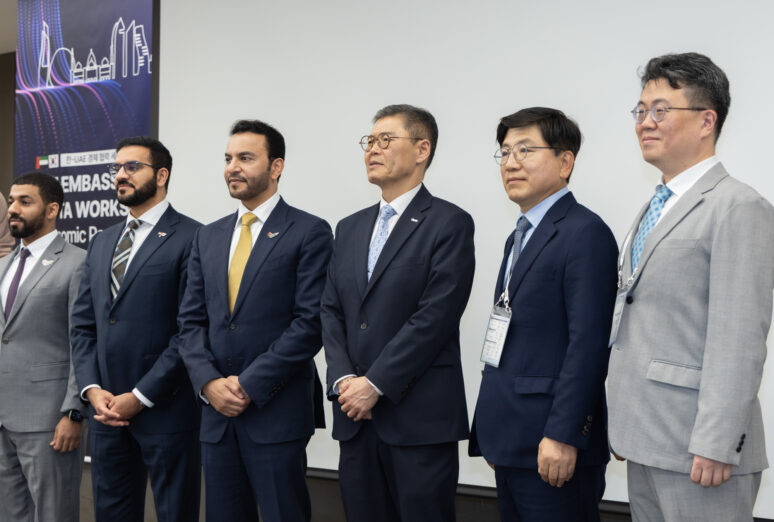
On the 20th, the Korea International Trade Association (KITA, Chairman Jin-sik Yoon) held the ‘Korea-UAE Economic Cooperation Seminar’ jointly with the Embassy of the United Arab Emirates (UAE) in Korea at the Trade Tower in Samseong-dong, Gangnam-gu, Seoul.
This seminar was organized to introduce the UAE business environment and CEPA-based entry strategies to Korean companies amid expectations that economic exchanges between the two countries will expand following the official signing of the Korea-UAE Comprehensive Economic Partnership Agreement (CEPA) in May last year. The event was attended by approximately 100 people, including Kim Ki-hyun, Director General of the International Cooperation Division of the Korea International Trade Association, Abdulla Al Nuaimi, Ambassador of the UAE to Korea, and businesspeople interested in entering the UAE.
The seminar was conducted in the following order: ▲Introduction to the UAE business environment, ▲Guide to utilizing CEPA and entering the UAE, and the ministries in charge of CEPA from both countries directly gave presentations.
Park Hee-kyung, director of the Free Trade Agreement Negotiation Division at the Ministry of Trade, Industry and Energy, introduced the progress and status of the Korea-UAE CEPA negotiations and predicted that economic cooperation with the UAE, a key ally in the Middle East, will expand in various areas, including energy and new industries.
On the UAE side, Sheikh Saleh Alsharqi, Director of the Economic Affairs Department at the UAE Embassy in Korea, introduced opportunities for Korean companies to enter the UAE in promising industries such as advanced manufacturing, fintech, greentech, and biohealth, and emphasized the importance of discovering mutual business partnerships. Next, Najla Majid Al Suwaidi, Director of International Cooperation at the Ministry of Economy, and Abdulla Ali Al Dhuhoori, Senior Economic Researcher, who participated in the presentation via video conference from the UAE, explained the significance of the CEPA conclusion and its potential economic effects from the UAE perspective. The local presenters emphasized that in addition to manufacturing and advanced industries, opportunities for Korean companies will expand in service industries such as logistics and transportation, construction and engineering, education and training, and consulting.
Next, Kang Geum-yoon, a senior researcher at the Korea International Trade Association’s International Trade and Commerce Research Institute, gave a presentation, selecting automobile parts and cosmetics, which will have tariffs eliminated immediately when CEPA goes into effect, as promising export items for our country, while Choi Ha-na, a customs broker at the FTA and Trade Support Center, explained the requirements for utilizing CEPA, major concession items, and how to write a certificate of origin.
Lawyer Kim Ki-dong of Law Firm Robax recently emphasized that although the UAE is emerging as a strategic base for advancing into MENA (Middle East and North Africa) by lowering entry barriers for foreign companies, it is also important to manage legal risks, such as complying with industry-specific legal regulations and preparing for disputes that may arise.
Kim Ki-hyun, head of the International Cooperation Division of the Korea International Trade Association, said, “Last year, Korea’s exports to the UAE increased by 14.3% year-on-year, making the UAE our 13th largest* trading partner. We expect that the base for mutual trade and investment will expand further when CEPA goes into effect,” adding, “The trade association plans to actively play a bridging role in business exchanges between the two countries through measures such as the formation of the Korea-UAE Economic Cooperation Committee.”
- See more related articles
You must be logged in to post a comment.