




The Ministry of SMEs and Startups (Minister Oh Young-joo, hereinafter referred to as the Ministry of SMEs and Startups) announced on the 7th that it held a 'Startup Field Dialogue' with climate tech startups at Superbin Co., Ltd. in Hwaseong-si, Gyeonggi-do and announced the 'Climate Tech Innovation Startup Level-up Strategy.'
The on-site discussion that day was designed to look at both the demand and supply perspectives, with the participation of climate tech startups, climate tech product demand organizations, and climate tech experts.
This event is a follow-up measure to the climate tech startup support announced through the previous 'COMEUP 2024', and is intended to present policy directions to level up the support strategy for climate tech innovative companies in the future.
The 'Climate Tech Innovation Startup Level-Up Strategy' is to ▲ focus on fostering 'process innovation and resource circulation' technologies tailored to SMEs under the vision of 'realizing carbon neutrality and sustainable economic growth led by startups' from 2025, ▲ revitalizing the startup ecosystem to foster green innovation leaders, ▲ expanding the global climate tech network, and ▲ establishing systems and institutions to lay the foundation for climate tech growth.
The detailed implementation strategy is as follows.
◆ We will focus on fostering customized technologies for small and medium-sized enterprises, while accelerating the commercialization of ‘market-leading fields’ that are already in high demand.
First, we will promote the commercialization of climate technology by focusing on two key fostering areas, namely ‘process innovation and resource circulation’ for export SMEs, such as responding to carbon trade regulations, and provide financial support necessary for technology verification and promote the convergence of advanced AI technologies.
In addition, we support joint commercialization and scale-up with large companies with a high interest in the climate sector, such as SK Innovation and POSCO, and support the entry of companies with excellent performance into the procurement market by linking with the K-Testbed operated by the Korea Water Resources Corporation.
◆ In order to support the challenges of capable climate tech entrepreneurs, we specialize support projects, expand liquidity supply for continuous growth, and support facilities.
We designate and utilize specialized TIPS operators with expertise in the climate tech field, and when climate tech startups perform deep tech TIPS, we give them preferential treatment when applying for the Ultra Gap 1000+.

In addition, by organizing and operating a super-gap VC membership, we plan to support regular networking and IR between VCs and startups that have invested or hope to invest in super-gap startups such as climate tech, so that they can lead to actual investments.
◆ To help innovative startups make a global leap forward, we will gradually support them by improving the use of regional strategic resources and securing networks.
First, through public-private collaboration, we provide consulting services by providing information on major funds and grants such as the Bill & Melinda Foundation and BEV, and we provide solutions to climate issues and support overseas expansion by utilizing the technological capabilities of startups.
In addition, we support overseas local verification of startups by advancing technology advancement through global acceleration and supporting developing countries through the TIPS-CTS (Creative Technology Solution) support project.
◆ The goal is to establish a dedicated regulatory-free special zone and related administrative service system, and to lay the foundation for activating the climate tech market.
First, by comprehensively considering the regional industrial environment, capabilities, etc., new regulatory-free special zones will be created for each of the five major climate tech fields: ▲Cleantech (renewable energy, decentralization) ▲Carbontech (carbon capture, mobility) ▲Ecotech (resource circulation) ▲Foodtech (low-carbon food production, cultivation) ▲Geotech (carbon observation, satellite information services).
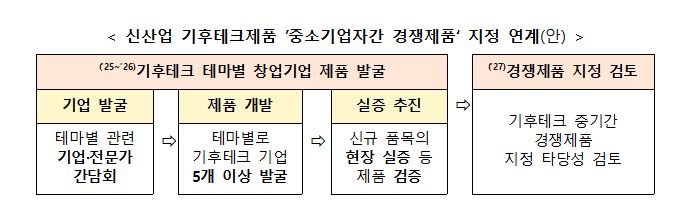
In addition, starting with the two major priority fostering areas by 2027, we plan to discover and foster more than five climate tech companies by theme (until 2026) to help small and medium-sized enterprises enter the competitive market worth 28 trillion won (as of 2023).
Innovative climate tech companies that attended the on-site dialogue held at Superbin Co., Ltd.’s “I’m Factory” factory on this day said, “Climate change response products are public goods in nature and require rapid technological development and timely investment,” and requested, “The Ministry of SMEs and Startups should play a pivotal role for climate tech startups.”
In particular, Superbin CEO Kim Jeong-bin added, “We will create a world where waste becomes money and recycling becomes fun” by installing and operating more than 1,500 AI-based robots, “Nephron,” across the country that sort and collect discarded plastic bottles and aluminum cans.
Minister Oh Young-joo said in an on-site dialogue today, “We will actively listen to the difficulties faced by climate tech startups, seek mid- to long-term solutions with experts to support the growth of innovative startups, and actively support them to secure competitiveness in the global market.” He also expressed his ambition by saying, “The Ministry of SMEs and Startups will establish a system to support innovative climate tech startups with the goal of achieving carbon neutrality led by climate startups to overcome the climate crisis.”
- See more related articles
You must be logged in to post a comment.